
It’s a common assumption that what’s bad for the gas pump is bad for the stock market. While rising oil prices can signal economic headwinds, the question of how oil prices affect tech stocks reveals a far more nuanced and indirect relationship. Unlike industries with heavy fuel consumption, the impact on the technology sector is not about direct operational costs but is channeled through secondary economic effects, including consumer spending habits and inflationary pressures. Understanding this complex interplay is critical for any tech investor navigating the markets in 2026.
Table of Contents
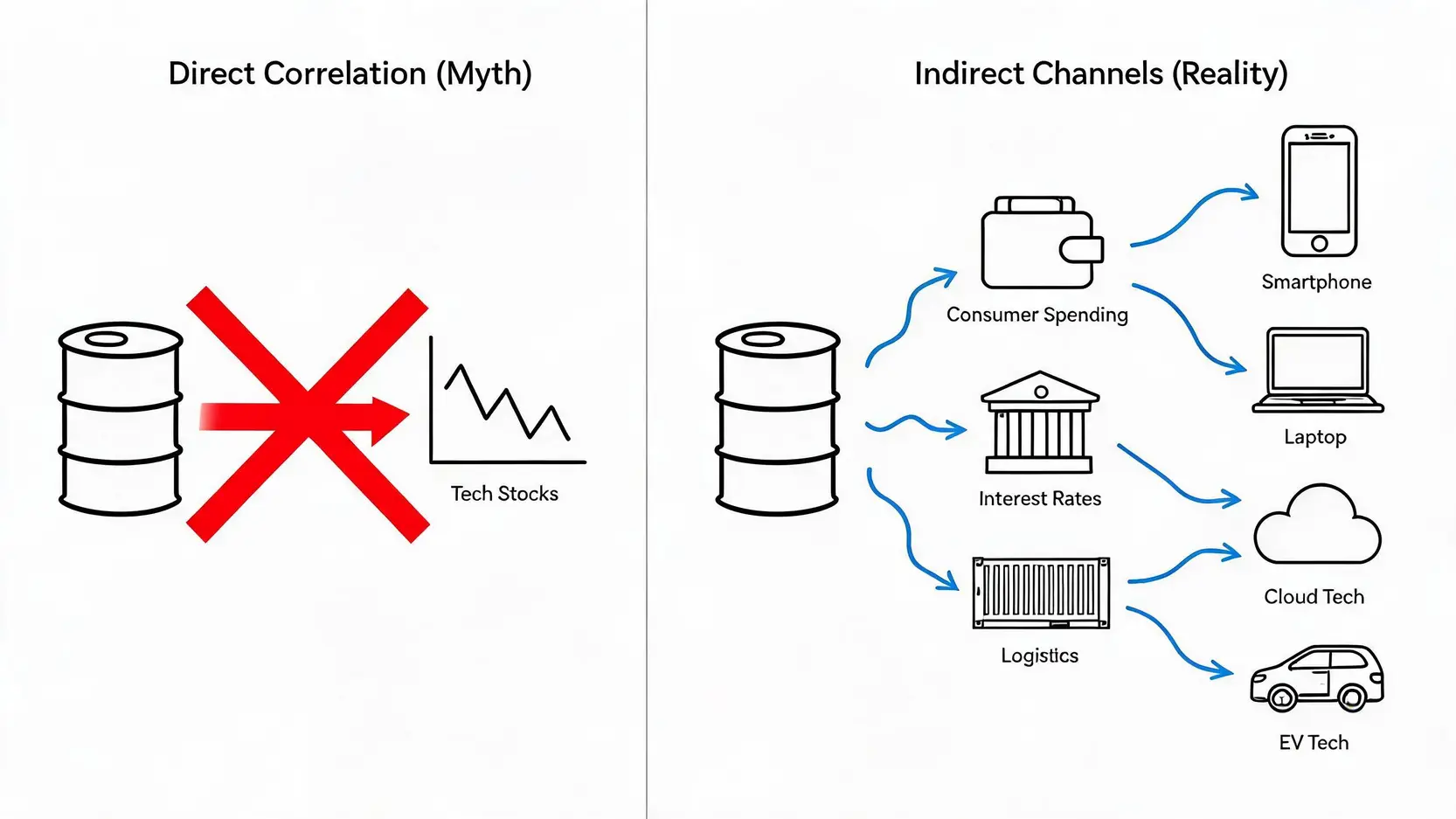
The Direct Correlation Myth: Why the impact of oil price on tech stocks is different
The narrative that soaring oil prices universally harm equities is overly simplistic, especially for the tech sector. While certain market-wide shocks can create temporary, fear-driven correlations, a deeper analysis reveals that the fundamental connection between oil and most technology companies is weak at best. The real story lies in distinguishing correlation from causation and recognizing the unique operational model of modern tech.
Correlation vs. Causation: Deconstructing the Market Noise
Often, a spike in oil prices coincides with broader geopolitical instability or macroeconomic shifts that pressure all stocks, including tech. An investor might observe both oil prices rising and the Nasdaq falling and incorrectly assume a direct causal link. However, the real driver might be a hawkish central bank response to inflation, for which oil is just one component. It’s crucial to analyze the underlying economic currents rather than drawing a straight line between the price of a barrel of WTI crude and the valuation of a SaaS company. The true relationship between oil prices and the stock market is far more intricate.
Low Energy Dependency: Why Software and SaaS Are Insulated
The core business of most tech giants—particularly in software, cloud computing, and digital services—is fundamentally insulated from direct energy costs. Their largest expenses are typically talent acquisition, research and development, and marketing. While data centers require significant electricity, this cost is a manageable operational expense and is not directly tied to the volatile price of crude oil. For companies like Microsoft, Adobe, or Salesforce, a 50% increase in oil prices has a negligible impact on their cost of goods sold (COGS), unlike an airline or a shipping company where fuel is a primary input.
The Indirect Channels: How Oil Prices Truly Ripple Through Tech stocks
While the direct impact is minimal, the indirect, second-order effects of oil price fluctuations are where tech investors should focus their attention. These ripples are transmitted through the broader economy, influencing consumer behavior, inflation, and ultimately, corporate valuations.
Consumer Spending Power: The Biggest Factor for B2C Tech
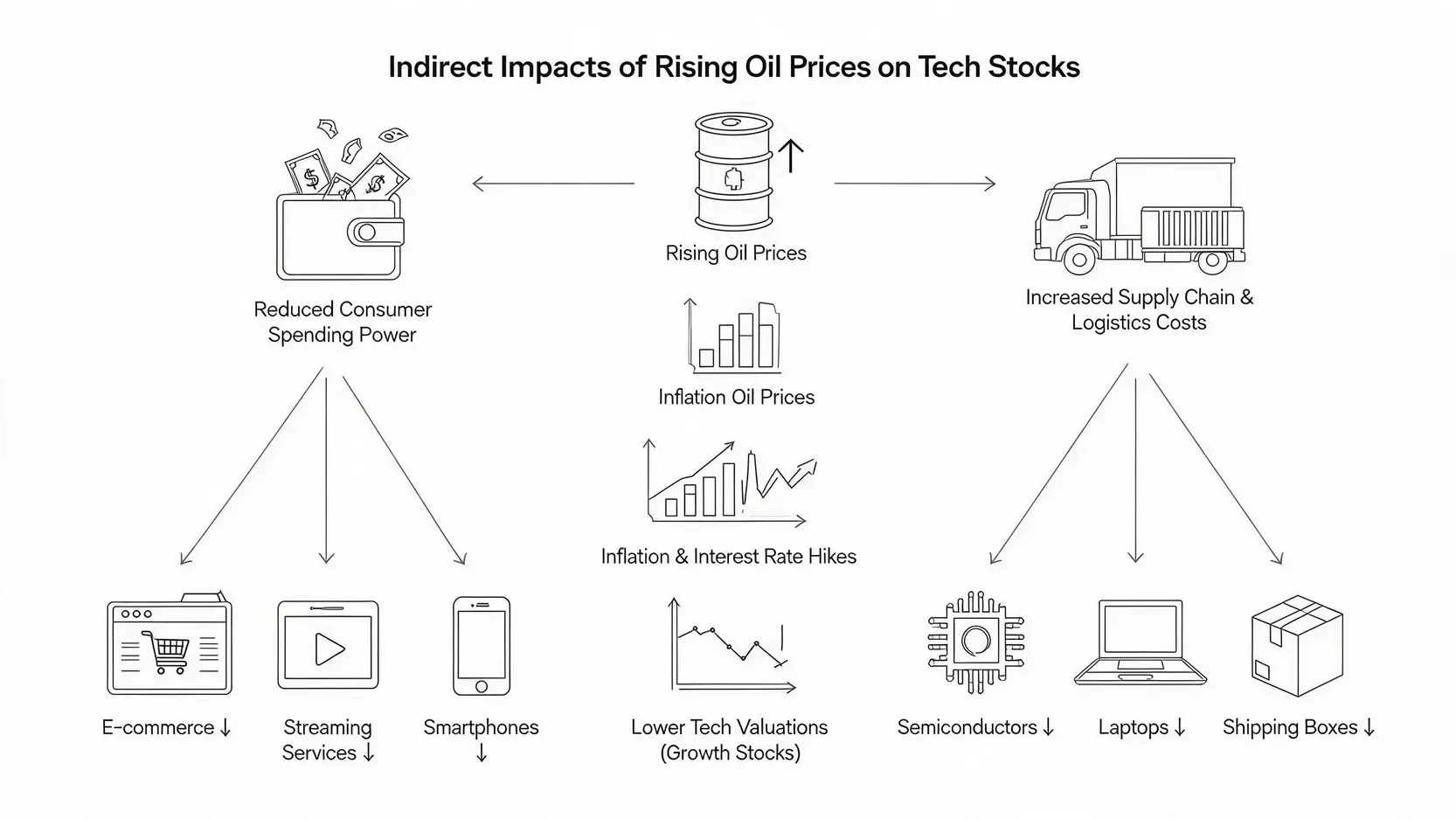
This is arguably the most significant channel. When consumers pay more at the pump and for heating, their discretionary income shrinks. This directly impacts business-to-consumer (B2C) tech companies. 🛒
- E-commerce: Consumers may cut back on non-essential online purchases.
- Streaming Services: Households might consolidate subscriptions to save money.
- Consumer Electronics: Big-ticket items like new smartphones or laptops become less of a priority.
Essentially, sustained high oil prices act as a tax on the consumer, leading to reduced demand for the goods and services many tech companies provide.
Inflation and Interest Rates: The Impact on Growth Stock Valuations
Surging oil prices are a primary driver of headline inflation. This forces central banks like the Federal Reserve to consider monetary tightening, primarily by raising interest rates, to cool down the economy. For tech stocks, this is a powerful headwind. Higher interest rates reduce the present value of future earnings. Since high-growth tech companies have most of their expected profits far in the future, their valuations are disproportionately sensitive to changes in the discount rate. This is a critical concept for investors, as the impact on growth stocks during inflationary periods can be severe, even if their underlying business is strong.
Supply Chain & Logistics: The Hidden Costs for Hardware and E-commerce
While software is insulated, the hardware side of the industry feels a more direct sting. Companies that manufacture and ship physical products are exposed to rising transportation costs. 🚢
- Semiconductors: The global and complex nature of the semiconductor supply chain involves extensive shipping, and higher fuel costs can eat into margins.
- Consumer Electronics (e.g., Apple): Transporting finished goods from factories in Asia to markets worldwide becomes more expensive.
- E-commerce Platforms (e.g., Amazon): While a tech company, Amazon’s logistics network is vast. Higher fuel costs directly impact its delivery expenses, potentially squeezing retail margins.
Sector-Specific Impacts: Not All Tech Stocks React the Same
The technology sector is not a monolith. The effect of oil prices varies significantly across different sub-sectors, creating both challenges and opportunities for discerning investors.
Clean Tech & EV Stocks: An Inverse Relationship?
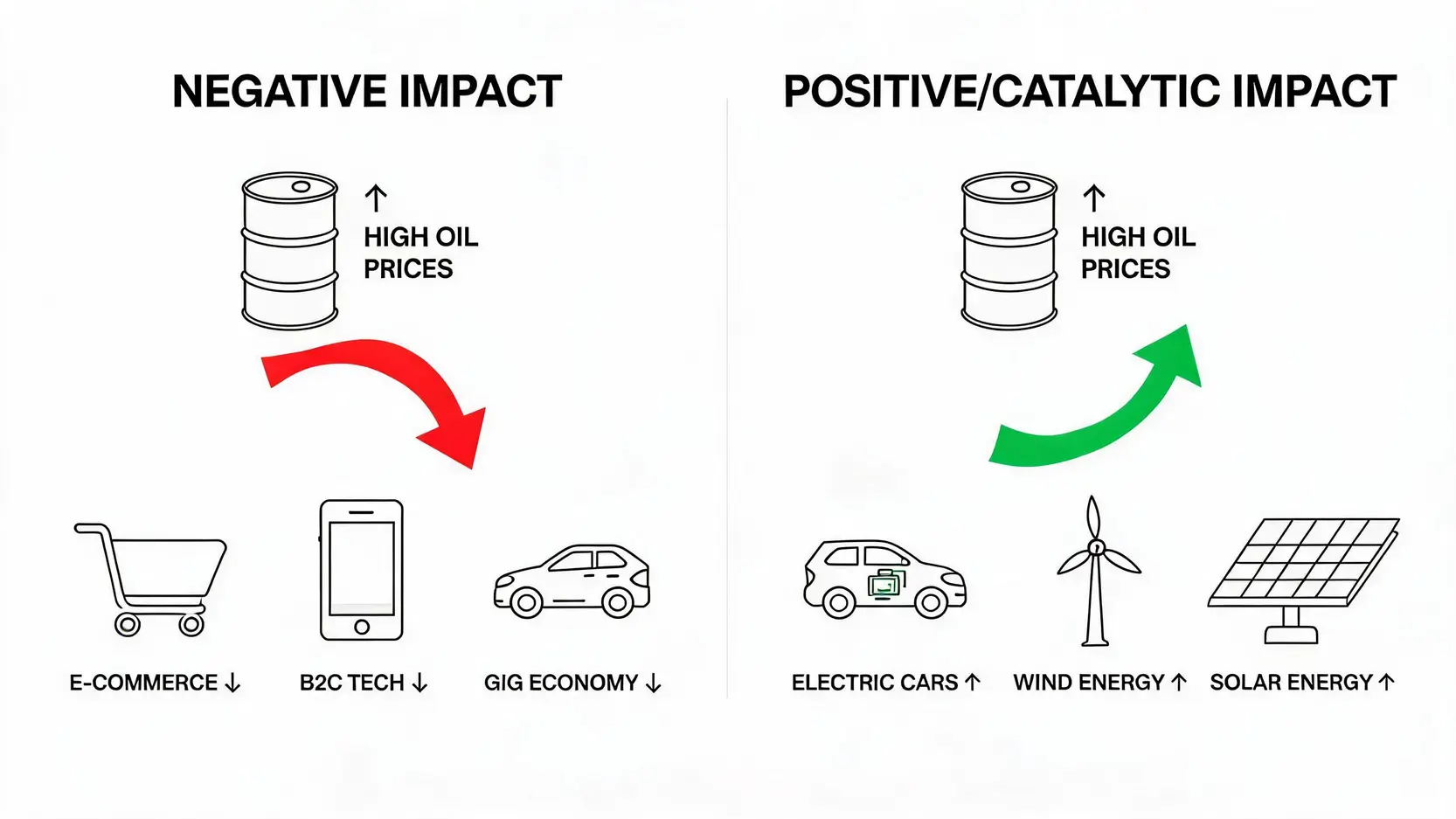
Sustained high oil prices can serve as a powerful long-term catalyst for the clean energy and electric vehicle (EV) sectors. When traditional gasoline-powered transportation becomes more expensive, the economic case for alternatives becomes stronger. This can boost investor sentiment and accelerate adoption curves for:
- EV Manufacturers: Higher gas prices make the total cost of ownership for an EV more attractive.
- Solar and Wind Energy Companies: These firms benefit from a broader push toward energy independence and non-fossil fuel sources.
- Battery Technology and Charging Infrastructure Firms: As EV adoption grows, the entire supporting ecosystem stands to benefit.
For those looking to capitalize on this trend, learning how to invest in renewable energy stocks is a strategic move in an era of energy transition.
Hardware & Semiconductor Companies: Feeling the Shipping Squeeze
As mentioned, companies reliant on physical supply chains are the most exposed within the tech sector. Their profitability can be directly impacted by rising freight and logistics costs. Investors in this space should monitor not just the price of crude oil, but also shipping indices and transportation costs as key indicators of potential margin pressure. The latest Short-Term Energy Outlook from the EIA provides crucial data for forecasting these trends.
Gig Economy & Ride-Sharing: The Direct Cost Challenge
Companies like Uber and Lyft face a unique and direct challenge. Their business model depends on a large network of independent drivers who bear the cost of fuel themselves. Sharply rising gasoline prices can erode driver earnings, potentially reducing the supply of drivers and forcing these platforms to increase fares or offer larger incentives, both of which can harm profitability. This makes them one of the few tech sub-sectors with a clear, negative, and almost immediate link to oil price spikes.
Conclusion
The impact of oil prices on tech stocks is a clear case of second-order thinking. For an investor in 2026, the key is to look beyond the headline price of a barrel of crude oil. The relationship is not one of direct operational cost but of indirect economic transmission. The primary channels of influence are the erosion of consumer spending power, the triggering of inflationary pressures and subsequent monetary tightening, and the squeeze on logistics costs for hardware-centric firms. The takeaway is clear: instead of reacting to the daily fluctuations of the oil market, a savvy tech investor should analyze the broader economic indicators—consumer confidence, inflation data, and central bank policy—to gain a true and actionable picture of the market landscape.
Frequently Asked Questions (FAQ)
Q: Do high oil prices always hurt the stock market?
A: Not necessarily. While sudden, sharp oil price shocks can create market-wide fear and sell-offs, moderately rising oil prices can also be a symptom of a strong, growing global economy, which is generally positive for stocks. The context is crucial; the cause of the price rise (demand-pull vs. supply-shock) and the response from central banks are more important factors than the price itself.
Q: Are tech stocks a good hedge against oil-driven inflation?
A: Generally, no. High-growth tech stocks are particularly vulnerable to the rising interest rates that are used to combat inflation. Their valuations are based on future earnings, which are discounted more heavily in a high-rate environment. Companies with strong pricing power and established cash flows (sometimes called ‘value’ tech) may fare better than speculative growth stocks.
Q: Which technology sub-sector is most sensitive to oil price changes?
A: The gig economy and ride-sharing sector (like Uber, Lyft) is the most negatively sensitive due to the direct impact on driver costs. Conversely, the clean technology and EV sector can be positively sensitive, as high oil prices accelerate the transition to alternative energy sources. Hardware and e-commerce sectors fall in the middle, feeling the pressure through increased logistics and shipping costs.
Q: How should I adjust my tech portfolio if I expect oil prices to rise?
A: Consider overweighting tech sub-sectors that may benefit, such as clean energy and EV stocks. You might reduce exposure to B2C tech companies that are heavily reliant on consumer discretionary spending. Also, be mindful of the impact of rising interest rates on high-valuation growth stocks. Focusing on tech companies with strong balance sheets, profitability, and pricing power can provide more resilience.