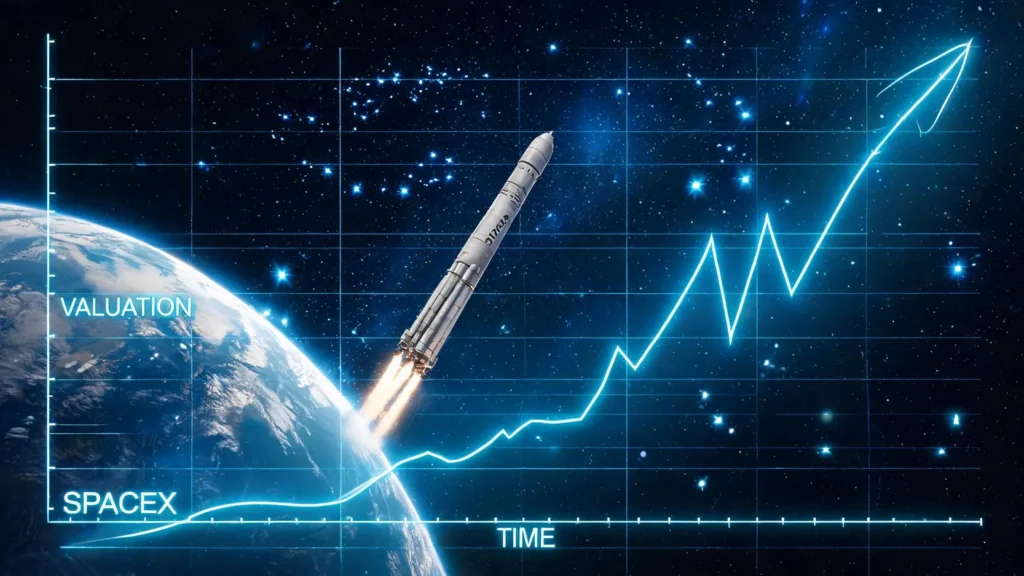
With a potential IPO perpetually on the horizon and a private valuation soaring past a staggering $1.7 trillion, the dominant question in investment circles is: Is SpaceX stock overvalued? While staunch supporters see a future unbound by earthly limits, seasoned analysts are sounding alarms about a ‘major disconnect’ between hype and financial reality. This deep-dive analysis deconstructs both sides of the SpaceX valuation debate, examining the core arguments for its astronomical price and the significant risks that could send it crashing back to Earth.
Table of Contents
Understanding SpaceX’s Current Valuation and IPO Buzz
To grasp the debate, one must first understand the numbers. SpaceX isn’t a public company, so its valuation is determined by private funding rounds and secondary market trades where early investors and employees can sell shares. The figures are breathtaking, placing it among the most valuable private entities globally.
The Path to a $1.7 Trillion+ Private Company
SpaceX’s valuation didn’t happen overnight. It’s the result of a series of strategic successes that have consistently allowed it to command higher prices in each new funding round. Key milestones include:
- ✅ First Private Company to Dock with the ISS (2012): Proved commercial spaceflight was viable.
- ✅ First Reusable Rocket Landing (2015): Revolutionized launch economics, drastically cutting costs.
- ✅ Successful Crewed Missions (2020): Ended U.S. reliance on Russia for astronaut launches, securing lucrative government contracts.
- ✅ Rapid Starlink Deployment: The ongoing launch of thousands of internet satellites created a new, potentially massive recurring revenue stream.
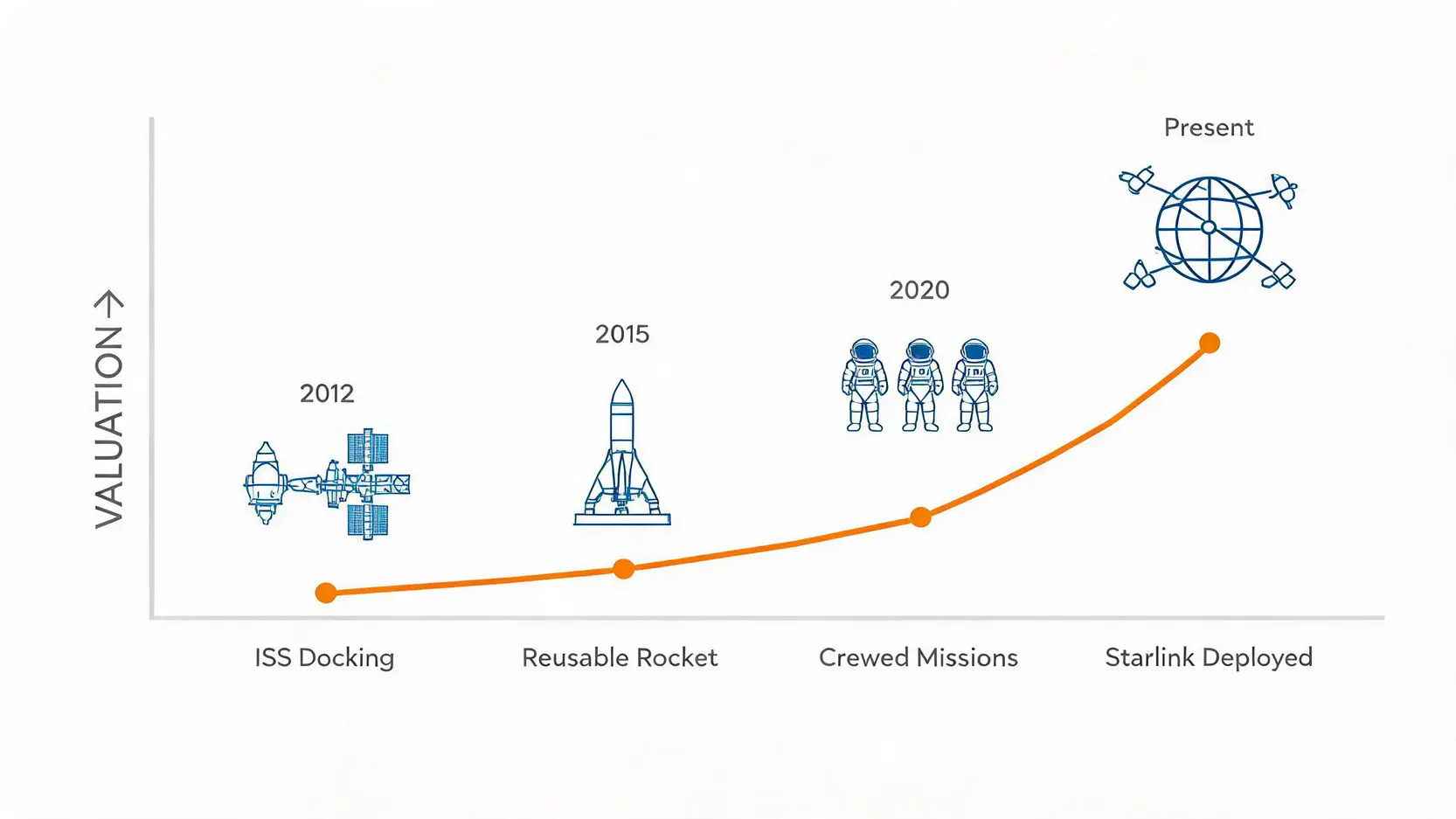
These achievements have fueled investor demand, pushing its valuation from a respectable $100 billion in 2021 to the current speculative stratosphere of over $1.7 trillion.
What Does the Rumored IPO Price Mean for Investors?
A future IPO is the event most retail investors are waiting for. Rumors suggest a potential share price of over $135, but this figure is highly speculative. For early private investors, an IPO at this level represents a monumental return on investment. For the public, it means buying into a company at its peak valuation, a scenario that carries substantial risk. The key question for IPO investors will be whether the company’s future growth can justify such a high entry point, or if the best gains have already been made.
The Bull Case: Arguments for SpaceX’s Sky-High Valuation
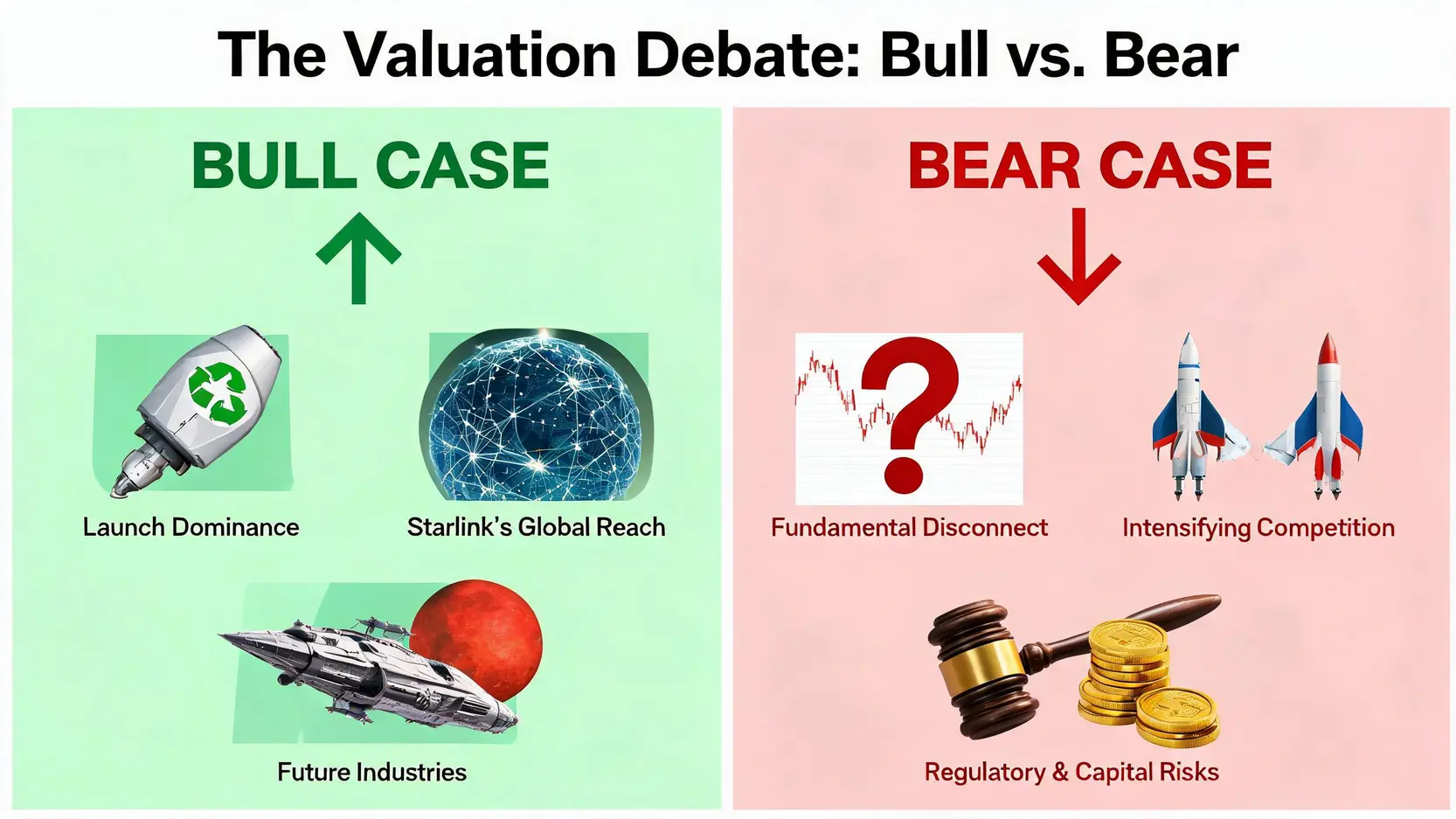
Why would investors pour billions into a company at such a high price? The bull case for the current SpaceX stock valuation rests on three foundational pillars: existing market dominance, a disruptive new service, and a vision for future industries it can create and conquer.
Dominance in the Launch Market with Reusable Rockets
SpaceX is not just a player in the satellite launch market; it is the market. Its fleet of reusable Falcon 9 and Falcon Heavy rockets has made it the most reliable and cost-effective launch provider in the world. By drastically reducing the cost of accessing space, SpaceX has created a deep competitive moat. This segment is a cash-generating engine, funding the company’s more ambitious projects and providing a stable financial floor. This dominance ensures a steady flow of high-margin revenue from both government (NASA, Department of Defense) and commercial clients.
Starlink: A High-Margin, Global Internet Service Provider
Perhaps the most compelling argument for SpaceX’s valuation is Starlink. This satellite internet constellation aims to provide high-speed, low-latency broadband to every corner of the globe. The potential market is enormous, encompassing rural and underserved communities, aviation, maritime, and military applications. With millions of subscribers and growing, Starlink represents a shift from one-off launch revenue to a recurring, high-margin subscription model. Bulls project this service alone could generate tens of billions in annual revenue, justifying a large portion of the company’s total valuation.
Future Growth Drivers: Mars Colonization and Point-to-Point Travel
Beyond current operations, investors are buying into Elon Musk’s long-term vision. The development of Starship, a fully reusable super-heavy launch vehicle, is the key. While the ultimate goal is the colonization of Mars—a concept too speculative for traditional valuation models—Starship has a more immediate, Earth-based application: point-to-point hypersonic travel. The ability to travel between any two cities on Earth in under an hour would disrupt the entire long-haul airline industry, a multi-trillion-dollar market. This transformative potential, however distant, is a significant factor in the bull thesis.
The Bear Case: Why Analysts Argue SpaceX is Overvalued
Despite the revolutionary technology, a growing chorus of analysts argues that the euphoria has created a valuation bubble disconnected from fundamentals. The bear case centers on professional skepticism, intensifying competition, and immense operational risks.
Morningstar’s Analysis: A 50%+ Discount to IPO Price?
The most prominent critique comes from the respected investment research firm Morningstar. In a recent 2026 analysis, they argued that SpaceX is “significantly overvalued.” They assigned the company a fair value estimate closer to $780 billion, less than half of its rumored IPO valuation. According to CNBC’s reporting on the analysis, Morningstar believes the current price relies too heavily on the successful and timely execution of highly speculative future projects like Mars colonization. They suggest that the market is not adequately pricing in the immense execution risk associated with these long-term, capital-intensive goals.
Intensifying Competition from Blue Origin and Others
SpaceX’s dominance is no longer unchallenged. The competitive landscape is heating up significantly:
- Blue Origin: Founded by Jeff Bezos, this company is SpaceX’s most direct rival, developing its own heavy-lift, reusable rocket (New Glenn).
- United Launch Alliance (ULA): The Boeing-Lockheed Martin joint venture is a formidable legacy player with deep government ties.
- Rocket Lab and other startups: A new wave of aerospace companies is targeting niche segments of the launch market.
- Amazon’s Project Kuiper: A direct competitor to Starlink, this satellite internet project has the backing of one of the world’s largest companies.
This rising competition could lead to price wars, compressing margins in both the launch and satellite internet sectors.
Regulatory Hurdles and High Capital Expenditure
Operating in space is not a free-for-all. SpaceX faces a complex web of regulatory oversight from agencies like the Federal Aviation Administration (FAA) for launches and the Federal Communications Commission (FCC) for its Starlink constellation. Any delays, launch failures, or environmental concerns could ground its fleet or slow its expansion. Furthermore, the company’s ambitions require a staggering amount of ongoing capital. The R&D for Starship and the manufacturing and launch of tens of thousands of Starlink satellites represent a continuous and massive cash burn that puts immense pressure on financial performance.
Beyond the Hype: A Strategic Look at SpaceX’s Financial Health
To make an informed decision, investors must look past the headlines and assess the company’s strategic financial position. This involves weighing its revenue against its costs, evaluating its leadership, and comparing its valuation to industry peers.
Analyzing Key Revenue Streams vs. Cash Burn Rate
The core financial tension at SpaceX is its established, profitable launch business versus the colossal expenses of its future projects. While the Falcon 9 launch manifest is booked solid and highly profitable, this revenue must fund the development of Starship and the Starlink network. Investors must question if the cash flow from launches is sufficient to sustain this burn rate without requiring constant new injections of capital, which could dilute existing shareholders. The path to profitability for Starlink is a critical metric to watch.
The ‘Elon Musk Factor’: A Risk or an Asset?
Elon Musk is inextricably linked to the SpaceX brand. His visionary leadership and engineering prowess are undeniable assets that have driven the company’s success. However, his divided attention across multiple companies (Tesla, X, Neuralink) and his often-controversial public persona are also significant risks. Key-person risk is exceptionally high at SpaceX; any change in his involvement or a decline in his reputation could have a material impact on investor confidence and the company’s valuation.
Comparing SpaceX’s Valuation to Other Tech and Aerospace Giants
Context is crucial. How does SpaceX’s valuation stack up against established public companies? A simple comparison reveals the premium it commands.
| Company | Industry | Market Capitalization (Approx.) | Key Differentiator |
|---|---|---|---|
| SpaceX | Aerospace & Communications | $1.7 Trillion+ (Private) | High-growth, disruption, vertical integration |
| Boeing | Aerospace & Defense | ~$180 Billion | Established, diversified, dividend-paying |
| NVIDIA | Technology (Semiconductors) | ~$3 Trillion | Dominant in AI, high-margin, rapid growth |
| Tesla | Automotive & Energy | ~$600 Billion | EV leader, high-growth, also led by Musk |
This table illustrates that investors are pricing SpaceX not as a traditional aerospace company like Boeing, but as a disruptive tech titan like NVIDIA, expecting exponential growth for years to come.
Conclusion: A Tale of Two Timelines
So, is SpaceX stock overvalued? The answer hinges entirely on your investment horizon and risk tolerance. For long-term believers who are confident in Musk’s ability to revolutionize multiple industries over the next two decades, the current valuation may seem a justifiable entry price for a company with a near-monopoly on the future of space and transportation. The bull case is a bet on visionary execution.
However, for more conservative investors focused on fundamentals over the next 3-5 years, the bear case is compelling. The significant execution risks, immense capital requirements, and warnings from credible analysts like Morningstar suggest that extreme caution is warranted. The current price leaves very little room for error. Ultimately, understanding both the boundless potential and the profound risks is the only way to make a rational decision about a potential SpaceX IPO.
Frequently Asked Questions about SpaceX Stock Valuation
Q: What is SpaceX’s current stock price?
A: As a private company, SpaceX does not have an official, publicly traded stock price. The valuation is derived from private funding rounds and transactions on secondary markets, where shares are unofficially traded among accredited investors. The rumored IPO price is speculative and subject to change.
Q: Is it possible to buy SpaceX stock before the IPO?
A: For the average retail investor, it is very difficult. Access to pre-IPO shares is typically limited to institutional investors and accredited investors (individuals with a high net worth or income) through specialized funds or platforms. These investments are highly illiquid and carry significant risk.
Q: What are the biggest risks to SpaceX’s valuation?
A: The primary risks include: 1) **Execution Risk:** Failure or significant delays in the Starship program or Starlink’s profitability. 2) **Competitive Risk:** Increased competition from companies like Blue Origin and Amazon could erode market share and margins. 3) **Financial Risk:** The high cash burn rate required for R&D and expansion could strain finances. 4) **Key-Person Risk:** Over-reliance on Elon Musk. 5) **Regulatory Risk:** Potential for stricter government oversight that could slow operations.
Q: How much of SpaceX’s valuation is tied to Starlink?
A: While SpaceX does not release specific financials, most analysts agree that Starlink constitutes a massive portion of the company’s future valuation. Unlike the project-based revenue from launches, Starlink promises a stable, recurring, and scalable subscription income stream, which investors typically value at a much higher multiple.