
The financial world is bracing for a seismic shift as Elon Musk’s SpaceX targets its landmark IPO. However, the most compelling narrative for astute investors is not just the public offering, but the accelerated timeline for its inclusion in the prestigious Nasdaq-100 index. The forthcoming SpaceX Nasdaq-100 inclusion date represents a pivotal market event, driven by groundbreaking new rules that could redefine index composition for mega-IPOs. This analysis breaks down the official projected timeline, deciphers the new regulations making this rapid entry possible, and explores the profound impact on your investment portfolio, particularly concerning the mechanics of the SpaceX IPO and its index inclusion.
Table of Contents
The Official Timeline: From IPO to Nasdaq-100 Inclusion
For investors looking to capitalize on this event, understanding the sequence of key dates is paramount. The path from a private valuation to becoming a component of one of the world’s most-watched indexes has been dramatically shortened, creating a unique set of opportunities and risks.
Key Date 1: The SpaceX IPO on Nasdaq
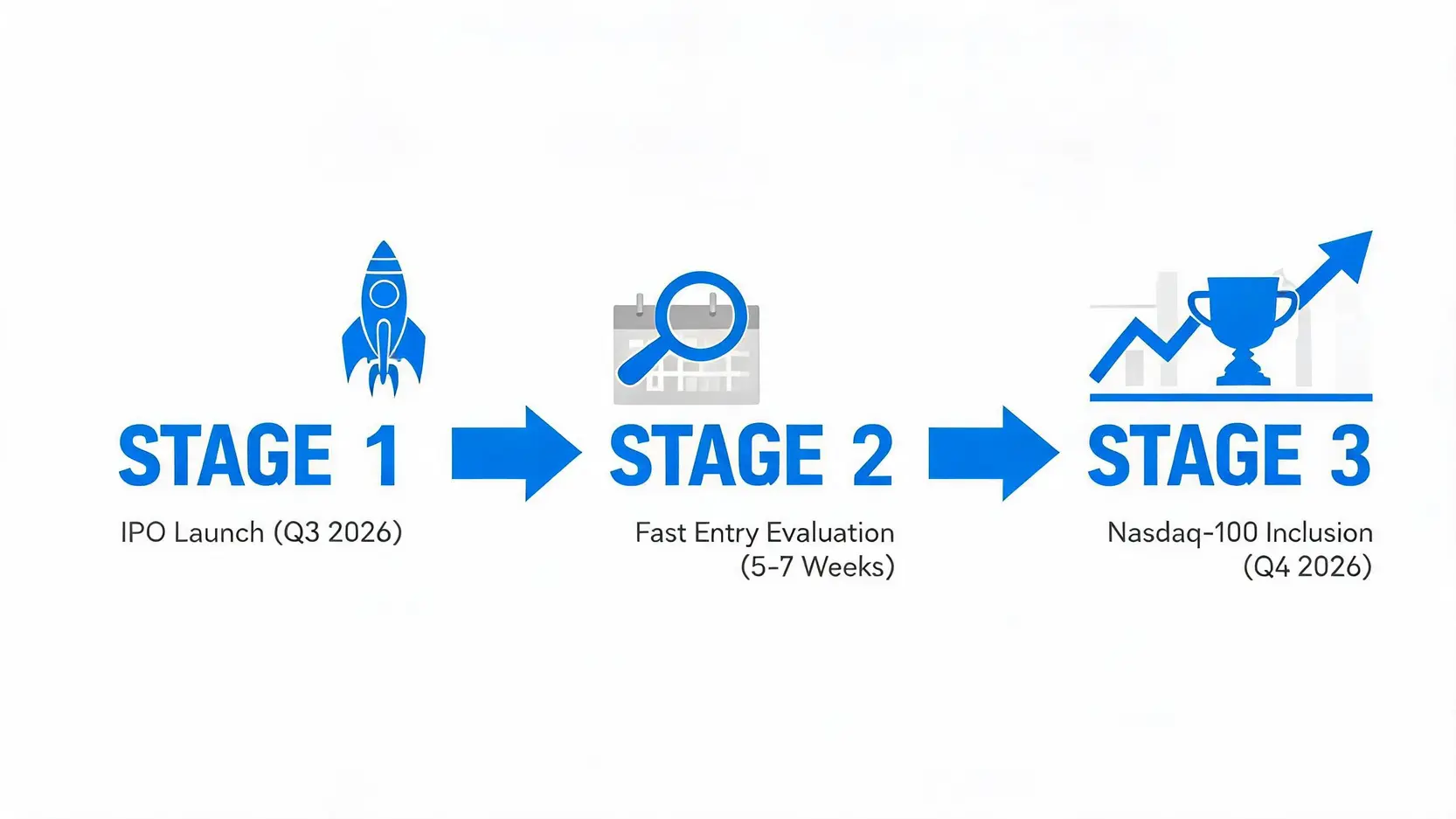
All indicators point to a launch window in the third quarter of 2026. The SpaceX Initial Public Offering is expected to be one of the largest market debuts in history. Listing on the Nasdaq is a strategic choice, aligning the company with the world’s foremost technology and innovation-driven exchange. The first day of trading will establish the initial public market capitalization, a critical metric for the subsequent index inclusion evaluation. Investors should monitor the S-1 filing for the official date and proposed ticker symbol, which will be the first concrete step in this multi-stage process.
Key Date 2: The Projected Nasdaq-100 Inclusion Date
Historically, a company would need to wait several months, or even until the annual reconstitution in December, to be considered for the Nasdaq-100. However, with Nasdaq’s new “Fast Entry” provision, SpaceX is on a fast track. The projected SpaceX Nasdaq-100 inclusion date is anticipated to occur as early as 5-7 weeks post-IPO. This means that by Q4 2026, SpaceX could officially be a constituent, triggering a massive wave of institutional buying from index-tracking funds.
Understanding the ‘Fast Entry’ Rule Change by Nasdaq
The mechanism enabling SpaceX’s rapid ascent into the Nasdaq-100 is a significant rule modification, informally dubbed ‘Lex SpaceX’ by market analysts. This change was strategically implemented to ensure the index accurately reflects the modern market landscape, where colossal companies can debut with valuations exceeding many existing index members.
How the New Rules Accelerate Index Inclusion for Mega-IPOs
The ‘Fast Entry’ or ‘Extraordinary Inclusion’ rule allows for a newly public company to be added to the index outside of the regular rebalancing schedule. To qualify, a company like SpaceX must meet specific, rigorous criteria upon its market debut, primarily centered around having an enormous market capitalization that would immediately place it in the top tier of Nasdaq-listed companies. Instead of a mandatory three-month trading history, eligibility is now assessed on a much shorter timeframe, focusing on sustained market value and liquidity shortly after the IPO. This rule acknowledges that for a company of SpaceX’s scale, its market significance is immediate and does not require a prolonged seasoning period.
Comparing ‘Lex SpaceX’ to Previous Index Entry Requirements
To appreciate the magnitude of this shift, consider the old paradigm. Previously, a new company had to wait for the quarterly rebalance or the annual reconstitution in December. A key hurdle was the requirement to have been listed on the Nasdaq for a minimum of three months. This created a significant lag between a company’s IPO and its inclusion in major indexes. The table below illustrates the dramatic acceleration:
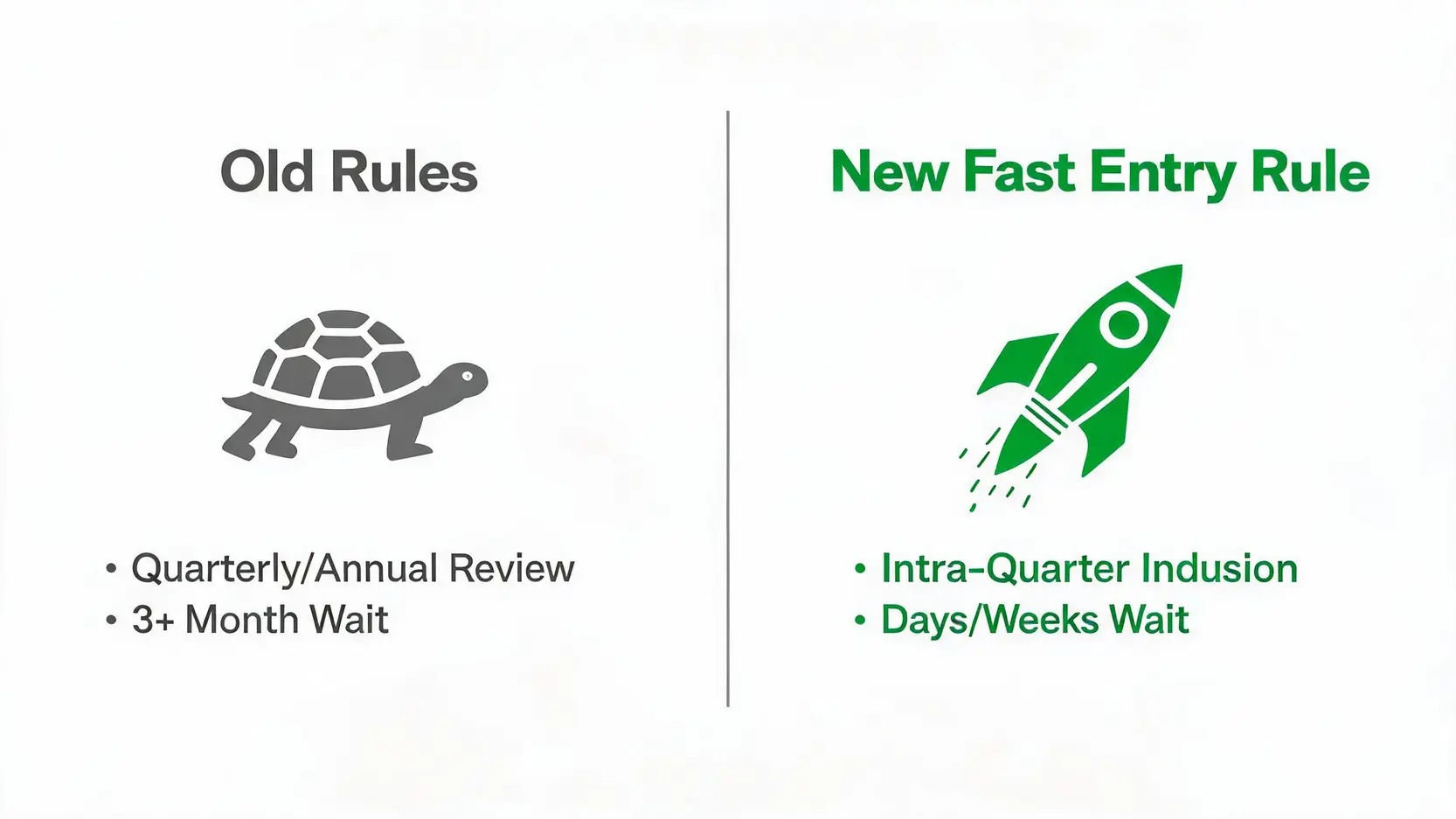
| Criteria | Previous Nasdaq-100 Rules | New ‘Fast Entry’ Rule (2026) |
|---|---|---|
| Timing of Inclusion | Annual Reconstitution (December) or Quarterly Rebalance | Eligible for intra-quarter inclusion shortly after IPO |
| Minimum Listing History | Typically 3 full calendar months | Reduced to days/weeks, contingent on sustained market cap |
| Primary Metric | Market capitalization at time of review | Sustained, exceptionally high market capitalization post-IPO |
| Trigger | Scheduled index review | Meeting predefined ‘mega-cap’ threshold upon listing |
This new framework, detailed in Nasdaq’s official communications, ensures the index remains dynamic and reflective of the market’s most influential players without unnecessary delay.
What SpaceX’s Nasdaq-100 Inclusion Means for Investors
The inclusion of a titan like SpaceX into the Nasdaq-100 is not merely a symbolic event; it has direct and tangible consequences for investors. From ETF portfolio managers to individual retail traders, the ripple effects will be significant and require strategic positioning.
The Immediate Impact on Nasdaq-100 ETFs (QQQ)
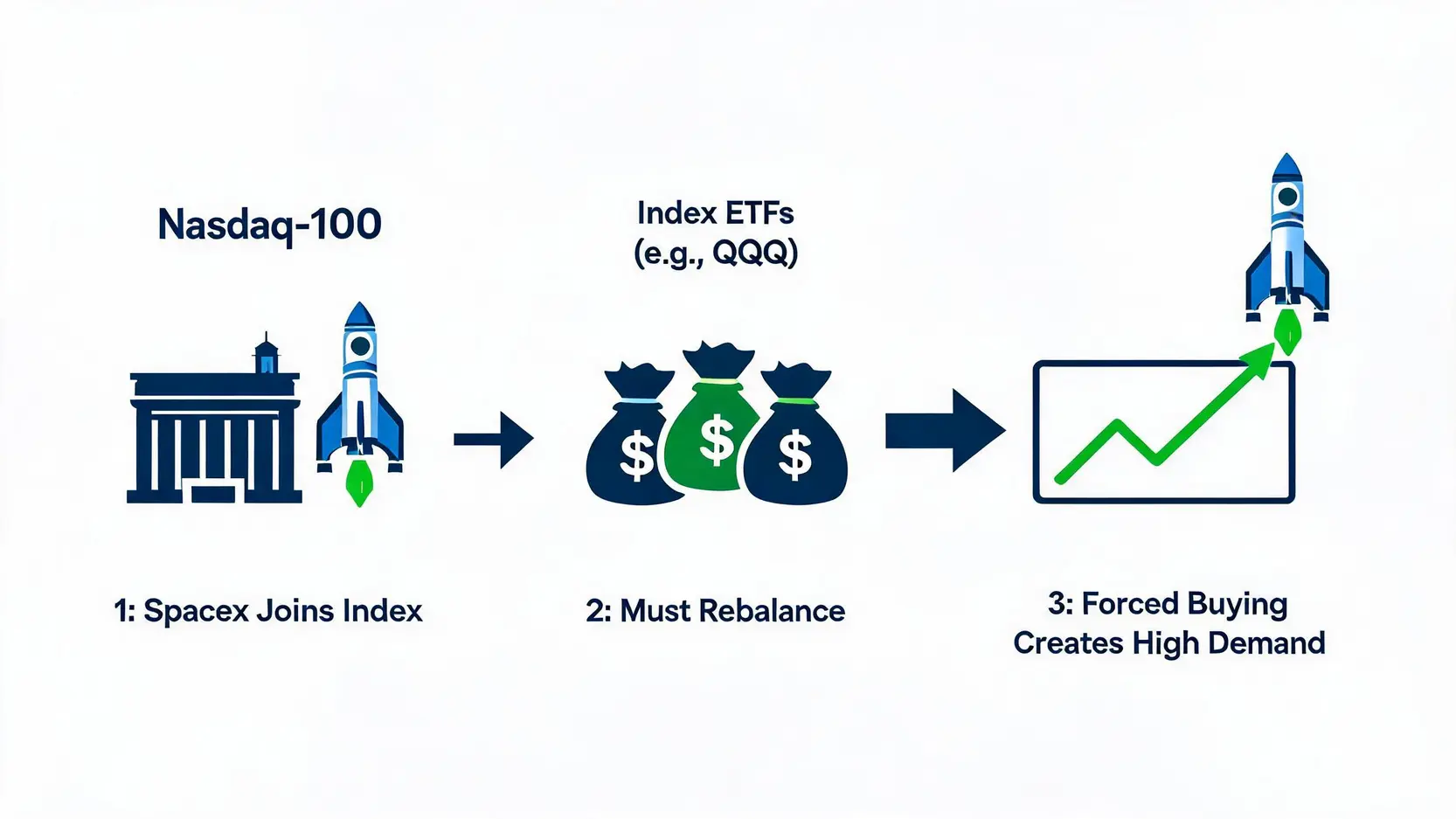
This is arguably the most critical consequence for the majority of investors. The Invesco QQQ Trust (QQQ), along with other ETFs and mutual funds that track the Nasdaq-100, will be mandated to purchase SpaceX shares to rebalance their portfolios. Their objective is to mirror the index’s composition as closely as possible. This creates a massive, non-discretionary demand for the stock on and around the inclusion date. We’re talking about billions of dollars in automatic buy orders. For investors, this means gaining exposure to SpaceX’s growth becomes as simple as holding a popular investment vehicle like the Nasdaq 100 ETF. 📈
Anticipating Market Volatility Around the Inclusion Event
The period between the IPO and the index inclusion will be characterized by heightened volatility. Sophisticated traders and hedge funds will attempt to front-run the forced buying from index funds, a strategy known as ‘index inclusion arbitrage.’ This can lead to a significant run-up in the stock price ahead of the official inclusion date. Once the inclusion happens and the wave of ETF buying is complete, the stock price may experience a short-term consolidation or pullback. Investors must be prepared for these sharp price swings and have a clear strategy, whether it’s long-term holding or tactical trading.
Strategic Considerations for Your Investment Portfolio
How an investor should approach this event depends on their risk tolerance and objectives.
- Pre-Inclusion Strategy: For those with a higher risk appetite, participating in the IPO or buying shares in the open market before the inclusion date offers the potential to benefit from the anticipated run-up. However, this also carries the risk of buying into IPO hype.
- Post-Inclusion Strategy: A more conservative approach is to wait for the volatility surrounding the inclusion event to subside. This allows for an entry point based on the company’s fundamental performance rather than market mechanics.
- ETF-Based Strategy: The simplest method is to invest in a Nasdaq-100 tracking ETF. This provides diversified exposure to SpaceX alongside other tech giants, mitigating single-stock risk while still capturing its potential upside.
Regardless of the chosen path, understanding the mechanics behind the SpaceX Nasdaq-100 inclusion date is crucial for making informed decisions.
Conclusion
In summary, the SpaceX Nasdaq-100 inclusion date is a landmark event for the market in 2026, made possible by strategic rule changes that reflect the new realities of mega-IPOs. The timeline from its initial public offering to becoming an index component will be extraordinarily compressed. Investors must be acutely aware of this schedule, the mechanics of forced buying from ETFs like QQQ, and the potential for increased market volatility. The introduction of the ‘Fast Entry’ provision is a game-changer, and staying informed is the critical first step in navigating both the risks and the historic opportunities presented by SpaceX’s public debut.
Frequently Asked Questions (FAQ)
Q: What is the official stock ticker for SpaceX?
A: As of June 2026, the official stock ticker for SpaceX has not been announced. It will be made public in the company’s S-1 filing with the Securities and Exchange Commission (SEC) prior to its IPO. Market speculation suggests tickers like ‘SPCX’ or ‘TSLAX’ (a nod to its sister company), but this remains unconfirmed.
Q: Will SpaceX be included in the S&P 500 as well?
A: Inclusion in the S&P 500 is a separate process with different criteria. The S&P 500 requires a company to have a history of positive earnings, specifically, profitability in its most recent quarter and over the cumulative trailing four quarters. While SpaceX’s rapid inclusion into the Nasdaq-100 is likely, its entry into the S&P 500 will depend on it meeting these stringent profitability metrics, which could take more time.
Q: How does a company qualify for the Nasdaq-100 index?
A: To qualify, a company must meet several criteria. It must be listed exclusively on the Nasdaq stock exchange and cannot be in the financial sector. The primary qualifications revolve around market capitalization and liquidity, requiring a minimum average daily trading volume. The Nasdaq-100 comprises the 100 largest non-financial companies based on these metrics, with the ‘Fast Entry’ rule now providing an accelerated path for exceptional new listings.
Q: Does the ‘Fast Entry’ rule guarantee SpaceX’s inclusion?
A: No, it does not guarantee inclusion, but it makes it highly probable. SpaceX must first complete a successful IPO and then maintain a market capitalization that unequivocally places it within the top ranks of Nasdaq-listed companies for a specified, albeit short, evaluation period. Assuming the IPO is as large as anticipated, it is almost certain to meet the necessary thresholds for this special inclusion.