The GLD ETF 2026 outlook commands significant attention from traders and long-term investors navigating the complexities of global financial markets. As an asset class, gold retains its status as a primary safe-haven instrument, and the SPDR Gold Shares (GLD) exchange-traded fund remains a premier vehicle for gaining liquid exposure.
Following a period marked by heightened inflation concerns, shifting central bank policies, and renewed market volatility, understanding the dynamics of the GLD ETF 2026 is more critical than ever.
This guide provides an in-depth analysis from a trader’s perspective, dissecting how GLD operates, the fundamental drivers influencing gold demand, the impact of ETF fund flows, and the hidden risks that every market participant must monitor before allocating capital. The core of this analysis is to equip you with a robust framework for making informed decisions regarding the GLD ETF 2026.
Table of Contents
What is the SPDR Gold Shares (GLD) ETF?
The SPDR Gold Shares, trading under the ticker GLD, is an exchange-traded fund meticulously designed to mirror the performance of physical gold bullion, less its operational expenses.
Consequently, it provides one of the most direct and liquid methods for investors to participate in the gold market without the complexities of purchasing, storing, and insuring physical gold bars.
The investment thesis for the GLD ETF 2026 is predicated on this direct correlation to the spot price of gold. Its structure as a grantor trust means the fund holds physical gold bullion, offering a tangible backing that resonates with investors seeking a pure-play on the precious metal. Many traders see the GLD ETF 2026 as an indispensable tool in their arsenal.
Understanding How GLD Tracks the Price of Physical Gold
The primary objective of the GLD ETF is to have its shares reflect the price of gold. This is achieved by holding allocated gold bars in secure vaults, primarily in London. The fund’s shares are issued and redeemed in large blocks (known as ‘baskets’) by authorised participants, a mechanism that helps keep the ETF’s market price aligned with its net asset value (NAV), which is based on the underlying gold holdings.
While minor tracking errors can occur due to the fund’s expense ratio and the timing differences between the ETF’s trading hours and the spot gold market, its performance remains a highly reliable proxy for gold’s price movements, a key factor for anyone analysing the GLD ETF 2026.
Key Distinction: GLD vs. Gold Mining ETFs (GDX)
A crucial distinction for investors is that GLD tracks the commodity itself, not the companies that extract it. This sets it apart from gold mining ETFs like the VanEck Gold Miners ETF (GDX). Investing in the GLD ETF 2026 insulates an investor from a host of company-specific risks inherent in mining stocks, such as:
- Operational Issues: Production costs, labour disputes, and mining disruptions.
- Management Performance: Corporate strategy, hedging decisions, and capital allocation.
- Financial Leverage: Debt levels and the cost of capital.
While mining stocks can sometimes offer leveraged exposure to rising gold prices, they also introduce a layer of equity risk that is absent in a direct gold investment through the GLD ETF 2026.
GLD ETF 2026 Forecast: Key Price Drivers to Monitor
The valuation of the GLD ETF 2026 is inextricably linked to the price of gold, which is influenced by a confluence of macroeconomic factors. A comprehensive forecast requires diligent monitoring of these key drivers, as they dictate institutional and retail fund flows into the asset class. Traders focusing on the GLD ETF 2026 must remain attuned to shifts in these fundamental indicators.
The Impact of Real Yields on Gold’s Attractiveness
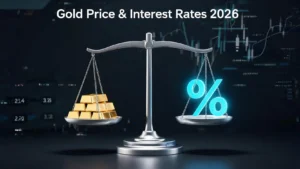
Perhaps the most potent driver for gold is the direction of real yields (nominal bond yields minus inflation expectations). Since gold offers no yield, its appeal diminishes when investors can earn a positive, inflation-adjusted return from fixed-income instruments. Conversely, when real yields fall or turn negative, the opportunity cost of holding a non-yielding asset like gold decreases, making it more attractive. Any credible analysis of the GLD ETF 2026 must centre on the trajectory of real yields.
How Central Bank Policies and Gold Purchases Provide Support
Central bank actions are a cornerstone of the gold market. Monetary policy decisions, particularly those from the U.S. Federal Reserve, directly influence interest rates and currency valuations, which in turn affect gold. Furthermore, direct purchases of gold by central banks for their reserves have become a significant source of structural demand. This trend, driven by a desire for diversification away from fiat currencies, provides a solid long-term support pillar for gold prices and, by extension, the GLD ETF 2026.
The U.S. Dollar’s Inverse Relationship with GLD
Because gold is predominantly priced in U.S. dollars, an inverse relationship typically exists between the two. A weaker dollar makes gold cheaper for buyers holding other currencies, which can stimulate demand and push prices higher. A stronger dollar tends to have the opposite effect. Traders of the GLD ETF 2026 should constantly monitor the U.S. Dollar Index (DXY) as a leading or confirming indicator for potential price movements.
Geopolitical Tensions as a Catalyst for Safe-Haven Demand
Gold’s historical role as a safe-haven asset means its price often rallies during periods of heightened geopolitical or economic uncertainty. These events can trigger a flight to safety, with investors seeking to preserve capital outside of traditional financial assets. While these rallies can be powerful, they can also be fleeting. If tensions ease, the safe-haven premium can evaporate quickly, leading to sharp pullbacks in gold and the GLD ETF 2026.
Technical Analysis: A Trader’s View on GLD in 2026
A purely fundamental view of the GLD ETF 2026 is incomplete without a rigorous technical analysis. For active traders, price action, volume, and key chart levels provide critical signals for entry, exit, and risk management. This approach helps to contextualise the fundamental drivers within the actual market behaviour. Success in trading the GLD ETF 2026 often hinges on combining both disciplines.
Identifying Key Support and Resistance Zones
Support and resistance zones represent price areas where buying or selling pressure is expected to be concentrated. Support is a price level where a downtrend can be expected to pause due to a concentration of demand. Resistance is the opposite, a level where an uptrend may pause due to a concentration of supply. For the GLD ETF 2026, identifying these zones—based on previous price highs and lows, moving averages, or Fibonacci levels—is fundamental to defining risk-reward scenarios for a trade.
The Importance of Volume Confirmation in Price Moves
A price move in the GLD ETF 2026 gains credibility when it is accompanied by high trading volume. A breakout above a key resistance level on strong volume suggests conviction and institutional participation, increasing the likelihood that the move is sustainable. Conversely, a rally on low volume may indicate a lack of broad interest and a higher risk of failure. Volume analysis is a non-negotiable component of a professional trading strategy for the GLD ETF 2026.
Navigating Potential Risks: Bull Traps and Failed Breakouts
Traders must remain vigilant for false signals. A ‘bull trap’ occurs when the price of the GLD ETF 2026 breaks above a resistance level, luring in buyers, only to quickly reverse and fall back below it. This failed breakout can lead to rapid losses for those who entered late. Prudent traders often wait for a confirmation of the breakout—such as a retest of the former resistance level as new support—before committing significant capital.
GLD for Investors: Analysing Fees, Liquidity, and Alternatives
While the GLD ETF 2026 is a dominant force in the gold ETF market, investors should conduct due diligence on its cost structure and compare it with other available options. The suitability of an ETF depends on the investor’s time horizon and trading style. For many, the unique attributes of the GLD ETF 2026 justify its position, but for others, alternatives may be more appropriate.
A Breakdown of the GLD Expense Ratio and Its Impact
The GLD ETF carries an expense ratio, which is an annual fee charged as a percentage of assets under management. While seemingly small, this fee compounds over time and can create a noticeable drag on long-term returns compared to holding physical gold directly (though physical holdings have their own storage and insurance costs). For a short-term trade, the expense ratio is largely negligible, but for a multi-year investment, it becomes a more significant consideration in the GLD ETF 2026 decision.
Comparing GLD vs. Lower-Cost Alternatives (IAU, GLDM)
Several other ETFs offer exposure to physical gold, often with lower expense ratios. The main competitors include the iShares Gold Trust (IAU) and the SPDR Gold MiniShares Trust (GLDM). Here is a comparative overview:
| Feature | GLD (SPDR Gold Shares) | IAU (iShares Gold Trust) | GLDM (SPDR Gold MiniShares) |
| Expense Ratio | Higher (e.g., ~0.40%) | Lower (e.g., ~0.25%) | Very Low (e.g., ~0.10%) |
| Liquidity | Extremely High | High | Moderate |
| Options Market | Very Active & Deep | Active, but less so than GLD | Limited |
| Best For | Active traders, large institutions | Long-term investors, some traders | Cost-conscious long-term investors |
Why Traders Prioritise GLD’s Liquidity and Options Market
Despite its higher fee, the GLD ETF 2026 remains the preferred choice for most active traders and large institutions. The reason is its unparalleled liquidity, which translates to high daily trading volumes and tight bid-ask spreads. This allows for the efficient execution of large orders with minimal market impact. Furthermore, GLD has the most robust and liquid options market of any gold ETF, providing traders with a versatile tool for hedging, generating income, or speculating with defined risk.
Principal Risks of Investing in GLD ETF in 2026
A balanced analysis requires a thorough examination of the potential downsides. Investing in the GLD ETF 2026 is not without risk, as it does not protect an investor from adverse movements in the price of gold. Understanding these risks is fundamental to responsible portfolio management and is a key part of any E-E-A-T compliant discussion of the GLD ETF 2026.
The Risk of a Sharp Gold Price Reversal
The most direct risk is a significant decline in the spot price of gold. If the fundamental drivers turn negative—for example, due to unexpectedly hawkish central bank policy or a resolution of geopolitical conflicts—gold prices can fall sharply. Since GLD is designed to track gold, its share price will decline in tandem. The GLD ETF 2026 offers no buffer against this primary market risk.
Headwinds from a Rebounding U.S. Dollar
As previously discussed, a strong U.S. dollar is a significant headwind for gold. Should economic conditions lead to a sustained rally in the dollar, it would likely exert downward pressure on gold prices and negatively impact the performance of the GLD ETF 2026. Investors must consider their outlook on the U.S. currency when formulating a thesis for gold.
The Danger of a “Crowded Trade” Scenario
When a particular asset becomes overwhelmingly popular among investors, it can become a ‘crowded trade’. This situation makes the asset vulnerable to sharp and rapid sell-offs if market sentiment suddenly shifts. If investment flows into the GLD ETF 2026 become excessively one-sided after a prolonged rally, the risk of a painful correction increases as latecomers rush for the exits at the first sign of trouble.
Conclusion: Practical Decision-Making for the GLD ETF 2026
The GLD ETF 2026 remains a pivotal instrument for accessing the gold market, standing at the crossroads of inflation expectations, monetary policy, and safe-haven demand. Its high liquidity makes it an exceptional tool for active traders seeking tactical exposure and risk management through its deep options market. However, this premier status comes at the cost of a higher expense ratio, which long-term, buy-and-hold investors must weigh against lower-cost alternatives like IAU or GLDM.
For practical application, traders should prioritise technical confirmation. Do not enter a position based on fundamentals alone; wait for price to validate the thesis by holding key support or breaking resistance on convincing volume. Always monitor real yields and the U.S. Dollar Index as primary macroeconomic indicators.
Long-term investors should focus on portfolio allocation, determining an appropriate size for a gold holding that aligns with their overall strategy, and avoid chasing performance by over-allocating after sharp price increases. The key to successfully navigating the GLD ETF 2026 lies in a disciplined approach that respects both its benefits and its inherent risks.
Frequently Asked Questions (FAQ)
Is GLD ETF a good investment for 2026?
The suitability of the GLD ETF 2026 as an investment depends on an individual’s financial goals, risk tolerance, and outlook on the key drivers of gold. It can be a valuable tool for portfolio diversification and for gaining liquid exposure to gold. However, its performance will hinge on factors like the direction of real yields, central bank policy, and the strength of the U.S. dollar.
Does the GLD ETF actually hold physical gold?
Yes, the SPDR Gold Shares (GLD) is structured as a trust that holds physical gold bullion in allocated accounts. Its objective is to reflect the price of gold, and it is not a fund that invests in gold mining companies. The physical backing is a key feature that appeals to investors seeking direct exposure to the commodity.
What is a realistic price prediction for GLD in 2026?
Providing a precise price prediction for the GLD ETF 2026 is challenging due to the multitude of factors influencing gold. Financial analysts’ forecasts vary widely, with bullish cases often citing persistent inflation and central bank buying, while bearish cases point to the potential for higher real yields. A realistic approach involves monitoring the key drivers and technical levels rather than relying on a single price target.
What are the main factors that could cause GLD’s price to fall?
The price of the GLD ETF 2026 could fall due to several factors. The most significant include a sustained rise in real yields, a strong and prolonged rally in the U.S. dollar, a shift to more aggressive tightening by central banks, or a significant decrease in market uncertainty and geopolitical risk, which would reduce gold’s safe-haven appeal.