As investors navigate the complex financial landscape of 2026, the intricate dance between “gold price and interest rates in 2026” remains a critical focus. This dynamic is not merely academic; it has profound implications for portfolio allocation and risk management. The market is currently pricing in a delicate balance, weighing persistent inflationary pressures against signs of a slowing global economy. Consequently, understanding the **Federal Reserve’s monetary policy’s impact on gold** is paramount. This article provides a comprehensive analysis of how central bank policies are expected to influence the precious metal’s value, offering expert **gold price predictions** and strategic insights for the year ahead.
Table of Contents
The Fundamental Principle: Why Interest Rates and Gold Prices Often Move in Opposite Directions
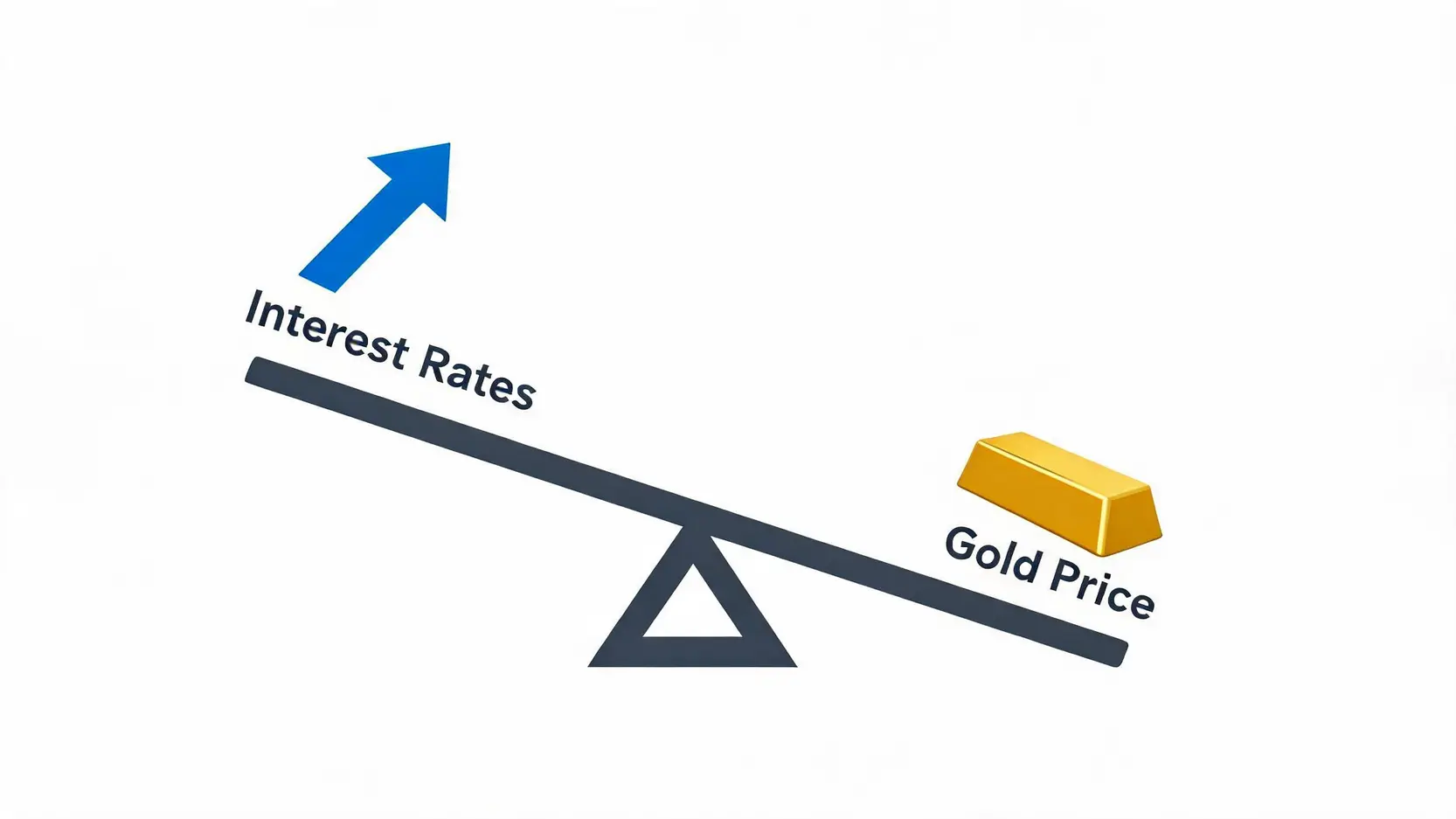
The inverse relationship between interest rates and the price of gold is a cornerstone of precious metals analysis. While not an absolute rule, the correlation holds true under most market conditions because it is driven by fundamental economic principles. At its core, this relationship is about capital allocation and the relative attractiveness of different asset classes. When the Federal Reserve adjusts the federal funds rate, it triggers a cascade of effects that directly and indirectly influence gold’s appeal to investors.
Understanding Opportunity Cost: The Yield vs. Safe Haven Debate
Gold is a non-yielding asset. It does not pay dividends or interest. Its value is derived from its scarcity, its historical role as a store of value, and its use in various industries. In contrast, assets like government bonds, corporate bonds, and even simple savings accounts generate income in the form of interest payments (yield). This is where the concept of opportunity cost becomes critical.
When interest rates rise, the yield on interest-bearing assets increases. For an investor, this makes holding bonds more attractive. The decision to hold gold, which offers no yield, means forgoing the guaranteed income they could be earning from a U.S. Treasury bond. This trade-off is the opportunity cost of holding gold. As this cost rises, demand for gold tends to fall, putting downward pressure on its price. Conversely, when interest rates are low or near zero, the opportunity cost of holding gold diminishes, making it a more attractive safe-haven asset relative to low-yielding bonds. This dynamic is explored further in our analysis of safe havens like gold versus the dollar.
The Role of the U.S. Dollar as an Intermediary
The U.S. dollar plays a crucial intermediary role in the relationship between gold and interest rates. Gold is priced in U.S. dollars on the international market. Therefore, the strength or weakness of the dollar has a direct impact on the price of gold for investors using other currencies.
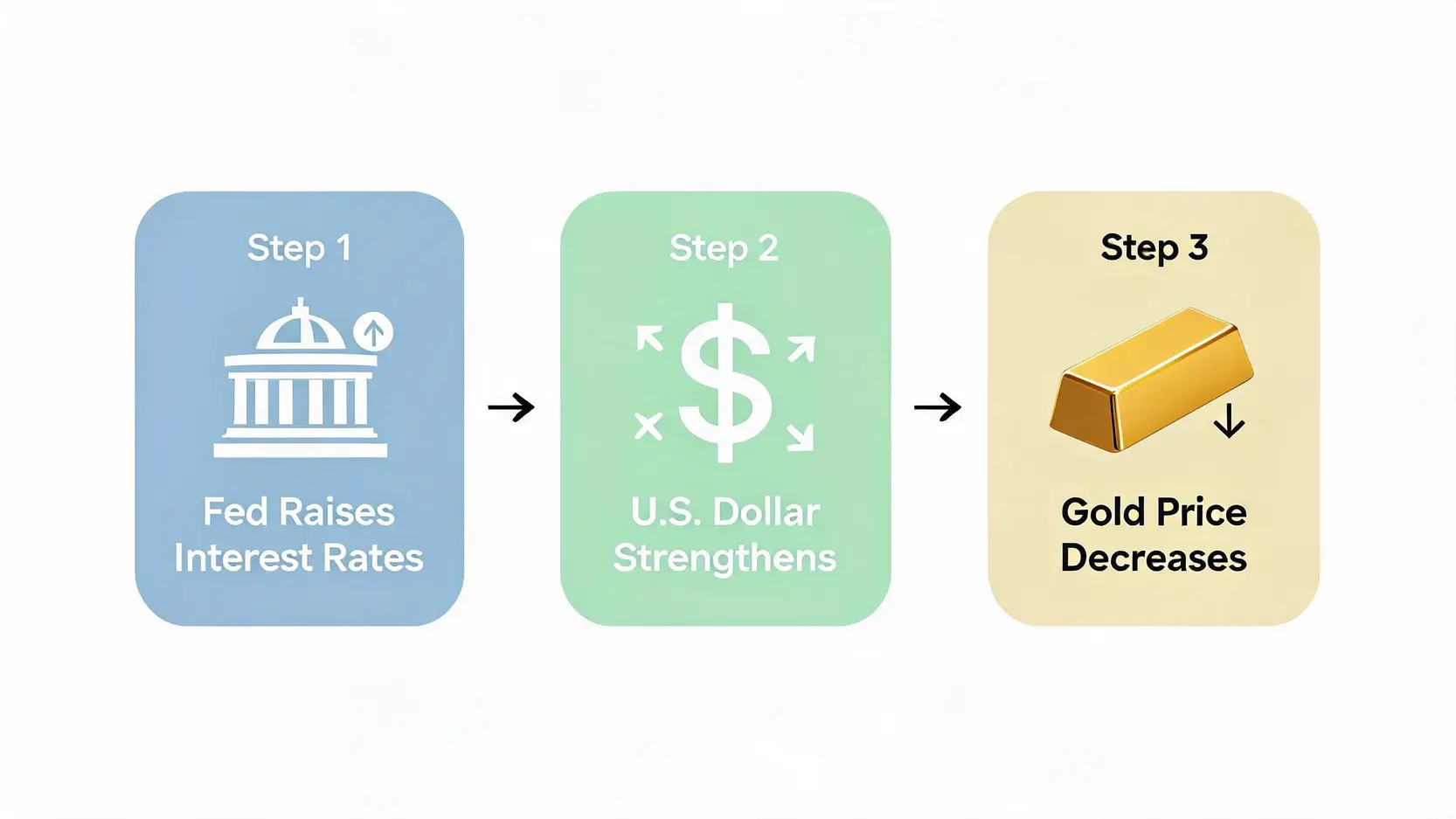
Here’s how it works:
- Higher Interest Rates → Stronger Dollar: When the Federal Reserve raises interest rates, it tends to attract foreign capital from investors seeking higher returns. This increased demand for dollars strengthens the currency.
- Stronger Dollar → Lower Gold Price: A stronger U.S. dollar makes gold more expensive for buyers holding other currencies. This can dampen international demand, leading to a decrease in the gold price.
Conversely, when U.S. interest rates fall, the dollar may weaken, making gold cheaper for foreign investors and potentially boosting its price. This currency effect, as explained by authoritative sources like CME Group, often amplifies the impact of opportunity cost.
2026 Gold Price Forecasts: What Top Analysts are Predicting Amid Fed Uncertainty
As of mid-2026, the financial community is buzzing with forecasts for the gold price, largely centered on the anticipated moves of the Federal Reserve. The consensus points towards a complex second half of the year, where the battle between inflation and growth will dictate monetary policy and, by extension, gold’s trajectory. A key theme in recent analyses is the divergence between near-term headwinds and long-term bullish structural factors.
Reviewing Projections from J.P. Morgan, CNBC, and Other Financial Institutions
Top-tier financial institutions have adjusted their forecasts to reflect the evolving economic data. Here’s a summary of the current sentiment:
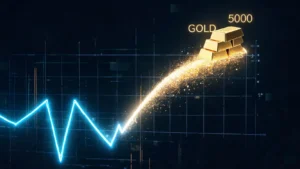
- J.P. Morgan: The firm has presented a nuanced view. While acknowledging that weaker investor demand might cap gains in the immediate term, their long-term outlook remains bullish. As reported in early July 2026, J.P. Morgan recalibrated its Q4 2026 forecast to approximately $4,500/oz, a reduction from earlier, more aggressive targets. However, their 2027 projections see prices rising again towards $5,000/oz, citing strong central bank buying and its role as a geopolitical hedge.
- ING Analysts (via CNBC): In late June 2026, ING analysts revised their gold forecasts, expecting an average price of $4,300/oz in Q3 and $4,600/oz in Q4 2026. This outlook is predicated on the dollar remaining strong as the Fed holds rates higher for longer than previously anticipated.
- Bank of America: BofA remains one of the more bullish institutions, maintaining a year-end target that could see gold reaching $5,000/oz, contingent on a dovish pivot from the Fed in late Q3 or early Q4.
These projections highlight a market in flux. While the short-term path may be volatile due to rate uncertainty, the underlying support for gold remains strong, driven by de-dollarization trends among emerging market central banks and persistent geopolitical risks.
Analyzing Key Economic Indicators Shaping These Forecasts
Analysts are not making these predictions in a vacuum. They are closely monitoring several key economic indicators that inform the Federal Reserve’s decisions:
- Inflation Data (CPI & PCE): The Consumer Price Index (CPI) and Personal Consumption Expenditures (PCE) price index are the Fed’s primary inflation gauges. Recent readings in 2026 have shown a sticky services inflation component, even as goods inflation has moderated. This stickiness is the primary reason the Fed has been hesitant to signal definitive rate cuts.
- Labor Market Data (Jobs Reports): The monthly Non-Farm Payrolls (NFP) report is a crucial indicator of economic health. A strong labor market gives the Fed more room to keep rates high to fight inflation. A sudden weakening in the jobs data would be a strong signal for a policy pivot, which would be bullish for gold.
- Geopolitical Developments: Ongoing trade negotiations, regional conflicts, and election cycles in major economies are adding a layer of uncertainty. These events bolster gold’s safe-haven appeal, creating a floor for prices even in a high-interest-rate environment.
2026 Scenario Analysis: How Different Fed Actions Could Impact Gold Prices
The future of the **gold price and interest rates in 2026** hinges on the Federal Reserve’s next moves. Investors must consider several potential scenarios, as the path of monetary policy is far from certain. Each scenario presents distinct risks and opportunities for gold investors.
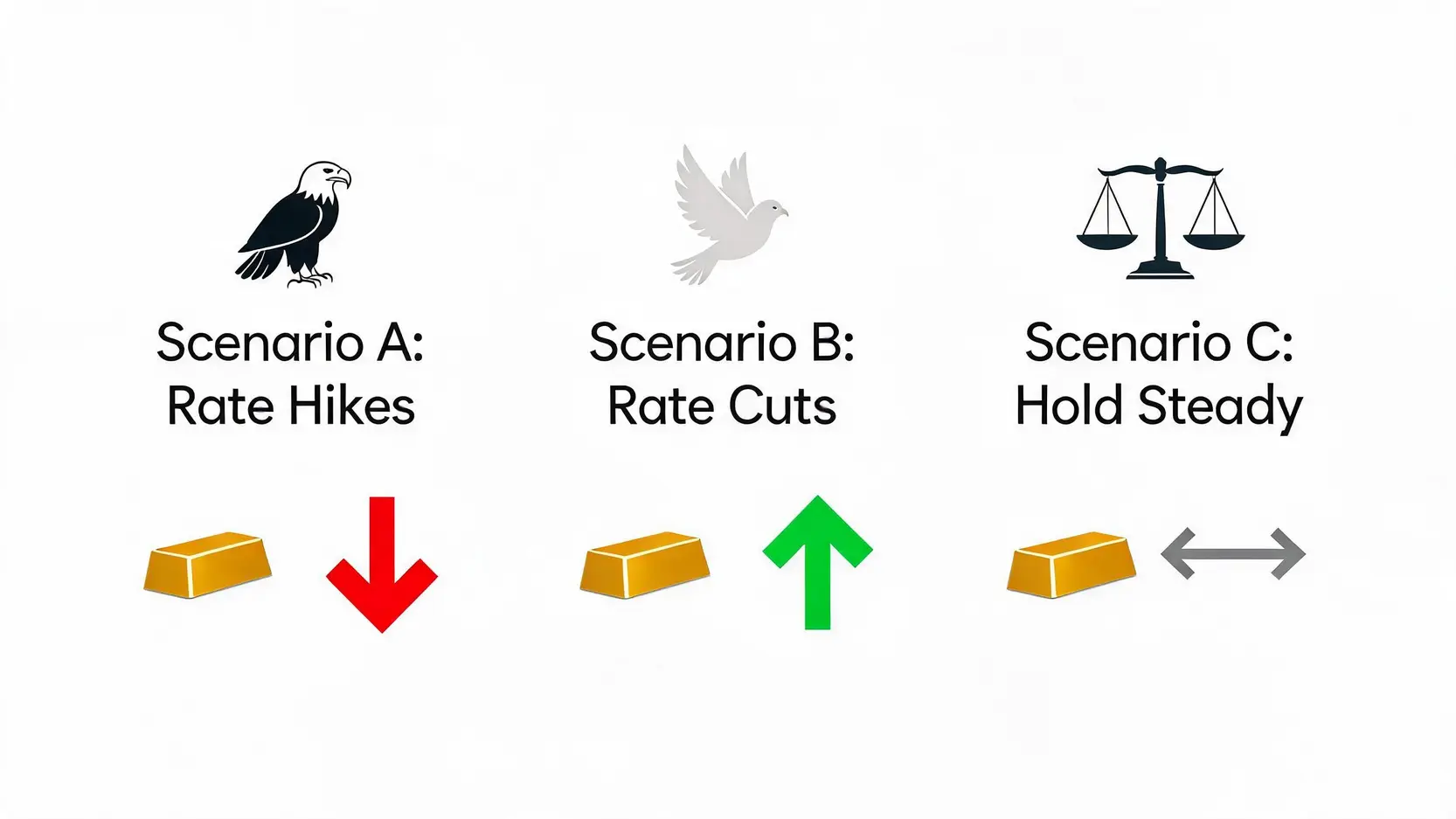
Scenario A: Aggressive Rate Hikes to Combat Stubborn Inflation
If inflation re-accelerates in the second half of 2026, the Fed could be forced into a new cycle of aggressive rate hikes. This is the most bearish short-term scenario for gold.
- Impact on Gold: Each 25-basis-point hike would significantly increase the opportunity cost of holding non-yielding bullion. This would likely trigger a sell-off in gold as capital rotates into higher-yielding government bonds.
- Impact on the Dollar: The U.S. dollar would likely surge, making gold more expensive for international buyers and further depressing prices.
- Market Outlook: In this scenario, gold could test lower support levels, potentially falling below the $4,000/oz mark. However, such aggressive tightening also increases the risk of a hard economic landing, which could set the stage for a sharp reversal in 2027.
Scenario B: A Dovish Pivot with Rate Cuts to Stimulate Growth
Should the labor market weaken significantly or other leading economic indicators point towards a recession, the Fed may pivot to a dovish stance and begin cutting rates. This is the most bullish scenario for gold.
- Impact on Gold: Rate cuts would lower the opportunity cost, making gold a more attractive asset. This move would likely unleash significant pent-up investment demand for bullion and gold ETFs.
- Impact on the Dollar: A dovish pivot would almost certainly weaken the dollar, providing a powerful secondary tailwind for gold prices.
- Market Outlook: Under this scenario, the more optimistic gold price predictions from institutions like J.P. Morgan and Bank of America (targeting $5,000/oz or higher) become highly plausible. Gold would reassert its role as a primary safe-haven asset.
Scenario C: A ‘Hold Steady’ Approach and Its Market Implications
Perhaps the most complex scenario is one where the economy muddles through—inflation cools slowly but remains above the Fed’s 2% target, and growth slows but avoids a deep recession. In this case, the Fed might adopt a ‘wait-and-see’ approach, holding rates steady for an extended period.
- Impact on Gold: Gold’s performance would be driven by real interest rates (nominal rates minus inflation). If inflation falls faster than the market expects while the Fed holds rates, real rates would rise, which is negative for gold. If inflation remains sticky while rates are held, real rates would fall, which is positive for gold.
- Impact on the Dollar: The dollar would likely trade in a range, influenced more by data from other major economies like the ECB and BOJ.
- Market Outlook: This scenario would lead to a choppy, range-bound market for gold. Price action would be highly sensitive to each new inflation and employment data release, creating opportunities for nimble traders but frustration for long-term investors seeking a clear trend.
Conclusion: Navigating the 2026 Gold Market Requires a Focus on the Fed
In conclusion, the outlook for the **gold price and interest rates in 2026** is inextricably linked. The prevailing inverse relationship, driven by opportunity cost and the dynamics of the U.S. dollar, remains the single most important factor for investors to understand. While bullish long-term forecasts are supported by central bank demand and geopolitical uncertainty, the short-to-medium-term path will be dictated by the Federal Reserve’s monetary policy decisions.
Investors must closely monitor incoming inflation and employment data, as these will be the primary inputs for any policy pivot. Whether the Fed continues its hawkish stance, pivots to a dovish cycle of cuts, or holds steady, each path has vastly different implications for the price of gold. Understanding this complex nexus is paramount to making informed and strategic decisions in the precious metals market this year.
Frequently Asked Questions (FAQ)
Q: What is the historical correlation between gold price and interest rates?
A: Historically, the correlation between the gold price and real interest rates is strongly negative. Data spanning several decades shows that periods of high or rising real interest rates (like the early 1980s) have corresponded with major bear markets in gold.
Conversely, periods of low or negative real interest rates (like the post-2008 financial crisis era and the 2020-2021 period) have been exceptionally bullish for the precious metal. While the short-term correlation can sometimes break down due to other factors, over the long term, the inverse relationship is one of the most reliable in finance.
Q: How do geopolitical events in 2026 affect the gold and interest rate relationship?
A: Geopolitical events act as a significant confounding variable. In a typical environment, rising rates would pressure gold lower.
However, a major geopolitical crisis can trigger a flight to safety, causing both the U.S. dollar (as a premier safe-haven currency) and gold to rise simultaneously. This disrupts the normal inverse relationship.
In 2026, events such as ongoing trade disputes or regional conflicts can create a ‘geopolitical risk premium’ in the gold price, providing a buffer against the negative impact of high interest rates.
This is a key reason why, despite high rates, gold has remained resilient. You can learn more about how geopolitical risk impacts gold prices in our detailed guide.
Q: Is gold a good investment if interest rates are expected to rise further in 2026?
A: It depends on the context and an investor’s goals. If the Federal Reserve is hiking rates to combat runaway inflation, then real interest rates may still be low or negative, which can be a supportive environment for gold. However, if rate hikes are occurring in an environment of falling inflation (leading to higher real rates), gold will face significant headwinds.
For most investors, gold’s value lies in its role as a diversification tool. It often performs well when other assets, like stocks and bonds, are under pressure during economic uncertainty. So, even if further rate hikes are expected, holding a strategic allocation to gold can be a prudent way to hedge against unforeseen economic shocks or a policy mistake by the central bank.