
The Non-Farm Payrolls (NFP) report remains the paramount macroeconomic indicator dictating momentum across global financial markets in 2026. Navigating the NFP impact on gold and silver requires a granular understanding of labor statistics and central bank psychology. For institutional and retail market participants alike, optimizing GLD ETF trading strategies and decoding Silver Beta market characteristics are critical competencies. The instantaneous repricing of assets following the US labor data release creates both immense risks and lucrative opportunities. This comprehensive analysis dissects the structural mechanisms driving capital flows, interest rate expectations, and volatility within the precious metals sector.
Table of Contents
Decoding the NFP Impact on Gold and Silver Prices
Published on the first Friday of every month by the US Bureau of Labor Statistics, the NFP data sets the foundational tone for monetary policy expectations. The core market dynamic revolves around the deviation between actual employment figures and consensus forecasts. A surprisingly strong NFP report indicates a resilient labor market and robust economic expansion. Consequently, this outcome often compels the Federal Reserve to maintain restrictive interest rates to mitigate inflationary pressures. Elevated borrowing costs increase the yield on treasury bonds, driving capital away from non-yielding assets and exerting severe bearish pressure on precious metals.
Conversely, a weak NFP print signals an economic deceleration. A cooling labor market fuels immediate expectations for monetary easing, plunging bond yields and aggressive dollar selling. Under these conditions, the intrinsic value of precious metals skyrockets as investors rush to deploy capital into safe-haven investment vehicles. Recognizing these binary outcomes is the first step in formulating actionable ETF execution frameworks.
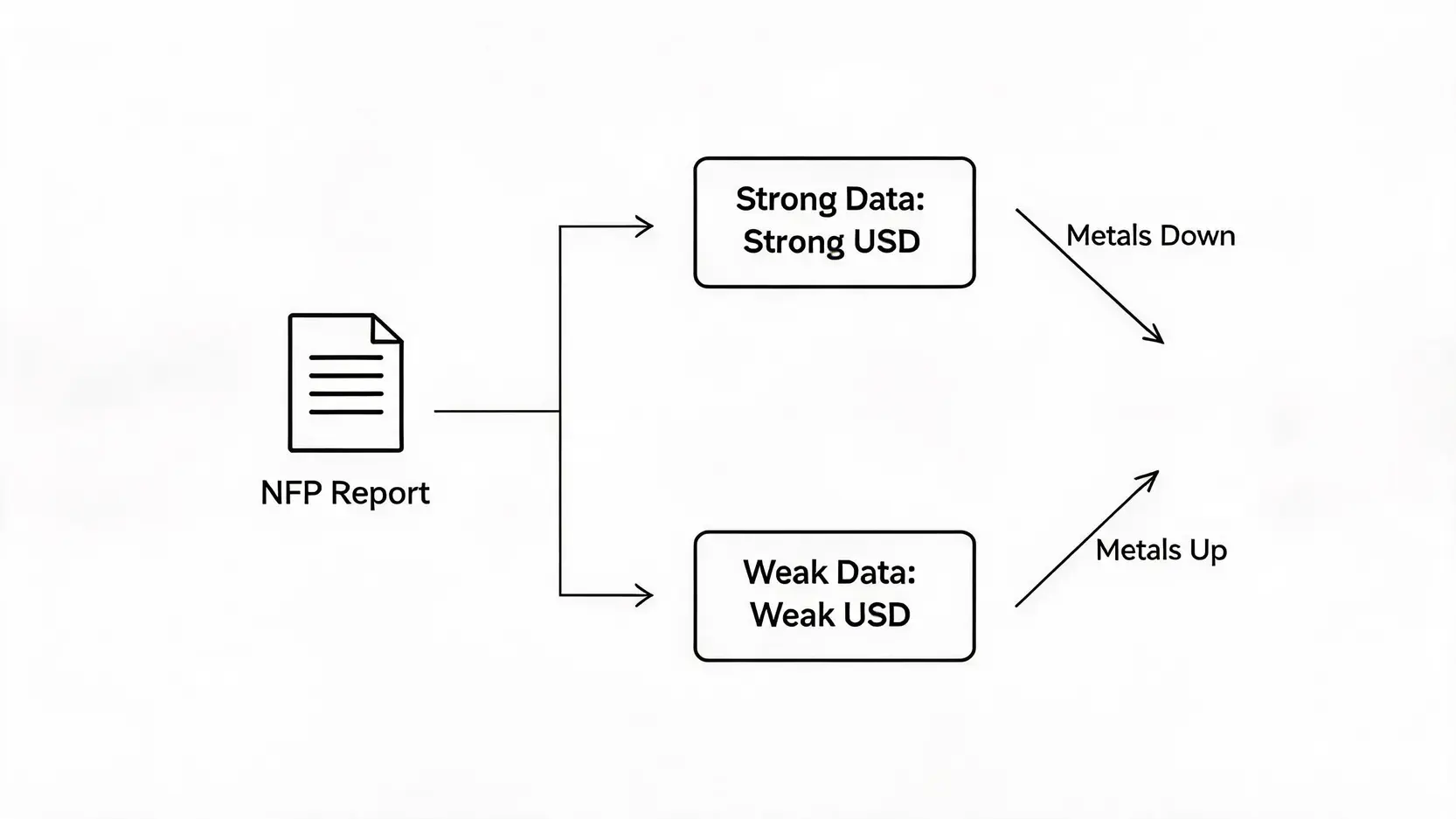
| NFP Scenario | Economic Indication | US Dollar & Yields | Precious Metals Reaction |
|---|---|---|---|
| Strong Print (Beat) | Labor market resilience, inflation risks persist | Bullish USD, Rising Yields | Aggressive Sell-off |
| Weak Print (Miss) | Economic slowdown, monetary easing anticipated | Bearish USD, Falling Yields | Explosive Rally |
| Inline (As Expected) | Status quo maintained, neutral policy outlook | Range-bound consolidation | Technical Trend Continuation |
The Interplay Between Fed Interest Rates, US Treasury Yields, and the Dollar Index
The Federal Reserve’s dual mandate of maximizing employment and stabilizing prices essentially tethers monetary policy to the NFP report. Evaluating the gold price and interest rate relationship reveals a persistent inverse correlation that algorithms aggressively trade in 2026. When robust employment data hits the terminal, the probability of rate hikes or sustained high rates spikes. US Treasury yields instantly reprice higher, establishing a formidable opportunity cost for holding bullion.
Simultaneously, a hawkish shift in interest rate projections acts as a powerful catalyst for the US Dollar Index (DXY). Because global commodities are priced in dollars, a surging greenback mathematically depresses the valuation of gold and silver. This dual headwind—rising yields and a strengthening dollar—creates a toxic environment for metals. Understanding this macroeconomic transmission mechanism is vital before deploying capital into the market, as ignoring the dollar-yield axis often leads to catastrophic drawdowns during data volatility.
Analyzing GLD and SLV ETF Capital Flows During Data Releases
Tracking the underlying asset is only one dimension of modern trading; analyzing secondary market vehicles like exchange-traded funds offers unparalleled insights into institutional positioning. The SPDR Gold Trust and the SLV ETF serve as the primary conduits for massive liquidity injections and liquidations. Leading up to a highly anticipated employment report, options volume on these ETFs typically surges, resulting in elevated implied volatility. Speculators utilize the liquidity of these funds to construct complex directional bets without the logistical hurdles of futures contracts.
Post-release capital flows are even more telling. Authorized participants actively create or redeem ETF shares based on the premium or discount to the Net Asset Value (NAV) caused by retail and institutional panic. Massive structural inflows into these ETFs following a weak NFP print often validate a sustainable macroeconomic breakout, providing traders with the conviction required to hold positions for extended durations.
Silver Beta: Why Silver Outperforms Gold in Volatility
Silver occupies a unique space in the financial ecosystem, acting as a hybrid between an industrial commodity and a monetary safe haven. This dual identity fosters erratic market behavior, quantified by analysts as Silver Beta. Essentially, Silver Beta measures the metal’s amplified sensitivity relative to gold movements. Due to a significantly smaller market capitalization and lower liquidity thresholds, silver price action is notoriously violent, frequently overshooting gold on a percentage basis.
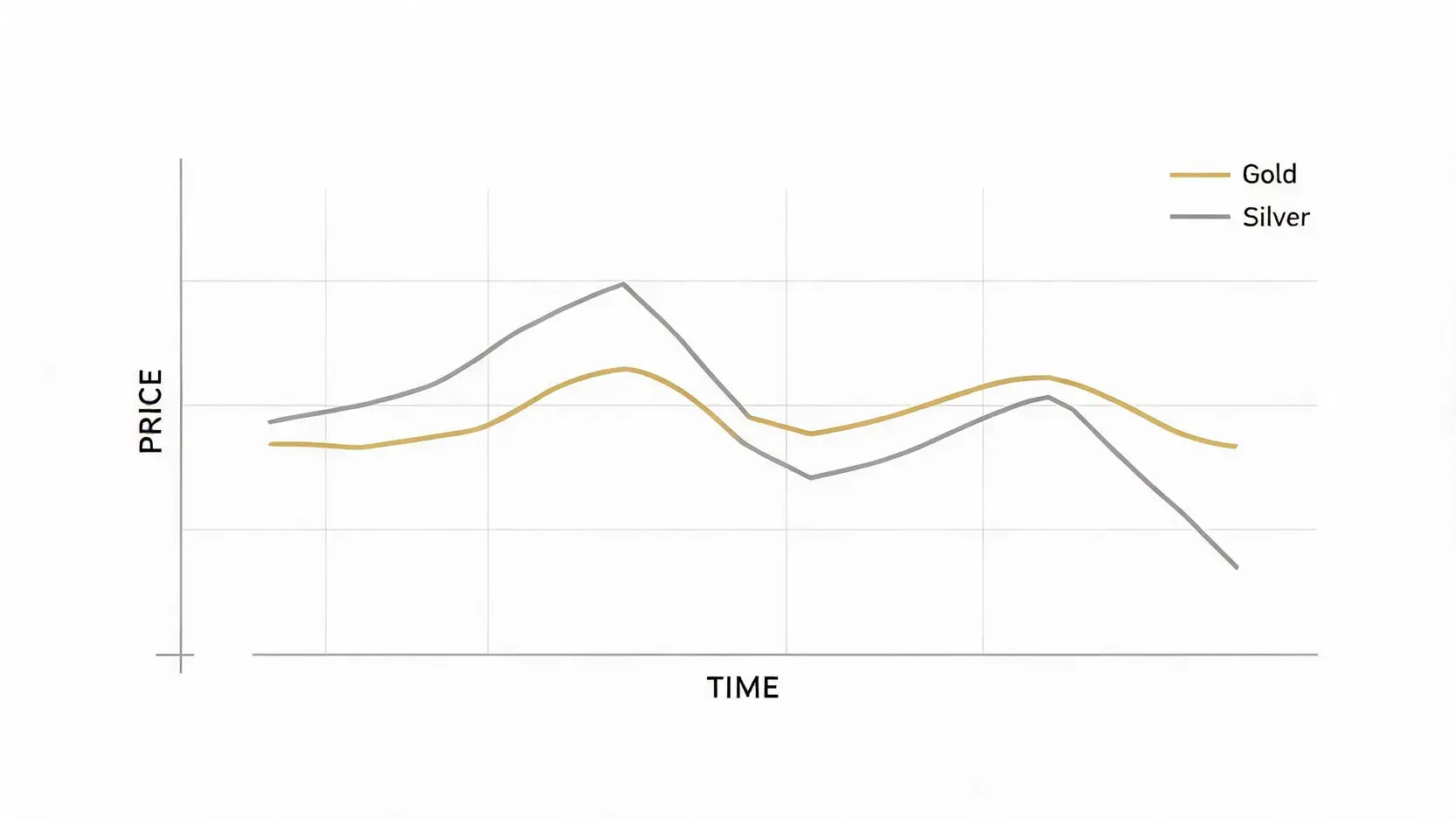
During an NFP release, if gold experiences a 1.5% directional move, it is entirely common for silver to register a 3% to 4% swing. Recognizing Silver Beta market characteristics allows astute participants to scale their exposure efficiently. Those seeking to maximize alpha during clear macroeconomic shifts often allocate heavier weightings to the white metal, acknowledging the elevated risk profile in exchange for superior percentage returns.
Advanced Trading Strategies for GLD and SLV ETFs in 2026
Success in navigating top-tier economic data requires transcending fundamental theory and mastering tactical execution. In 2026, market depth can evaporate milliseconds before the NFP publication, leading to severe slippage. Establishing delta-neutral positions using ETF options—such as straddles or strangles—prior to the release allows traders to capitalize on pure volatility expansion regardless of the directional outcome. Once the data is absorbed and the initial algorithmic whipsaw concludes, directional trend-following setups become viable.
Furthermore, relative value trades offer a sophisticated approach to risk management. By monitoring the XAUUSD vs Gold ETF dynamics, participants can identify brief arbitrage windows where the ETF price temporarily disconnects from the spot market due to overwhelming order flow imbalances. A well-constructed pairs trade, such as going long SLV while shorting GLD, can isolate the anticipated economic expansion metrics while neutralizing broader systemic risks.
Conclusion on Precious Metals and Economic Data
The intrinsic link between the NFP report and precious metals valuations forms the bedrock of macroeconomic trading. By synthesizing employment statistics with Federal Reserve interest rate projections, bond yields, and dollar strength, investors can map out high-probability scenarios. Leveraging instruments like GLD and SLV provides the necessary liquidity and flexibility to execute these strategies effectively. Acknowledging the extreme volatility parameters of Silver Beta ensures that risk management protocols remain robust. As global markets continue to evolve in 2026, empirical data analysis and disciplined tactical execution will remain the ultimate arbiters of sustained trading success.
Frequently Asked Questions (FAQ)
How does a strong NFP report affect the GLD ETF?
A robust employment report consistently triggers aggressive selling pressure on the GLD ETF. Strong labor statistics signal economic health, which reduces the probability of imminent monetary easing. Consequently, treasury yields rise, increasing the opportunity cost of holding non-yielding gold, prompting institutional capital rotation out of the ETF.
Why does the SLV ETF experience higher volatility than GLD during data releases?
The SLV ETF tracks silver, a market with significantly lower overall liquidity and a smaller capitalization compared to gold. Combined with its dual application in industrial manufacturing and investment, this lack of depth amplifies speculative trading forces, resulting in a higher Silver Beta and vastly wider price swings.
What is the relationship between US Treasury yields and precious metals?
Precious metals and US Treasury yields share a foundational inverse relationship. Because bullion yields no interest or dividends, rising treasury yields mathematically increase the opportunity cost for investors. When yields surge post-NFP, capital rapidly migrates from metals into risk-free government bonds.
Can Silver Beta be used to predict directional gold price movements?
While Silver Beta primarily quantifies relative volatility rather than forecasting direction, a sudden and sustained surge in silver prices frequently acts as a leading indicator for broader sector strength. It reflects a spike in speculative appetite that eventually cascades into heavy gold accumulation.
How do Fed interest rate expectations alter ETF investment strategies?
Anticipation of restrictive, higher-for-longer interest rates drives capital outflows from precious metals ETFs into yield-bearing instruments. Conversely, credible expectations of aggressive rate cuts encourage institutional funds to accumulate GLD and SLV heavily, positioning them as essential hedges against currency debasement and systemic inflation.