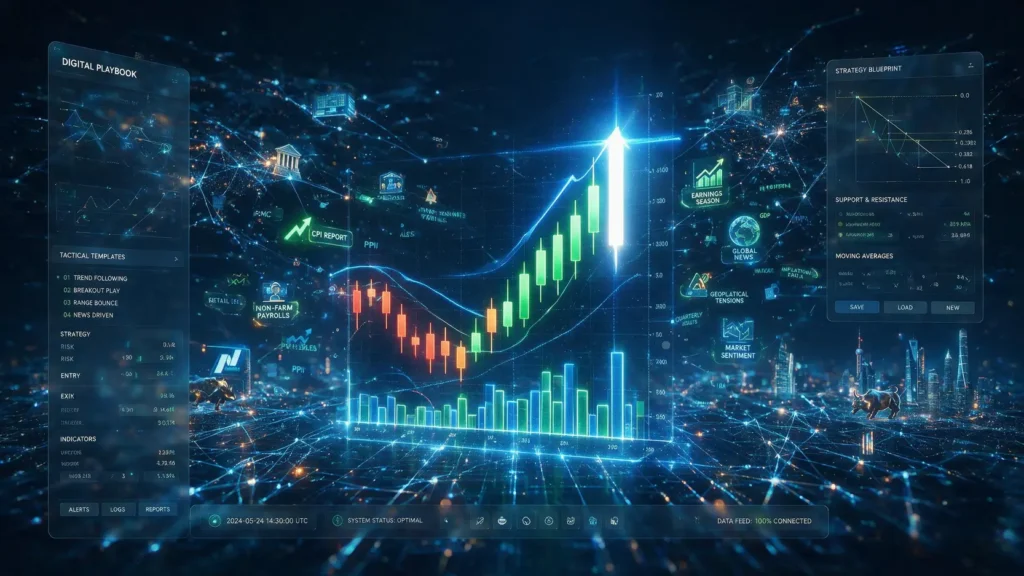
Volatility during the release of the Consumer Price Index (CPI) and corporate earnings reports can be a double-edged sword for traders. Without a clear plan, these periods of intense market movement can lead to significant losses. However, for the prepared trader, they offer immense opportunity. This guide provides a comprehensive CFD news trading playbook, designed to turn market-moving data into structured, actionable trades. We will explore everything from a core strategy for earnings releases to navigating the turbulence of a strategy for CPI data, focusing on disciplined execution and robust risk management.
Table of Contents
Foundations: What is News Trading and Why Use CFDs?
News trading is a strategy that involves taking positions in financial markets immediately before or after the release of significant economic data or corporate announcements. The goal is to profit from the resulting volatility. High-impact news events act as powerful catalysts, often causing sharp, short-term price swings. For CFD traders, these moments are prime opportunities, provided they are approached with a sound methodology.
Understanding the Market Impact of CPI and Earnings Reports
Economic indicators and company performance reports are the lifeblood of market sentiment. Two of the most potent are:
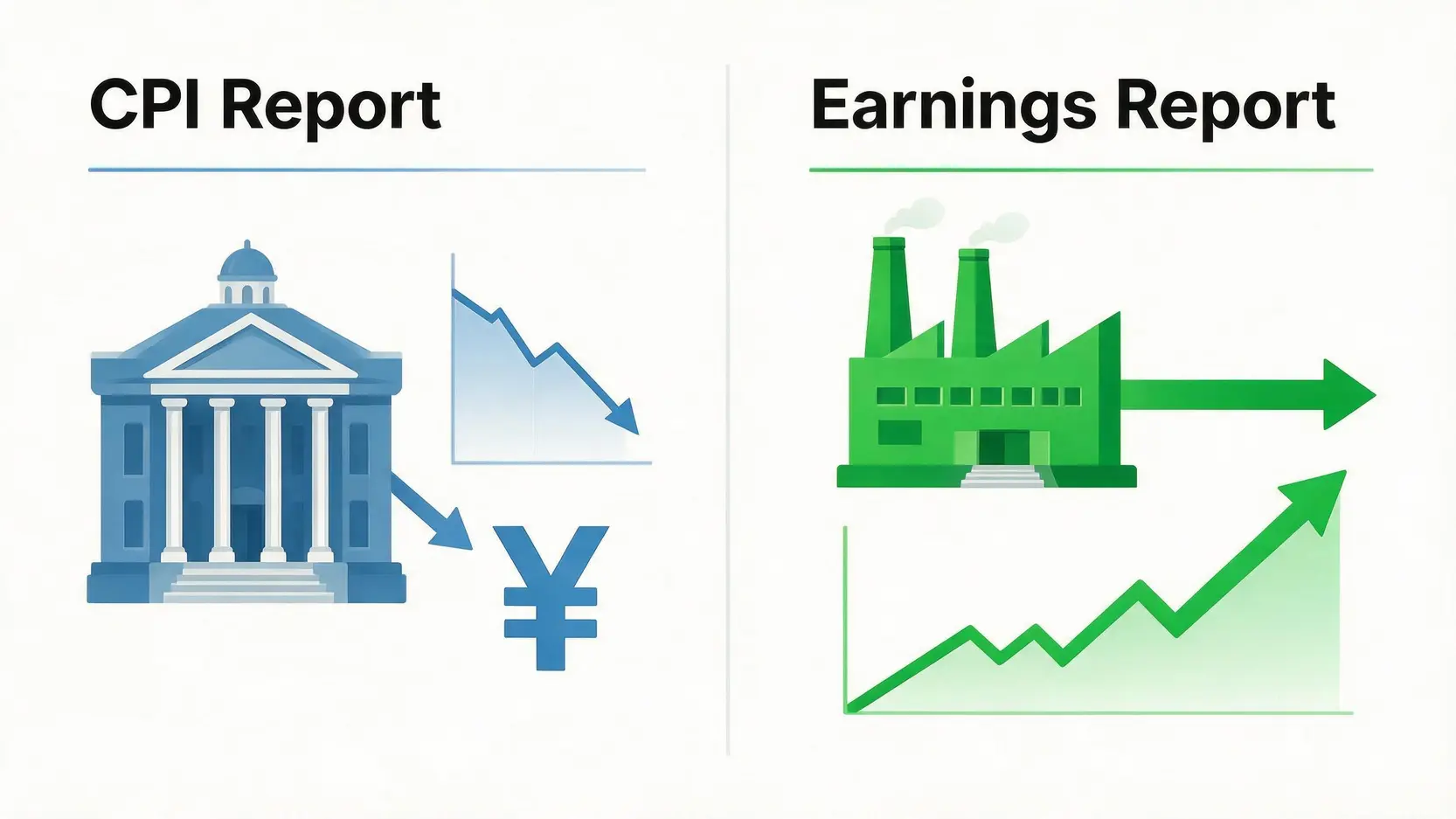
- Consumer Price Index (CPI): As a primary measure of inflation, the CPI tracks the average change in prices paid by urban consumers for a basket of goods and services. A higher-than-expected CPI suggests rising inflation, which may prompt central banks to raise interest rates, typically strengthening the currency and impacting stock indices. A lower reading can have the opposite effect.
- Corporate Earnings Reports: Publicly traded companies are required to report their financial performance quarterly. These reports provide a detailed look at a company’s profitability, revenue, and future outlook (guidance). A company that beats earnings and revenue expectations will often see its stock price surge, while a miss can lead to a sharp decline.
Other critical events for a CFD news trading strategy include Non-Farm Payrolls (NFP), central bank interest rate decisions (like those from the FOMC), and GDP announcements.
The Strategic Advantages of CFDs for News Trading (Leverage, Short-Selling, and Access)
Contracts for Difference (CFDs) are particularly well-suited for news trading for several key reasons:
- Leverage: CFDs allow you to control a large position with a relatively small amount of capital. This amplifies both potential profits and losses, making it a powerful tool for capturing even small price movements during news events.
- Short-Selling: News can be negative just as often as it is positive. CFDs make it seamless to go short (sell) if you anticipate that an earnings miss or poor economic data will drive prices down. This flexibility is crucial for a bi-directional news trading approach.
- Broad Market Access: A single CFD platform can provide access to thousands of markets, including stock indices, individual stocks, forex pairs, and commodities. This allows traders to execute a strategy on the most relevant asset, whether it’s the US100 index following a CPI report or Apple (AAPL) stock after its earnings release.
Core Strategies for Trading High-Impact News
Reacting to news without a plan is gambling. A successful CFD news trading strategy for earnings and CPI requires a predefined set of rules. Here are two core approaches.
The Breakout Strategy: How to Capture Initial Momentum
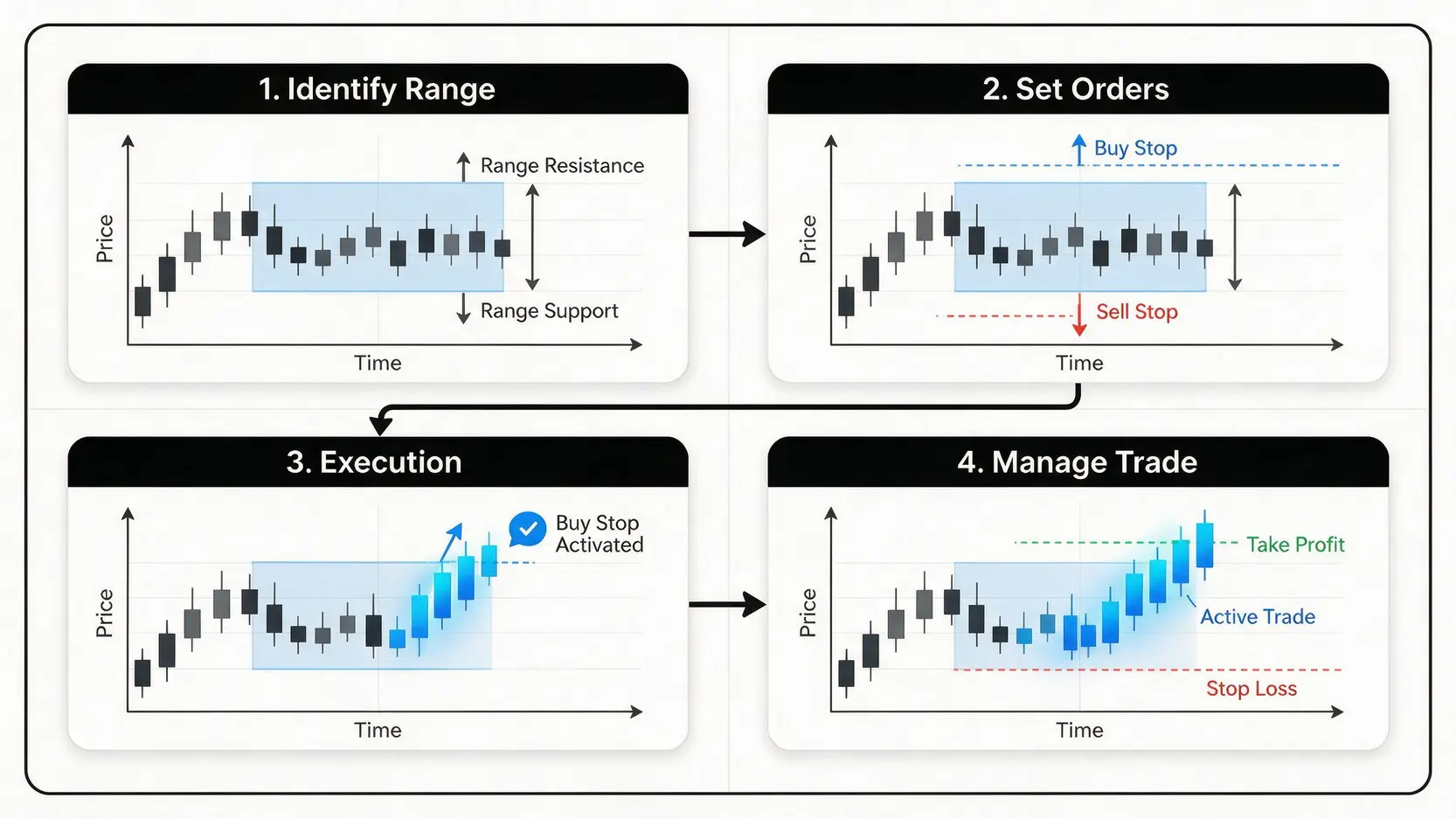
The breakout strategy is designed to capture the powerful, directional move that often follows a significant data surprise. The setup is straightforward:
- Identify Pre-Release Range: In the 15-30 minutes before the news release, the market often consolidates into a tight trading range. Identify the high (resistance) and low (support) of this range.
- Set Entry Orders: Place a buy-stop order a few pips above the range’s resistance and a sell-stop order a few pips below the range’s support.
- Execution: When the news is released, the price will ideally break out of the range in one direction, triggering one of your orders. The other order is then cancelled.
- Manage the Trade: A stop-loss should be placed on the other side of the consolidation range. A take-profit can be set based on a risk-reward ratio of 1.5:1 or 2:1, or by using a trailing stop to lock in profits as the trade moves in your favor.
The Volatility Straddle: Profiting from the Move, Regardless of Direction
Sometimes, you are certain an event will cause volatility, but the direction is unclear. This is where the straddle (or strangle) comes in. This strategy uses options or CFDs to profit from a large price swing in either direction.
The logic is similar to the breakout, involving placing both a buy and a sell order. However, the key difference lies in the expectation that volatility itself is the profit source. The potential profit is the magnitude of the price move minus the spread paid on both potential positions. This strategy is more advanced and requires careful calculation of potential costs versus the expected price jump.
The Pre- and Post-Release Playbook
A gap in many traders’ approach is the lack of a structured routine. Success in a CFD news trading environment is built on preparation before the event and disciplined management after.
Pre-Release Checklist: Analyzing Forecasts and Setting Up Your Trade
✅ Know the Schedule: Use a reliable economic calendar. Know the exact time of the release (e.g., CPI at 8:30 AM EST).
✅ Understand the Forecast: What is the consensus forecast? What was the previous number? The market’s reaction is based on the *surprise*—the difference between the actual number and the forecast.
✅ Define Your Market: Which asset will be most affected? For US CPI, this is often the US Dollar (e.g., EUR/USD), major US indices (e.g., US100, SPX500), and Gold.
✅ Set Price Levels: Based on the pre-release consolidation, mark your support and resistance levels clearly on your chart.
✅ Calculate Position Size: Determine your position size based on your account size and the distance to your stop-loss. Never risk more than 1-2% of your capital on a single trade.
✅ Prepare Your Orders: Input your entry and stop-loss orders in the platform ahead of time to avoid last-second fumbling.
Execution Example 1: Trading a CPI Release with an Index CFD (e.g., US100)
- Scenario: US CPI data release. Forecast is +0.3% MoM. The actual number comes in at +0.6%.
- Market Impact: This is a significant inflationary surprise. The market now expects a more aggressive Federal Reserve. This is typically negative for tech stocks, which are sensitive to higher interest rates.
- Trade: Your pre-placed sell-stop order below the consolidation range on the US100 CFD is triggered.
- Management: The US100 falls 150 points. Your stop-loss was placed at the top of the range. You might use a trailing stop to follow the price down or have a pre-set take-profit at a 2:1 risk-reward ratio.
Execution Example 2: Trading a Company’s Earnings with a Stock CFD (e.g., AAPL)
- Scenario: Apple (AAPL) is reporting earnings after market close. The consensus EPS forecast is $1.50. Apple reports an EPS of $1.75 and provides a strong forecast for the next quarter.
- Market Impact: This is a strong beat. Demand for the stock is expected to surge in after-hours and pre-market trading.
- Trade: Using a breakout strategy, your buy-stop order placed above the pre-earnings resistance level is triggered as the price gaps up.
- Management: The position is now long on AAPL CFDs. A stop-loss is placed below the breakout level. Given the strong positive surprise, you hold the position to capture the opening momentum of the next trading day, eventually closing it for a significant profit.
Essential Risk Management for News-Driven Volatility
Trading high-impact news without mastering risk is a recipe for disaster. The volatility that creates opportunity also creates extreme risk. A robust CFD trading risk management plan is non-negotiable.
Setting Smart Stop-Losses to Survive the Spikes
During news releases, prices can experience violent, erratic swings or “spikes.” A stop-loss placed too close to the current price is likely to be triggered by this noise before the true directional move begins. It is often wise to place your stop-loss on the other side of the entire pre-release consolidation range, giving the trade room to breathe. Always use a hard stop-loss; mental stops are unreliable in fast-moving markets.
Managing Slippage and Spreads During High-Impact Events
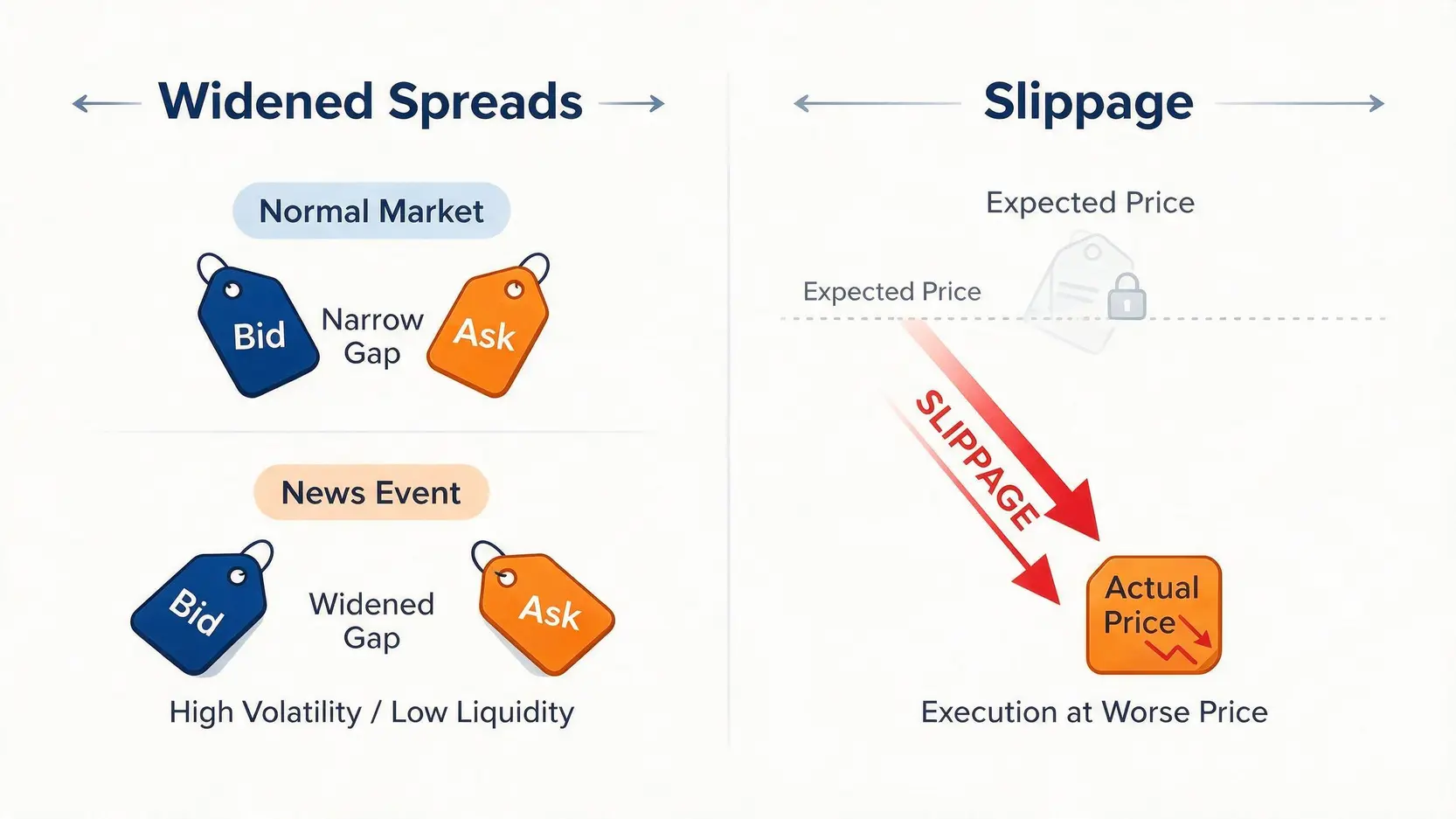
Two unavoidable realities of news trading are slippage and spread widening.
- Spreads: Liquidity thins out moments before and after a news release, causing brokers to widen the bid-ask spread. This is a trading cost that must be factored into your strategy.
- Slippage: This occurs when your trade is executed at a different price than requested. During extreme volatility, a market order can be filled at a substantially worse price. While unavoidable, it can be partially managed by using limit orders where possible, though this carries the risk of the order not being filled at all if the price moves too quickly. Acknowledging the potential for slippage is a key part of a realistic trading plan.
Conclusion
Mastering a CFD news trading strategy for earnings and CPI requires far more than just reacting quickly to headlines. As we’ve detailed in this playbook, success is built on a foundation of rigorous preparation, a clearly defined strategic approach like the breakout or straddle, and, most importantly, disciplined risk management. By analyzing forecasts, preparing trades in advance, and understanding how to manage the inherent volatility, you can approach these market-moving events with the confidence and structure needed to transform risk into calculated opportunity.
Frequently Asked Questions (FAQ)
Q: Is it profitable to trade the news?
A: Yes, it can be highly profitable, but it is also one of the riskiest forms of trading. Profitability depends entirely on having a well-tested strategy, excellent risk management, and the discipline to follow your plan. Without these, traders are more likely to experience significant losses due to the extreme volatility.
Q: What are the biggest risks when trading CPI or earnings reports?
A: The three primary risks are: 1) Volatility Spikes: Sudden, erratic price moves that can trigger stop-losses prematurely. 2) Slippage: Your order executing at a much worse price than anticipated due to low liquidity. 3) Widened Spreads: The cost of entry and exit increases significantly, eating into potential profits. These risks make a robust strategy for earnings and a disciplined strategy for CPI absolutely essential.
Q: Which CFD broker is best for news trading?
A: The ideal broker for news trading offers a combination of fast execution speeds, low spreads on major indices and forex pairs, and a stable platform that doesn’t freeze during high-volatility events. Look for brokers with a strong regulatory track record and transparent pricing, and consider testing their platform with a demo account during a live news event.
Q: What other news events are important for CFD traders?
A: Beyond CPI and earnings, traders should closely watch Non-Farm Payrolls (NFP), central bank meetings (e.g., FOMC, ECB), retail sales data, GDP figures, and Purchasing Managers’ Index (PMI) reports. Each of these has the potential to cause significant, tradable market movements across different asset classes.