
The landscape for India government bond yields in 2026 is proving to be a complex tapestry woven from domestic policy decisions and global economic crosscurrents. As investors navigate this environment, understanding the nuances of yield movements is paramount. The benchmark 10-year bond yield, a critical barometer for the nation’s economic health, has been shaped by a vigilant Reserve Bank of India (RBI) and a significant influx of foreign capital. This article provides a comprehensive analysis of the prevailing trends, the key drivers influencing the Indian bond market analysis, and actionable forecasts to inform your investment strategy for the remainder of the year.
Table of Contents
The State of India Government Bond Yields in 2026
As of mid-2026, the Indian bond market is characterized by a delicate equilibrium. Yields have stabilized after a period of volatility, reflecting a market that has priced in the central bank’s measured approach to monetary policy and the government’s commitment to fiscal consolidation. However, underlying currents, both domestic and international, continue to create subtle but significant shifts across the yield curve.
Analysis of the 10-Year Benchmark Yield Performance
The bellwether 10-year India government bond yield is currently hovering around the 6.95% to 7.05% range. This level represents a modest easing from the tighter conditions seen in previous years, which were dominated by post-pandemic inflationary pressures and aggressive global monetary tightening. The current yield reflects a market cautiously optimistic about India’s growth trajectory but remaining wary of persistent inflation risks. Trading volumes have been robust, supported by increased participation from foreign portfolio investors (FPIs) following India’s inclusion in major global bond indices.
Historical Context: How 2026 Yields Compare to Past Years
To put the current yields into perspective, it’s essential to look back. The 2023-2024 period was marked by rising yields as the RBI hiked the repo rate to combat inflation. In contrast, 2026 has been a year of policy recalibration. The central bank has paused its rate-hiking cycle, allowing yields to find a more stable footing. The table below provides a snapshot of the historical 10-year yield movement:
| Period | Average 10-Year Yield Range | Key Market Theme |
|---|---|---|
| Mid-2026 | 6.95% – 7.05% | RBI Policy Pause, FPI Inflows |
| FY 2025 | 7.10% – 7.25% | Inflation Moderation |
| FY 2024 | 7.20% – 7.40% | Aggressive Rate Hikes |
Performance Across Other Maturities (e.g., 15, 30-Year Bonds)
The yield curve in 2026 has remained relatively steep, indicating positive expectations for long-term economic growth. Longer-tenor bonds, such as the 15-year and 30-year securities, are yielding approximately 7.20% and 7.35%, respectively. This spread over the 10-year bond provides a premium for investors willing to take on longer duration risk. The demand for these longer-dated papers has been steady, particularly from domestic insurance companies and pension funds seeking to match their long-term liabilities.
Key Drivers Shaping Indian Bond Yields Outlook in 2026
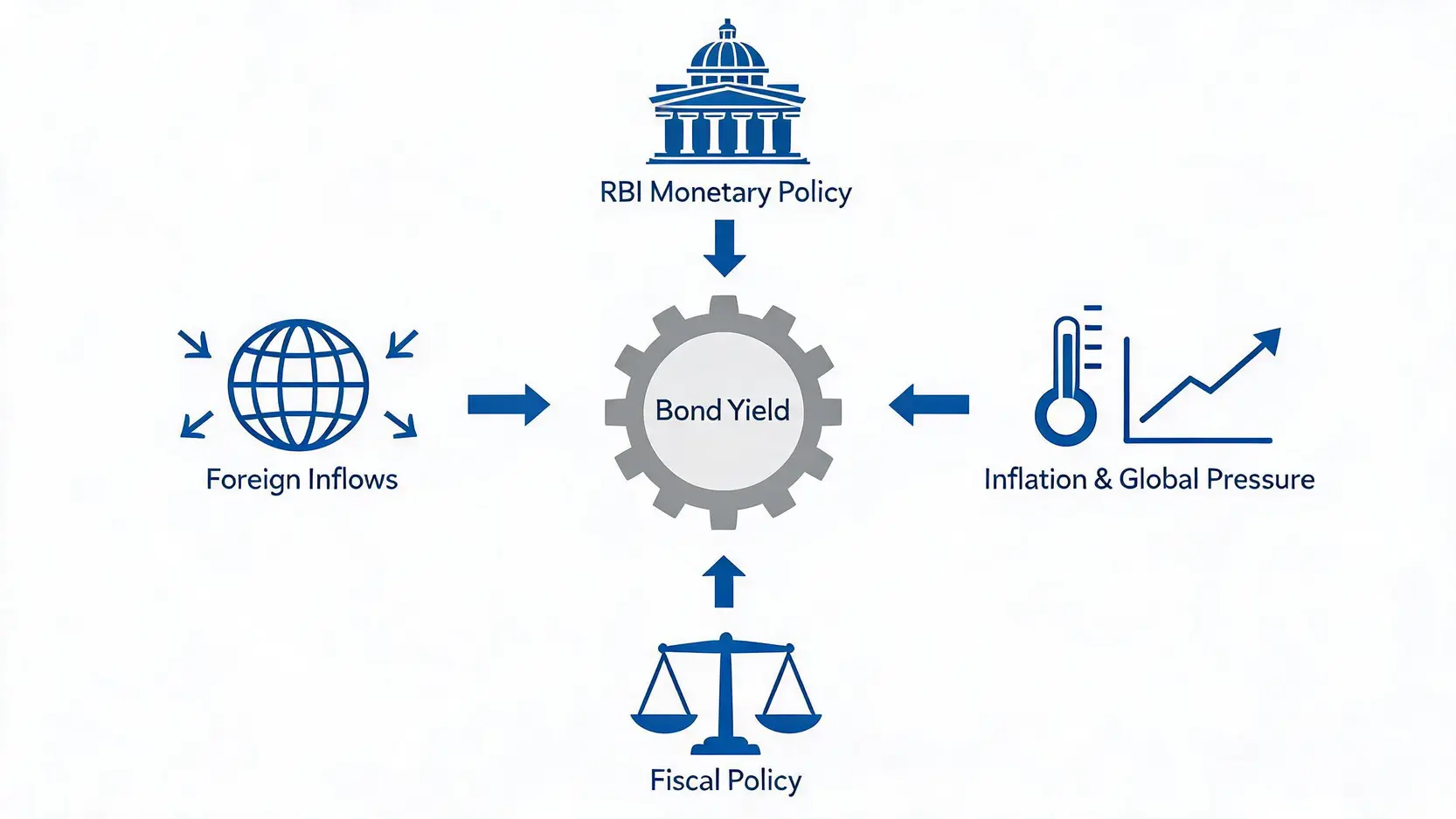
Several interconnected factors are steering the direction of India government bond yields. A granular understanding of these drivers is crucial for any bond investment forecasts in 2026. These forces range from the RBI’s policy maneuvers to the vast flows of international capital.
Impact of the Reserve Bank of India’s (RBI) Monetary Policy
The RBI remains the single most influential driver of bond yields. In its recent policy reviews, the Monetary Policy Committee (MPC) has opted to keep the benchmark repo rate unchanged at 5.25%, maintaining a stance of “withdrawal of accommodation.” This signals that while the aggressive tightening cycle is over, the central bank is not yet ready to pivot towards rate cuts. The RBI’s primary focus remains on guiding inflation back to its 4% target. Any future guidance on liquidity or shifts in this stance will be a primary catalyst for yield movements. The market now anticipates a prolonged pause, with potential rate cuts only being considered in late 2026 or early 2027, contingent on inflation data.
The Role of Government Budget and Fiscal Policies
The government’s fiscal policy and borrowing calendar are fundamental to the supply-demand dynamics of the bond market. For the fiscal year 2026-27, the government has projected a narrower fiscal deficit, indicating a commitment to fiscal prudence. This has been a source of comfort for the market, as a lower borrowing requirement reduces the supply pressure on government securities, thereby helping to keep yields in check. Any deviation from this fiscal consolidation path would be a significant risk factor, potentially pushing yields higher.
Foreign Investment Inflows and Regulatory Changes
The year 2026 is a landmark for the Indian bond market due to its inclusion in major global bond indices, such as the J.P. Morgan GBI-EM. This has unlocked a torrent of passive investment from foreign investors. These FPI inflows have been a powerful force, creating sustained demand for Indian government bonds and acting as a structural tailwind to bring yields down. This phenomenon, as explored in detailed studies on the impact of foreign investors on government bond markets, fundamentally alters market dynamics. The increased foreign participation has not only supported bond prices but also enhanced market liquidity and depth. Investors must monitor FPI activity closely, as it has become a dominant variable in the yield equation.
Inflation Trends and Global Economic Pressures
Domestic inflation remains a key concern. While the Consumer Price Index (CPI) has moderated from its peaks, it continues to hover above the RBI’s 4% target, driven by food price volatility and sticky core inflation. Bond yields are highly sensitive to inflation expectations; a sustained rise in CPI would force the RBI to maintain its hawkish stance, putting upward pressure on yields. 📈 On the global front, the actions of central banks like the U.S. Federal Reserve are highly influential. A higher-for-longer interest rate environment in developed markets makes their bonds more attractive, potentially slowing capital flows to emerging markets like India.
Investor and Economic Impact of 2026 Yields on Your Portfolio
The trajectory of India government bond yields 2026 is not just an abstract economic indicator; it has tangible consequences for investment portfolios, corporate strategy, and the broader economy. Understanding these linkages is vital for effective financial planning.
What Fluctuating Yields Mean for Your Investment Portfolio
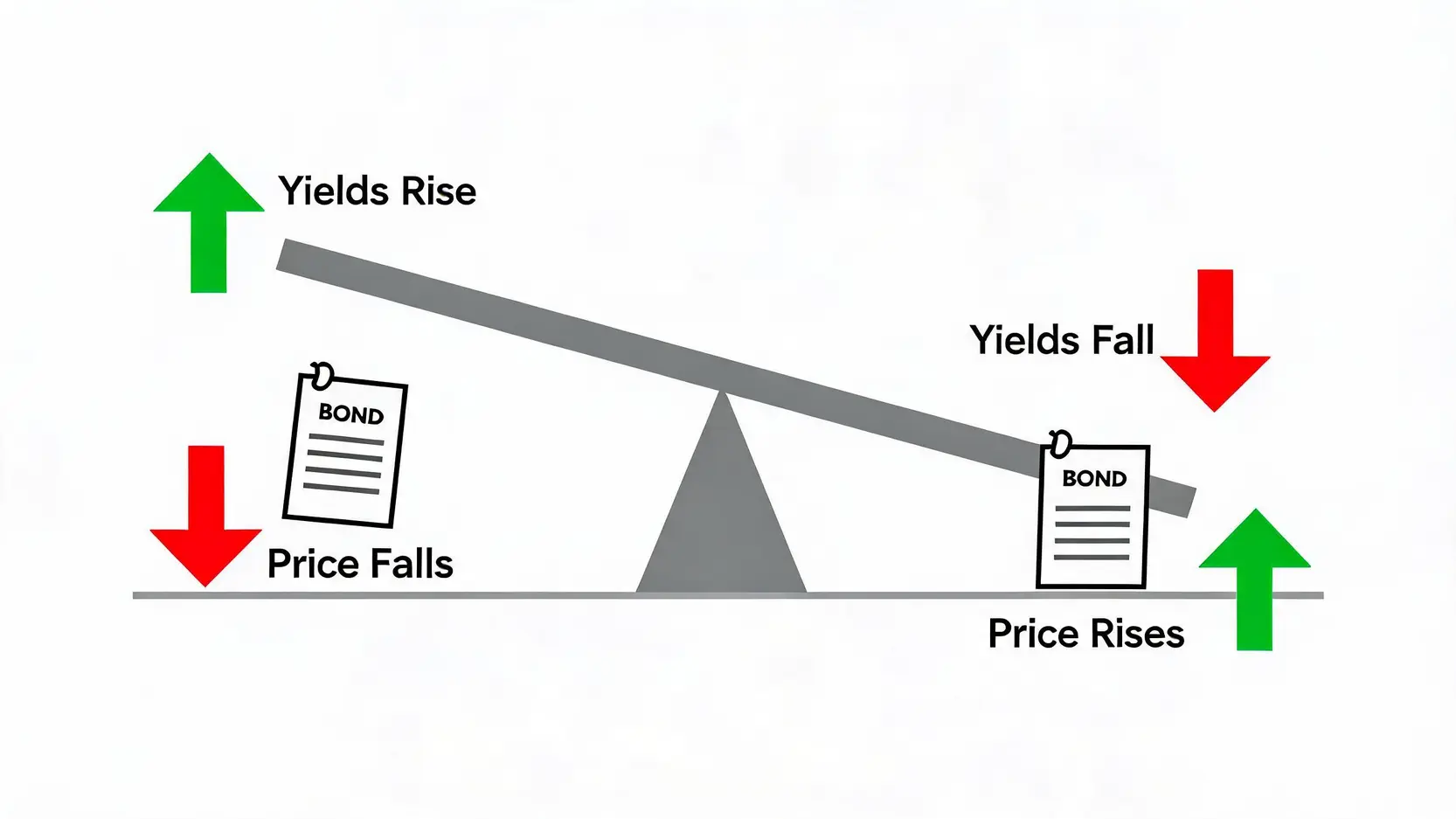
For fixed-income investors, the relationship between bond prices and yields is inverse. When yields rise, the prices of existing bonds fall, and vice-versa. In the current environment of stable-to-falling yields, investors who held bonds from the higher-yield era of 2024 are seeing capital appreciation. For those entering the market now, the ~7% yield on a 10-year sovereign bond offers a compelling real return, especially if inflation continues to trend downwards. It represents a relatively safe and attractive yield in a world of geopolitical uncertainty.
The Link Between Bond Yields, Lending Rates, and Economic Growth
Government bond yields serve as the benchmark for the entire credit market. Corporate borrowing costs are typically priced as a spread over the corresponding government security yield. Therefore, stable or lower G-sec yields translate into cheaper capital for companies, encouraging investment, expansion, and job creation. Similarly, retail lending rates for products like home and auto loans are also influenced by these yields. A stable yield environment fosters a more predictable and supportive lending landscape, which is a crucial ingredient for robust economic growth. Investors should be keen on understanding economic indicators to make informed decisions.
Strategies for Investors in the Current Yield Environment
Given the current market dynamics, investors should consider a few key strategies:
- Duration Management: For investors with a moderate risk appetite, a “barbell” strategy could be effective. This involves allocating capital to both short-duration bonds (to mitigate interest rate risk) and long-duration bonds (to capture higher yields).
- Focus on Real Yields: The key is not the nominal yield but the real yield (nominal yield minus inflation). With inflation projected to ease, the real return on Indian government bonds is becoming increasingly attractive.
- Diversification: While government bonds are a safe anchor, diversifying into high-quality corporate bonds and state development loans (SDLs) can offer a yield pick-up without a significant increase in credit risk.
For those looking to refine their approach, exploring various bond investment strategies is a logical next step to optimize portfolio returns in a changing rate environment.
Conclusion
The narrative for India government bond yields in 2026 is one of cautious stability, underpinned by strong structural demand from foreign investors and a prudent domestic policy framework. Yields are likely to remain range-bound for the near term, with the 10-year benchmark consolidating around the 7% mark. The dominant drivers to monitor are the RBI’s evolving monetary policy stance, the trajectory of domestic inflation, and the persistence of FPI inflows. While global economic uncertainties pose a risk, the Indian bond market’s robust fundamentals position it as a compelling destination for fixed-income investors seeking a blend of safety and attractive real returns.
Frequently Asked Questions (FAQ)
Q: What is the current 10-year government bond yield in India for 2026?
A: As of June 2026, the benchmark 10-year India government bond yield is trading in a range of approximately 6.95% to 7.05%. This level is influenced by the Reserve Bank of India’s decision to pause interest rate hikes and strong demand from foreign portfolio investors.
Q: How does inflation directly affect India’s bond yields?
A: Inflation has a direct and significant impact on bond yields. When inflation rises, investors demand a higher yield to compensate for the decreased purchasing power of their future returns. Furthermore, high inflation typically prompts the central bank (RBI) to raise interest rates to cool down the economy, which pushes bond yields higher. Conversely, falling inflation allows for lower interest rates and typically leads to lower bond yields.
Q: Is it a good time to invest in Indian government bonds in 2026?
A: 2026 presents a potentially favorable environment for investing in Indian government bonds. Yields are at attractive levels, offering a positive real return over expected inflation. The structural demand from global index inclusion provides a strong support for bond prices. However, investors should remain mindful of risks, including potential inflation spikes and shifts in global monetary policy, and consider their own investment horizon and risk tolerance.
Q: What role do foreign investors play in the Indian bond market?
A: Foreign Portfolio Investors (FPIs) have become pivotal players in the Indian bond market, especially in 2026. India’s inclusion in global bond indices has led to substantial and sustained inflows from these investors. This influx of capital increases demand for government securities, which helps to suppress yields (and increase bond prices). Their participation also enhances market liquidity and brings India’s bond market into greater alignment with global standards.