With central banks navigating a complex macroeconomic landscape in 2026, bond yields are rising, prompting a critical question for every investor’s portfolio: is this a golden opportunity or a financial trap? The answer isn’t simple. Understanding if bonds are a good investment right now requires a deep dive into the mechanics of fixed-income markets. This guide provides a definitive analysis of the inverse relationship between bond prices and yields, breaking down the impact on your portfolio and outlining strategic approaches for navigating this high-yield environment.
Table of Contents
Understanding the Core Concept: Bond Prices vs. Yields
The fundamental principle of bond investing is the inverse relationship between price and yield. When one goes up, the other goes down. This concept is non-negotiable and governs the entire fixed-income market. For investors to truly grasp the opportunities and risks in a rising rate environment, they must first master this dynamic.
The Seesaw Effect: Why Bond Prices Fall When Yields Rise
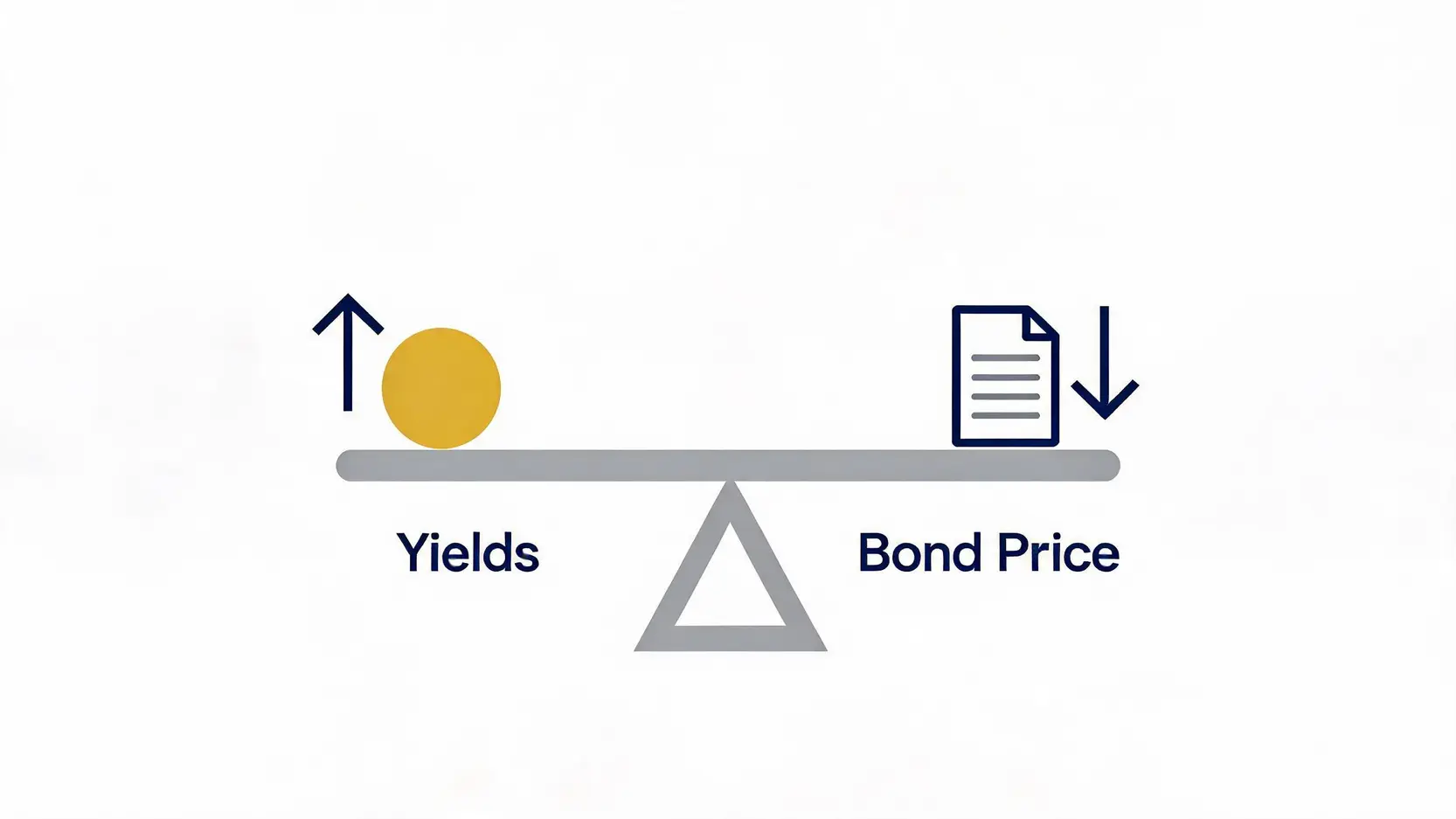
Think of the relationship between bond prices and yields as a seesaw. When interest rates in the broader economy rise, newly issued bonds come to market with more attractive coupon rates (higher yields) to compete for capital. Consequently, older bonds with lower fixed coupon rates become less desirable. To attract a buyer, the price of these existing, lower-yielding bonds must decrease. This price drop compensates the new buyer for the lower coupon payments, effectively increasing the bond’s yield-to-maturity to match the current market rate. As Investopedia explains, this adjustment ensures that an old bond’s yield is competitive with new bonds. This is the core reason why rising yields lead to falling prices for existing bonds.
The Key Difference: New High-Yield Bonds vs. Existing Low-Yield Bonds
The distinction between investing new capital and holding an existing bond portfolio is critical.
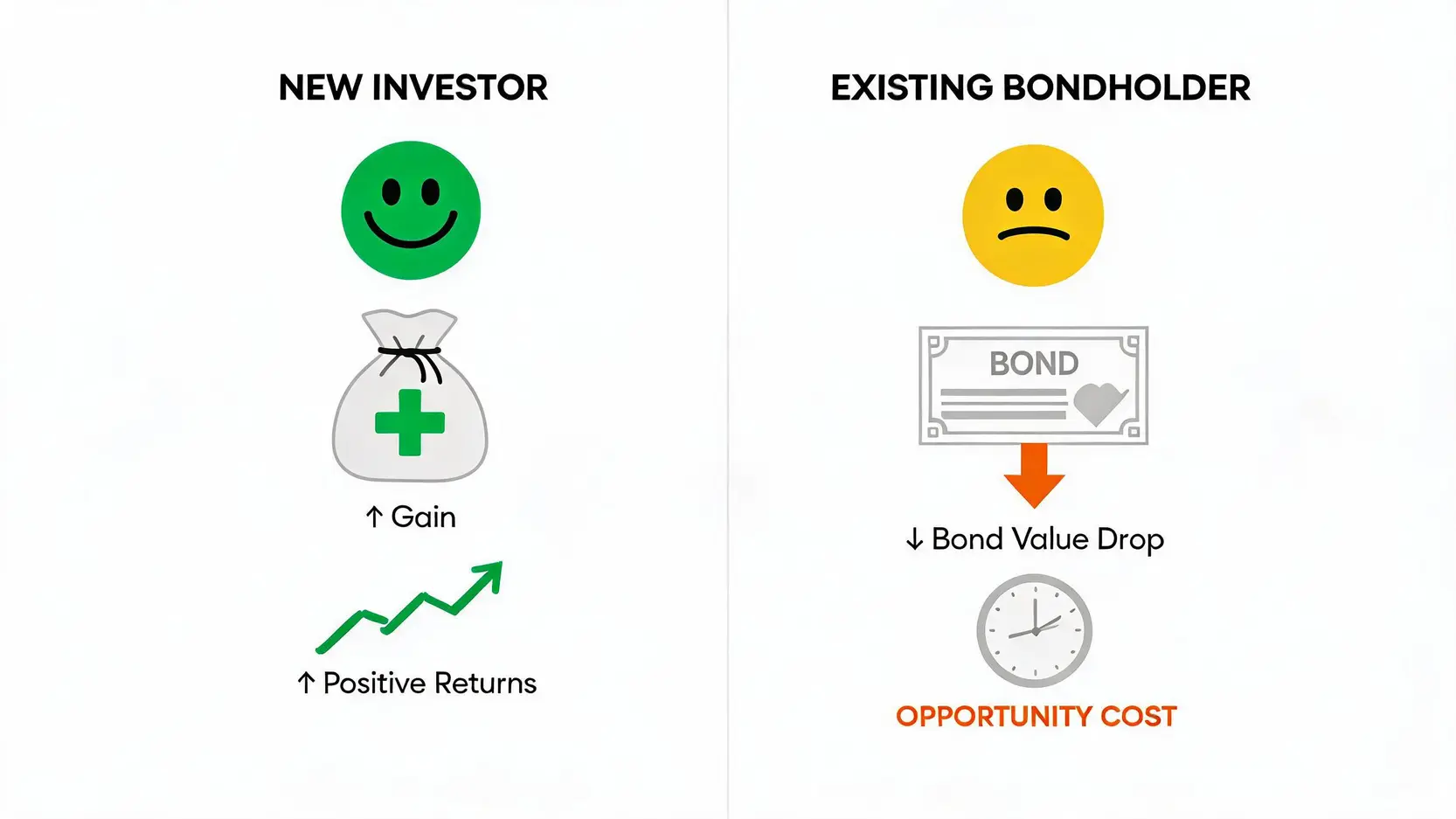
- For New Capital: A rising yield environment is unequivocally positive. Investors can purchase new bonds or bond ETFs that pay a higher rate of interest, locking in a more substantial income stream for years to come. The initial investment provides a better return than it would have just months prior.
- For Existing Bonds: An investor holding a portfolio of bonds purchased when rates were lower faces a challenge. The market value, or the price they could sell their bonds for, has decreased. This creates a paper loss. However, this loss is only realized if the bond is sold before maturity. If held to maturity, the investor will still receive the full principal back along with all promised coupon payments. The opportunity cost is the primary concern here—the capital is locked into a lower-yielding asset compared to what’s currently available.
The Two Sides of the Coin: Who Wins and Loses When Yields Rise?
A rising yield environment creates a clear divergence in outcomes for different types of investors. What is a headwind for one is a tailwind for another. Understanding your position in this market is the first step toward making strategic decisions rather than reactive ones. The impact of rising rates on bond portfolios is not uniform; it depends entirely on your timeline and whether you are deploying new cash or managing an existing portfolio.
The Opportunity: Why It’s a Good Time for New Investors
For individuals with fresh capital to deploy—whether they are new to investing, reallocating from other assets, or simply have cash on the sidelines—rising yields are a clear-cut opportunity. The primary advantage is the ability to lock in higher income streams. A 10-year government bond yielding 4.5% is fundamentally more attractive than the same bond yielding 2.5% a year earlier. This improved return profile enhances the role of bonds as a stable, income-generating component of a diversified portfolio. Furthermore, for those who believe interest rates may eventually fall, buying bonds at a discount (below face value) offers the potential for capital appreciation in the future. As a foundational part of any portfolio, learning about Investment Strategies, Trading Guides & Market Insights can provide the necessary context for making these allocations.
The Challenge: The Impact on Existing Bondholders and Bond Funds
Conversely, investors who already own a significant portfolio of bonds or bond funds face a more challenging scenario. The market value of their holdings has likely declined. This is particularly pronounced in bond funds and ETFs, which must mark their portfolios to market daily. An investor looking at their statement will see a negative return, which can be unsettling. The key is to understand the concept of ‘duration’—a measure of a bond’s sensitivity to interest rate changes. Longer-duration bonds and funds experience more significant price drops when rates rise. Selling in this environment would lock in those losses. Therefore, the strategic imperative for existing bondholders is to manage duration risk and assess whether their current holdings align with their long-term objectives, rather than panic-selling based on short-term price fluctuations.
Strategic Approaches to Bond Investing in a High-Yield Market
Navigating a market with rising bond yields requires more than a simple buy-and-hold mentality. It demands a proactive and strategic approach to mitigate risks while capitalizing on the opportunities presented by higher income levels. For sophisticated investors, this is a time to refine their fixed-income allocation, not abandon it. Here are three effective strategies for bond investing in the current high-yield landscape of 2026.
Strategy 1: Focus on Short-Duration Bonds to Minimize Risk
One of the most effective ways to mitigate interest rate risk is to shorten the duration of your bond portfolio. Short-duration bonds (typically with maturities of 1-3 years) are far less sensitive to changes in interest rates than their long-duration counterparts. While they may offer slightly lower yields, their prices will not fall as dramatically if rates continue to climb. This strategy provides a defensive posture, allowing an investor to still earn a competitive yield without exposing their principal to significant volatility. Investing through short-duration bond ETFs can be an efficient way to implement this, offering diversification and liquidity. The goal is to preserve capital while waiting for rates to stabilize before considering extending duration again.
Strategy 2: Implement a Bond Ladder for Steady Income
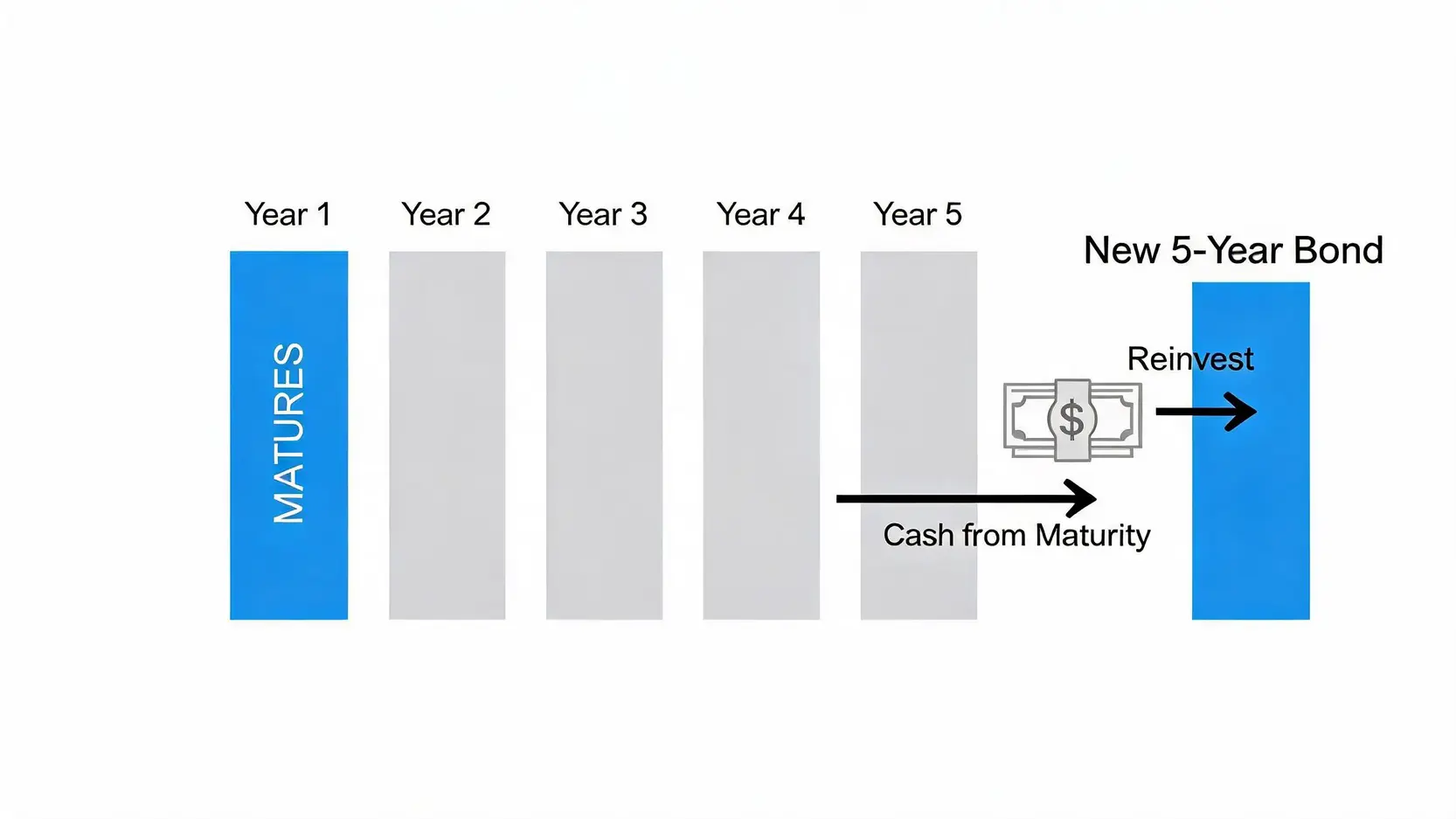
A bond ladder is a time-tested strategy that involves building a portfolio of individual bonds with staggered maturity dates. For example, instead of investing $50,000 into a single 5-year bond, you would invest $10,000 each into bonds maturing in 1, 2, 3, 4, and 5 years. As each bond matures, the principal is returned and can be reinvested at the front end of the ladder (e.g., into a new 5-year bond) at current, presumably higher, interest rates. This approach provides several key benefits:
- Reduces Reinvestment Risk: You aren’t forced to reinvest your entire portfolio at one specific point in the rate cycle.
- Improves Liquidity: A portion of your capital is maturing each year, providing predictable cash flow.
- Averages Out Interest Rates: Over time, your portfolio’s yield will adjust to the prevailing interest rate environment, smoothing out returns.
This disciplined method helps investors systematically take advantage of rising rates without trying to time the market perfectly.
Strategy 3: Consider TIPS and Floating-Rate Bonds
When yields rise due to inflation fears, certain types of bonds are specifically designed to protect investors. Treasury Inflation-Protected Securities (TIPS) are government bonds whose principal value adjusts upward with the Consumer Price Index (CPI). This means that both the principal you get back at maturity and the value of your coupon payments increase with inflation, offering a direct hedge. You can learn more about how they work in our guide to the Best ETFs for Inflation 2026. Another option is floating-rate bonds. The interest payments on these bonds are not fixed but reset periodically based on a benchmark rate, such as SOFR. As interest rates rise, the coupon payments on these bonds also increase, protecting investors’ income streams from being eroded by the rising rate environment. Both are powerful tools for a portfolio focused on real returns.
Conclusion
In conclusion, whether bonds are a good investment when yields rise depends entirely on your position and strategy. For investors deploying new capital, the current environment presents a prime opportunity to lock in higher, more attractive income streams that have been unavailable for years. The calculus is more complex for existing bondholders, who must weather the temporary decline in the market value of their holdings. However, this is a paper loss unless realized. By understanding the fundamental dynamics of bond prices versus yields and employing sophisticated tactics like shortening duration, building a bond ladder, or allocating to inflation-protected securities, investors can successfully navigate a rising yield environment. The key is to shift from a passive to an active mindset, viewing market changes not as threats, but as opportunities to optimize a portfolio for the long term.
Frequently Asked Questions (FAQ)
Q: What happens to my bond fund when interest rates go up?
A: When interest rates rise, the price of the existing bonds held within a bond fund or ETF will fall. This is because the fund’s older, lower-yielding bonds are now less attractive than newly issued bonds with higher yields. As a result, the fund’s Net Asset Value (NAV), or share price, will decrease, reflecting the lower market value of its holdings. However, the fund will also start buying newer, higher-yielding bonds, which will gradually increase the income (dividend) distributed to shareholders over time.
Q: Should I sell my old bonds to buy new, higher-yield bonds?
A: This is a complex decision that depends on your individual financial situation, including tax implications. Selling an old bond at a loss to buy a new, higher-yielding one is known as a “tax-loss swap” if done in a taxable account, which can be beneficial for offsetting capital gains. However, if you simply sell in a panic, you are realizing a permanent loss. If you don’t need the capital immediately and the bond still fits your portfolio’s goals, holding it to maturity will ensure you receive your full principal back, regardless of interest rate fluctuations.
Q: How do rising yields affect my overall investment portfolio?
A: Rising yields have a multifaceted impact. In the short term, the bond portion of your portfolio will likely see a decrease in value. However, rising yields can also signal a strong economy, which may be positive for the stock (equity) portion of your portfolio. Over the long term, higher yields mean that the expected future returns from the bond portion of your portfolio have increased. A diversified portfolio is designed to handle these cycles, with different asset classes performing well in different economic environments.
Q: Are all bonds affected equally by rising rates?
A: No. The primary factor determining a bond’s sensitivity to interest rate changes is its duration. Bonds with longer durations (i.e., longer maturities) will experience much larger price drops when rates rise compared to bonds with shorter durations. Therefore, a 30-year Treasury bond will be far more volatile than a 2-year Treasury note. This is why a common strategy in a rising-rate environment is to shift toward short-duration bonds to minimize this price risk.
Q: Is it better to own individual bonds or bond funds when rates are rising?
A: Both have pros and cons. Individual bonds offer the certainty of holding to maturity, meaning you are guaranteed to get your principal back if the issuer doesn’t default, which insulates you from price volatility if you don’t plan to sell. Bond funds offer diversification and liquidity but do not have a maturity date, so their value will fluctuate with interest rates, and you are never “guaranteed” to get your initial investment back. In a rising rate environment, the hold-to-maturity feature of individual bonds can be particularly appealing for risk-averse investors, while bond funds offer simplicity and professional management.