Starting your investment journey with $1,000 is a powerful first step towards building wealth in 2026. Many people wonder about the best way to invest $1,000, and the good news is you have more powerful options than ever. This guide provides a clear roadmap for beginner-friendly investment options, moving from safe, steady strategies to higher-growth opportunities. Making a smart, informed decision with your first $1,000 is the launchpad for a more secure financial future, and this is the perfect place to start.
Table of Contents
Before You Invest: 3 Crucial First Steps
Jumping into the market without a plan is like sailing without a compass. Before you allocate a single dollar, it’s critical to establish a solid foundation. These three steps are non-negotiable for any new investor looking for the best way to invest their first $1,000.
Define Your Financial Goals (Short-term vs. Long-term)
Why are you investing? The answer dictates your entire strategy. Your goals determine your investment timeline, which in turn influences how much risk you can afford to take.
- 🏡 Short-term Goals (1-3 years): These might include saving for a down payment on a car, a vacation, or building an emergency fund. For these goals, capital preservation is key. You don’t want to risk your principal on volatile assets.
- 💰 Mid-term Goals (3-10 years): This could be for a down payment on a house, funding a small business, or saving for a wedding. Here, you can tolerate a bit more risk for potentially higher returns. A balanced approach of stocks and bonds might be suitable.
- 🌴 Long-term Goals (10+ years): Retirement is the classic example. With a long time horizon, you can weather market fluctuations and take on more risk for the highest potential growth. Equity-heavy portfolios are common for long-term objectives.
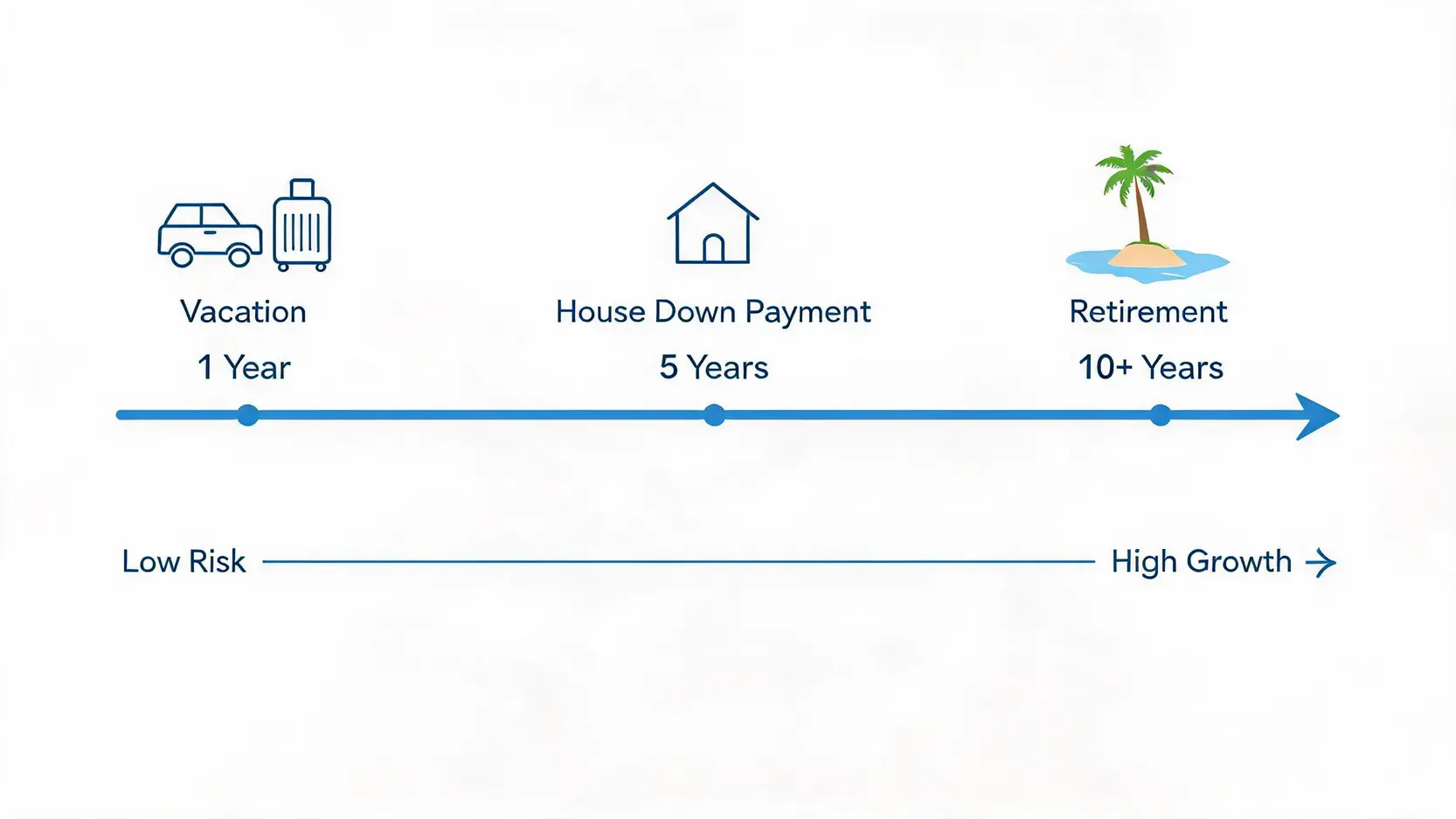
Write down your goals and assign a timeline to each. This simple act will bring immense clarity to your investment decisions.
Assess Your Personal Risk Tolerance
Risk tolerance is your emotional and financial ability to handle market downturns without panicking. It’s a combination of your personality, financial stability, age, and goals. Ask yourself honestly: how would you react if your $1,000 investment dropped to $700 overnight?
- Conservative: You prioritize protecting your principal over achieving high returns. You’re uncomfortable with market volatility.
- Moderate: You are willing to accept some risk to achieve higher returns but want a balanced portfolio to cushion against losses.
- Aggressive: You are comfortable with significant market swings and are willing to take on substantial risk for the chance of maximizing long-term growth.
Understanding this is crucial. An aggressive strategy might offer the best returns on paper, but if it causes you to sell in a panic during a dip, it’s the wrong strategy for you.
Why an Emergency Fund in a High-Yield Savings Account is Non-Negotiable
Before investing for growth, you must invest in your own security. An emergency fund is a pool of 3-6 months’ worth of essential living expenses kept in a liquid, easily accessible account. This is not your investment capital. Its purpose is to cover unexpected events—a job loss, medical bill, or urgent home repair—without forcing you to sell your investments at a loss.
A High-Yield Savings Account (HYSA) is the ideal home for this fund. They are FDIC-insured (up to $250,000), offer significantly better interest rates than traditional savings accounts, and allow you to access your money quickly. Think of it as the financial bedrock upon which your entire investment portfolio is built.
Top 5 Investment Vehicles for Your First $1,000
With your foundation in place, it’s time to explore the most effective investment tools for a beginner. Here are five of the best ways to put your $1,000 to work in 2026.
S&P 500 Index Funds & ETFs: The Gold Standard for Beginners
For new investors, an S&P 500 index fund or Exchange-Traded Fund (ETF) is often considered the gold standard. Instead of trying to pick individual winning stocks, you buy a single share that represents a small piece of the 500 largest publicly traded companies in the U.S. (like Apple, Microsoft, and Amazon).
- Instant Diversification: Your $1,000 is immediately spread across 500 companies, drastically reducing the risk associated with any single company failing.
- Low Cost: Index funds and ETFs are passively managed, meaning their management fees (expense ratios) are incredibly low (often below 0.10%).
- Proven Performance: Historically, the S&P 500 has delivered an average annual return of around 10% over the long term.
Popular examples include the Vanguard S&P 500 ETF (VOO) and the iShares CORE S&P 500 ETF (IVV). For a beginner, this is arguably the simplest and one of the most effective ways to start building wealth.
Roth IRA: For Tax-Free Future Growth
A Roth Individual Retirement Account (IRA) isn’t an investment itself, but a powerful type of investment account with a huge tax advantage. You contribute after-tax dollars, meaning you pay taxes on the money now. The magic happens later: your investments grow completely tax-free, and you pay zero taxes on withdrawals in retirement (after age 59½).
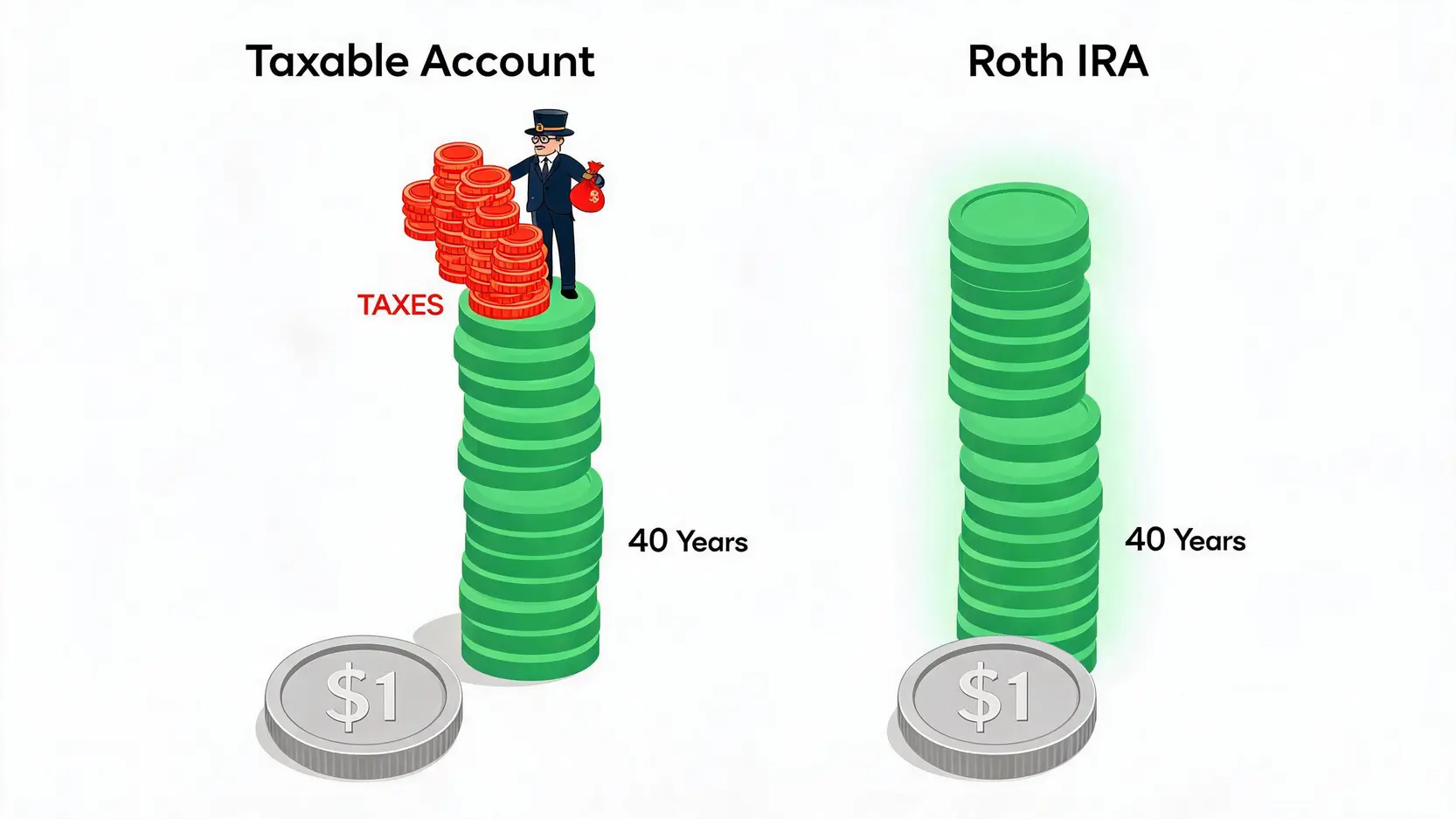
With a Roth IRA, you can invest your $1,000 in a wide range of assets, including the S&P 500 ETFs mentioned above. The long-term benefit is staggering. A $1,000 investment growing at 8% annually for 40 years could become over $21,000—all of which could be withdrawn tax-free. This is an essential tool for long-term wealth building.
Robo-Advisors: Automated Investing Made Simple
If you want a hands-off, professionally managed approach, a robo-advisor is an excellent choice. These are digital platforms that use algorithms to build and manage a diversified portfolio for you based on your goals and risk tolerance.
You simply answer a questionnaire, deposit your $1,000, and the robo-advisor handles the rest—including rebalancing and dividend reinvestment. They typically invest in a mix of low-cost ETFs. While they charge a small management fee (usually around 0.25% annually), the convenience and discipline they provide can be well worth it for beginners who feel overwhelmed.
Fractional Shares: Own Pieces of Big-Name Stocks
What if you want to invest in a company like NVIDIA or Tesla, but a single share costs more than $1,000? Fractional shares are the solution. Most modern brokerages now allow you to buy a slice of a share for as little as $1. This allows you to build a diversified portfolio of individual stocks you believe in, even with a small amount of capital. You can own a piece of dozens of different companies with your $1,000, giving you direct ownership in businesses you admire.
Series I Bonds: Protect Your Money from Inflation
For the highly risk-averse investor or for short-term goals, Series I Savings Bonds are a compelling option. Issued by the U.S. Treasury, these bonds are designed to protect your money’s purchasing power from inflation. Their interest rate is a combination of a fixed rate and a variable inflation rate that adjusts every six months.
This makes them one of the safest investments available, backed by the full faith and credit of the U.S. government. You can purchase them directly from the TreasuryDirect website. While they won’t provide the high growth of stocks, they ensure your cash doesn’t lose value over time, which is a victory in itself.
Two ‘Unconventional’ High-Return Investments with Guaranteed Returns
Sometimes the best financial moves aren’t in the stock market. These two strategies offer some of the highest and most certain returns you can get on your money.
Pay Down High-Interest Debt: The Only Guaranteed Return
If you have high-interest debt, such as from credit cards or personal loans, paying it off is a guaranteed, risk-free return on your investment. According to Forbes, the average credit card APR in 2026 is hovering around an astounding 25.22%.
By paying off a $1,000 balance on a card with a 25% APR, you are essentially *earning* a 25% return on your money by avoiding that interest payment. No investment in the stock market can guarantee that kind of return. Before investing externally, ensure your internal financial house is in order by eliminating costly debt.
Invest In Yourself: Education and Skills for Higher Earning Potential
The single greatest asset you have is your ability to earn an income. Using your $1,000 to acquire a new skill, earn a professional certification, or take a course can increase your earning potential for the rest of your life. This could be a coding bootcamp, a digital marketing course, or a public speaking workshop.
An investment that increases your annual salary by even a few thousand dollars provides an incredible return that will dwarf what you could make from a $1,000 market investment. Don’t underestimate the power of investing in your own human capital. 🧠
How to Make Your First Investment: A 3-Step Walkthrough
Ready to take action? Here’s a simple, step-by-step guide to making your first trade. This example will focus on buying an ETF, one of the most recommended starting points.
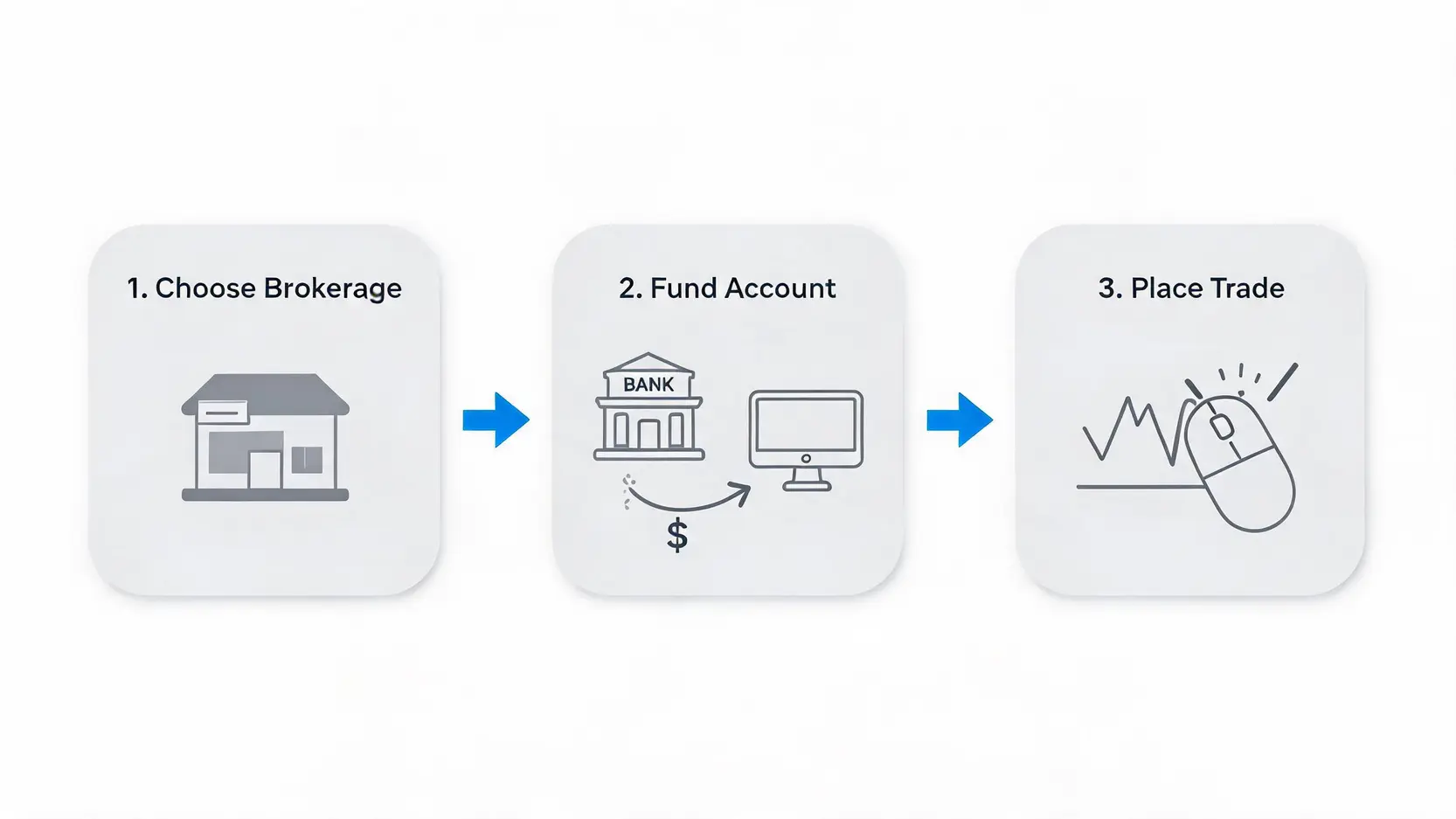
Step 1: Choosing a Beginner-Friendly Brokerage
A brokerage is a company that provides a platform to buy and sell investments like stocks and ETFs. For beginners, look for a brokerage with:
- Zero Commission Fees: Most major brokerages now offer $0 commission trades on stocks and ETFs.
- User-Friendly Interface: A clean, intuitive mobile app and website are essential.
- Fractional Shares: This feature allows you to invest every dollar.
Popular choices in the U.S. and UK include Fidelity, Charles Schwab, Vanguard, and Interactive Brokers. Opening an account is a straightforward online process that takes about 15 minutes.
Step 2: Funding Your Account and Avoiding Fees
Once your account is open, you need to fund it. This is typically done via an electronic bank transfer (ACH), which is free and usually takes 1-3 business days. You can link your checking or savings account directly to your brokerage account. Avoid wire transfers or other methods that may incur fees. Deposit your $1,000 to get started.
Step 3: Placing Your First Trade (Example: Buying an ETF)
With your account funded, you’re ready to invest. Let’s walk through buying a share of an S&P 500 ETF, like VOO.
- Log in to your brokerage account.
- Navigate to the ‘Trade’ or ‘Invest’ section.
- Enter the Ticker Symbol: In the search bar, type the ETF’s ticker symbol (e.g., ‘VOO’).
- Select the Order Type: For your first trade, use a ‘Market Order’. This tells the brokerage to buy the shares at the best available price right now.
- Enter the Amount: You can choose to buy a specific number of shares or, if using fractional shares, a specific dollar amount. Enter ‘$1,000’.
- Review and Submit: The platform will show you a summary of your order. Double-check everything and click ‘Submit’ or ‘Place Trade’.
Congratulations! 🎉 You are now an investor and a part-owner of 500 of America’s leading companies.
Conclusion
The best way to invest $1,000 in 2026 is to begin now. Action is the most critical component of building wealth. Whether you choose the elegant simplicity of an S&P 500 ETF, the tax-advantaged power of a Roth IRA, or the guaranteed return of paying off debt, making a move is what matters. This initial $1,000 is not just a sum of money; it is your entry ticket to a more financially secure future. By starting today, you are giving your money the most valuable asset of all: time to grow.
Frequently Asked Questions About Investing $1,000
Q: What is the safest way to invest $1,000 in 2026?
A: The safest investment vehicles are those with the lowest risk of losing principal. A High-Yield Savings Account (HYSA) is arguably the safest as it’s FDIC-insured and provides a modest return. U.S. Series I Savings Bonds are another extremely safe option, as they are backed by the government and designed to protect your money from inflation.
Q: Can I start investing with less than $1,000?
A: Absolutely. Thanks to fractional shares and zero-commission trading, you can start investing with as little as $1. The key is not the amount you start with, but the habit of consistent investing. Starting with a smaller amount is a great way to learn the process and get comfortable with market movements.
Q: Should I invest all $1,000 at once or spread it out?
A: This is a classic question about lump-sum investing versus dollar-cost averaging (DCA). Historically, data suggests that investing a lump sum as soon as you have it performs better about two-thirds of the time. However, for a beginner, DCA (investing smaller amounts, like $200 a month for five months) can be psychologically easier. It reduces the risk of investing everything right before a market downturn and helps build a consistent saving habit. For a $1,000 amount, either approach is perfectly fine.
Q: Should I invest in cryptocurrency with my first $1,000?
A: While cryptocurrency can offer high returns, it is also extremely volatile and speculative. For a beginner’s first $1,000, it is generally not recommended as a primary investment. It is more prudent to build a solid foundation in proven, diversified assets like index funds first. If you are interested in crypto, consider allocating only a very small portion of your portfolio (1-5%) that you are fully prepared to lose.