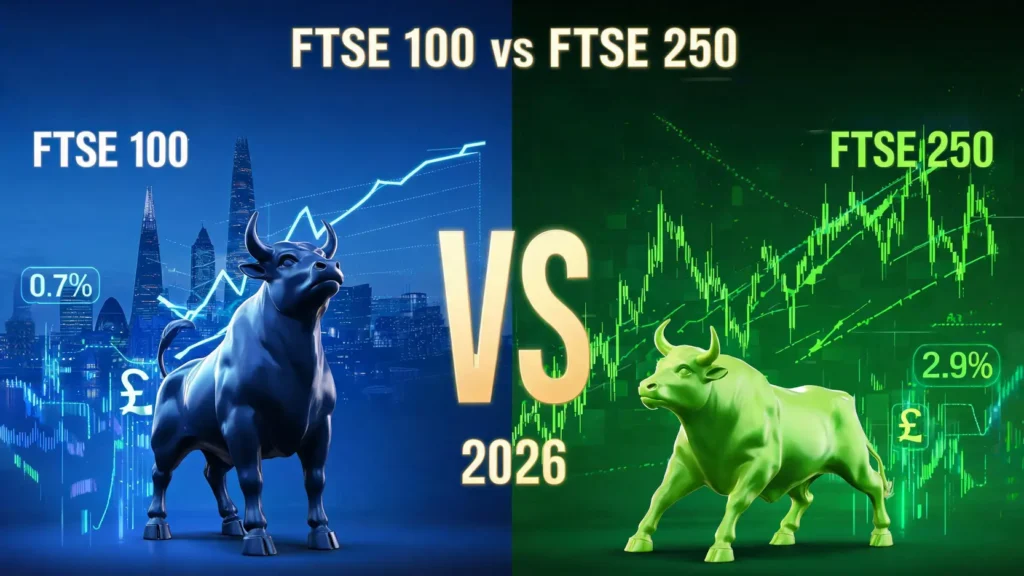
For investors navigating the UK market in 2026, the critical choice between its two premier indices, the FTSE 100 and FTSE 250, has never been more pivotal. This comprehensive analysis of the FTSE 100 vs FTSE 250 for 2026 dissects their fundamental differences, from international revenue exposure to domestic market sensitivity, to help you make an informed investment decision. As the economic landscape shifts, understanding the divergent risk profiles and potential returns of these indices is paramount for portfolio construction this year.
Table of Contents
Understanding the FTSE 100: The UK’s Global Giants
The Financial Times Stock Exchange (FTSE) 100 Index is often perceived as the primary benchmark for the UK stock market. However, this view can be misleading. It represents the 100 largest blue-chip companies listed on the London Stock Exchange by market capitalization. These are not just UK-centric firms; they are multinational behemoths with significant global footprints. 🌍
Composition and Market Capitalization
The FTSE 100 is a market-cap-weighted index, meaning the largest companies have the most significant impact on its performance. As of early 2026, the index is dominated by titans in sectors like pharmaceuticals, energy, and consumer staples. The sheer scale of these constituents means their fortunes are more closely tied to global economic currents than to the UK’s domestic health.
Here are some of the top constituents by market capitalization in 2026:
- AstraZeneca (AZN)
- Shell (SHEL)
- Linde (LIN)
- HSBC Holdings (HSBA)
- Unilever (ULVR)
- BP (BP.)
Key Sectors and International Revenue Exposure
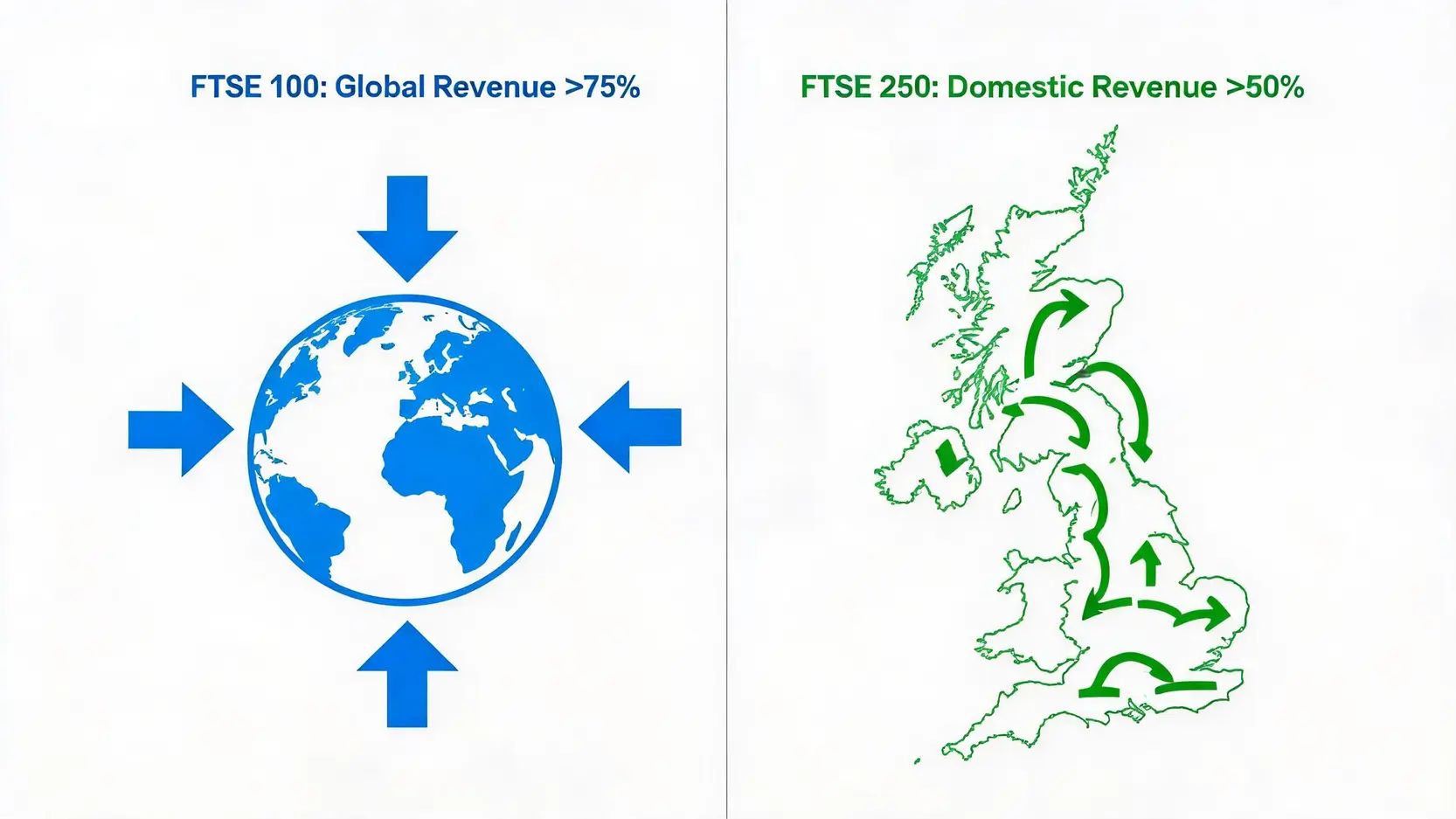
A defining characteristic of the FTSE 100 is its immense international revenue exposure. It is estimated that over 75% of the total revenue generated by FTSE 100 companies comes from outside the United Kingdom. This makes the index a proxy for the global economy, offering a layer of diversification away from UK-specific risks. The dominant sectors include:
- Energy: Companies like Shell and BP are global players whose profits are dictated by worldwide oil and gas prices.
- Healthcare: Giants such as AstraZeneca and GSK have global sales channels and R&D operations.
- Financials: Major banks like HSBC have extensive operations across Asia and other international markets.
- Consumer Staples: Firms like Unilever and Diageo are household names across the globe.
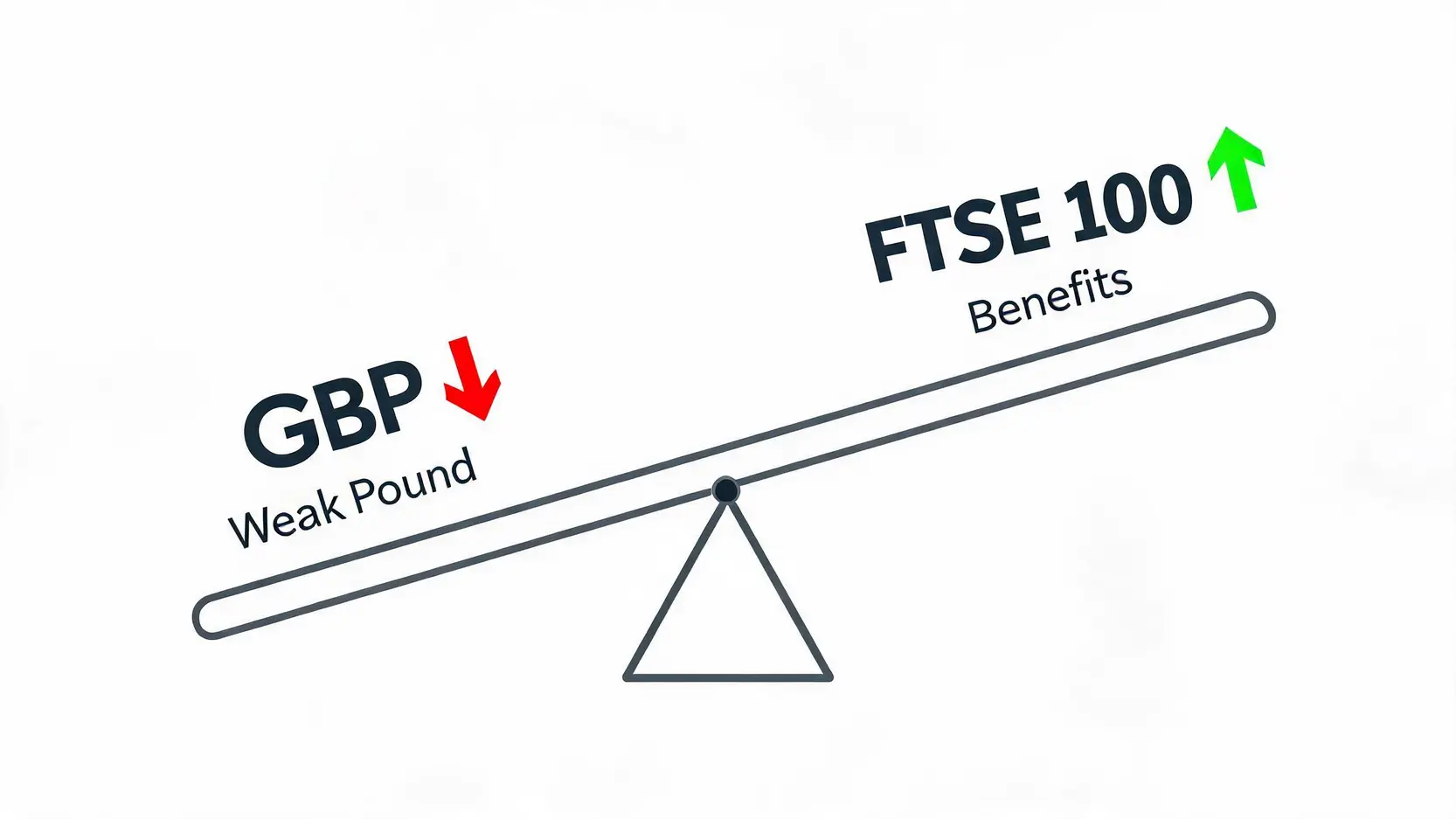
This global exposure means the FTSE 100 can perform well even when the UK economy is sluggish, provided the global outlook is positive. Conversely, it is more vulnerable to global geopolitical risks and currency fluctuations, particularly the strength of the British Pound (GBP).
Understanding the FTSE 250: A Barometer for the UK Economy
In stark contrast to its larger counterpart, the FTSE 250 is widely regarded as a more accurate reflection of the UK’s economic health. This index tracks the 101st to the 350th largest companies listed on the London Stock Exchange, often referred to as mid-cap stocks. These companies are typically more focused on the domestic market, making the index highly sensitive to UK economic data, consumer sentiment, and government policy.
Composition and Focus on Mid-Cap Companies
The FTSE 250 is home to a diverse range of dynamic, growing companies that are often leaders in their specific niches. While they are smaller than the blue-chip giants of the FTSE 100, they are substantial businesses. The index provides exposure to a different growth story—one that is intrinsically linked to the prosperity of the United Kingdom itself. As of 2026, some of the largest companies include names from diverse sectors like travel, industrials, and real estate, such as Carnival Corporation & plc and Babcock International.
Key Sectors and Domestic Market Sensitivity
The revenue profile of FTSE 250 companies is the mirror image of the FTSE 100. It is estimated that over 50% of their earnings are generated domestically. This makes the index a direct beneficiary when the UK economy is performing well but also exposes it more acutely to domestic downturns, political uncertainty, and changes in UK interest rates. Key sectors include:
- Financial Services: Niche banks, wealth managers, and insurance companies focused on UK clients.
- Industrials & Construction: Companies directly involved in UK infrastructure, housing, and manufacturing.
- Retail & Consumer Discretionary: Businesses that rely on the spending power of UK consumers.
- Real Estate: UK-focused property developers and REITs.
Head-to-Head: FTSE 100 vs FTSE 250 at a Glance
When comparing the investment potential of these two UK indices, several factors come into play. The decision often hinges on an investor’s risk tolerance, growth expectations, and macroeconomic outlook for 2026.
| Feature | FTSE 100 | FTSE 250 |
|---|---|---|
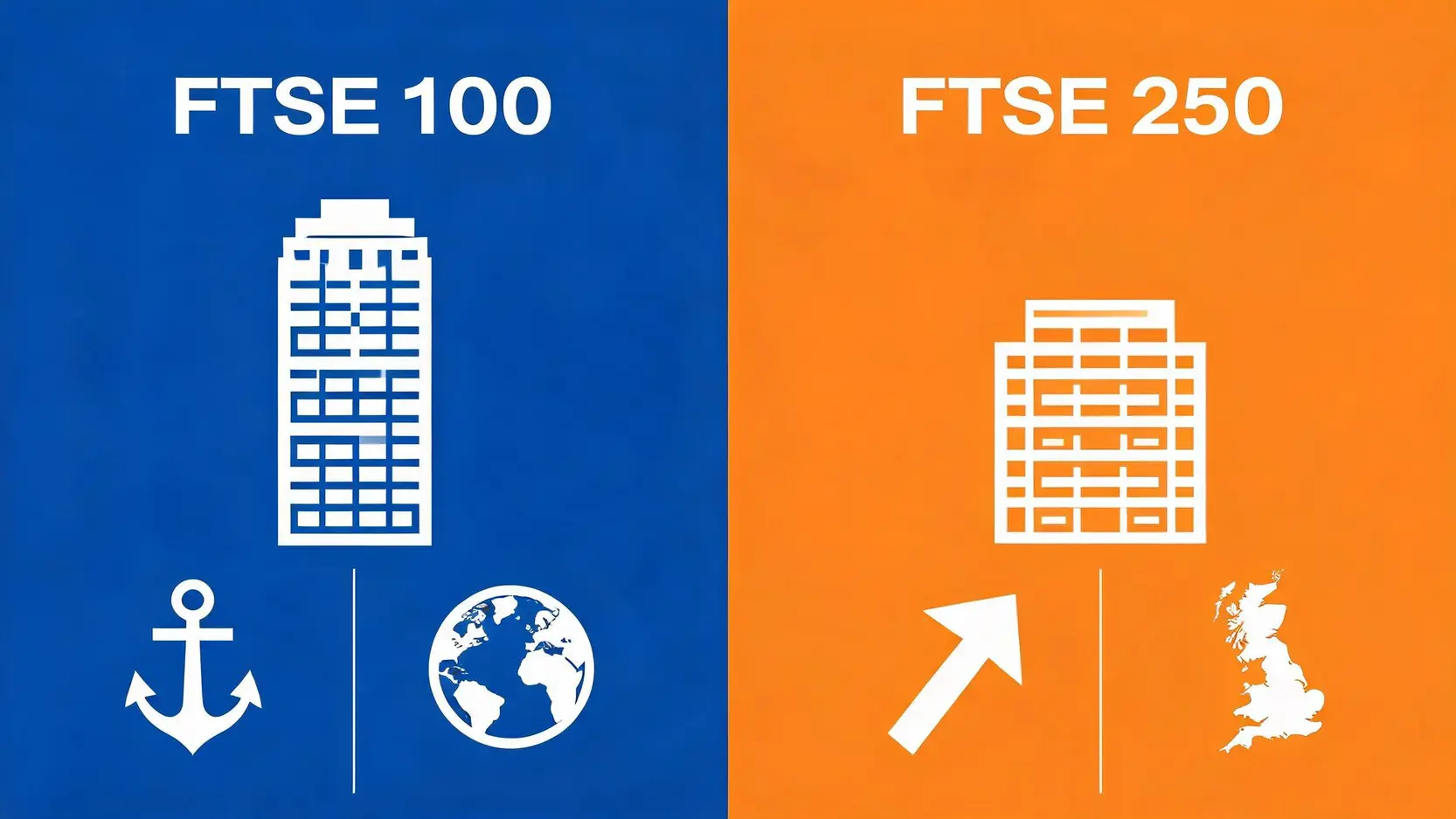
| Economic Focus | 🌍 Global (Over 75% international revenue) | 🇬🇧 Domestic (Over 50% UK revenue) |
| Company Size | Large-Cap (Blue-chip multinationals) | Mid-Cap (UK-focused businesses) |
| Volatility | Lower | Higher |
| Growth Potential | Moderate (Mature companies) | Higher (Growth-oriented companies) |
| Dividend Yield | Generally Higher | Generally Lower (Profits often reinvested) |
| Currency Sensitivity | Stronger when GBP is weak | Stronger when GBP is strong |
Volatility and Risk Profile Comparison
Historically, the FTSE 250 has exhibited higher volatility than the FTSE 100. The smaller size of its constituent companies and their greater reliance on a single economy (the UK) make them more susceptible to sharp market swings. The FTSE 100, with its portfolio of stable, dividend-paying global giants, is often considered a more defensive play during times of economic uncertainty.
Dividend Yield and Growth Potential
The FTSE 100 is renowned for its attractive dividend yield, as its mature companies tend to return a significant portion of their profits to shareholders. For income-focused investors, it remains a compelling choice. In contrast, FTSE 250 companies often reinvest a larger share of their earnings back into the business to fuel further expansion. This translates to lower dividend yields but potentially higher capital growth over the long term. This is a classic growth vs. value trade-off that investors must consider. Exploring Investment Strategies, Trading Guides & Market Insights can provide deeper context on balancing these objectives.
Historical Performance Review (2021-2025)
Looking back at the period from 2021 to 2025, the performance of the two indices has been a tale of two different economic stories. The FTSE 100 benefited from the post-pandemic global recovery and soaring commodity prices, which bolstered its large energy and mining constituents. The FTSE 250, however, faced headwinds from UK-specific challenges, including high inflation, rising interest rates, and political instability, which dampened domestic consumer and business confidence.
2026 Outlook: Key Economic Factors and Expert Forecasts
As we navigate 2026, the debate over the FTSE 100 vs FTSE 250 performance outlook is intensifying. The trajectory of each index will be shaped by a unique set of economic variables at both the domestic and global levels.
Impact of UK Inflation and Interest Rate Policies
The UK economic environment remains a critical factor. According to the Office for Budget Responsibility’s March 2026 forecast, UK GDP growth is expected to be a modest 1.1% in 2026. The Bank of England’s stance on interest rates to control inflation will be closely watched. A stable or falling interest rate environment could provide a significant tailwind for the domestically focused FTSE 250, as it would lower borrowing costs for businesses and potentially stimulate consumer spending. Conversely, stubbornly high rates could favour the globally diversified FTSE 100.
Global Economic Trends and Their Effect on Each Index
The health of the global economy, particularly key markets like the US and China, will be the primary driver for the FTSE 100. Factors such as global trade dynamics, commodity price cycles, and the strength of the US dollar will have a much larger impact on the FTSE 100’s earnings than on the FTSE 250. Investors with a bullish view on global growth may find the FTSE 100 more appealing.
Which Index Do Top Analysts Favor for 2026?
Analyst consensus for 2026 is mixed, reflecting the complex macroeconomic backdrop. Some argue that UK assets, including the FTSE 250, have been undervalued for years and are poised for a rebound as political stability returns and inflation subsides. They see a compelling growth story in the UK’s mid-cap sector. Others remain cautious about the UK’s growth prospects and prefer the defensive qualities and global diversification of the FTSE 100, especially if global economic activity remains robust.
How to Invest: Gaining Exposure to UK Indices
For most investors, the most efficient way to gain exposure to either index is through Exchange-Traded Funds (ETFs) or index tracker funds. These investment vehicles offer diversification across all the constituent companies at a very low cost. Our ETF Investing Guide provides a solid foundation for understanding these instruments.
Popular FTSE 100 ETFs and Funds
There are several large and liquid ETFs that track the FTSE 100. They are an excellent way to buy into the UK’s largest companies with a single transaction. Some of the most popular options available to UK investors include:
- iShares Core FTSE 100 UCITS ETF (ISF)
- Vanguard FTSE 100 UCITS ETF (VUKE / VUKG)
- HSBC FTSE 100 UCITS ETF (HUKX)
Leading FTSE 250 ETFs and Funds
Similarly, gaining exposure to the UK’s domestic economy via the FTSE 250 is straightforward with low-cost ETFs. These funds are ideal for capturing the growth potential of the UK’s mid-cap sector. Leading choices include:
- Vanguard FTSE 250 UCITS ETF (VMIG)
- iShares FTSE 250 UCITS ETF (MIDD)
Conclusion: Building Your 2026 Portfolio with the FTSE 100 or FTSE 250
The decision between the FTSE 100 and FTSE 250 for your 2026 portfolio is not about choosing a definitive ‘winner’. Instead, it’s about strategic alignment with your personal investment goals, risk appetite, and your view on the relative strengths of the UK versus the global economy.
FTSE 100: For Stability and Global Diversification
If your priority is stability, income generation through dividends, and exposure to a broad range of global economic drivers, the FTSE 100 is the logical choice. It serves as a defensive anchor in a portfolio, shielding it from localised UK economic shocks.
FTSE 250: For Higher Growth and UK-Specific Exposure
If you have a higher risk tolerance and a bullish outlook on the UK economy’s ability to outperform, the FTSE 250 offers significant growth potential. It is a direct investment in the health of British enterprise and the spending power of the UK consumer.
Frequently Asked Questions (FAQ)
Q: Is the FTSE 250 a riskier investment than the FTSE 100?
A: Yes, generally. The FTSE 250 is considered higher risk due to its higher volatility and concentration on the UK domestic economy. Its constituent mid-cap companies can be more sensitive to economic downturns compared to the large, globally diversified blue-chip companies in the FTSE 100.
Q: How does the value of the British Pound (GBP) affect these indices?
A: A weaker GBP is generally beneficial for the FTSE 100, as its companies earn a large portion of their revenue in foreign currencies. When these earnings are converted back into sterling, they are worth more. Conversely, a stronger GBP tends to benefit the FTSE 250, as it can reduce the cost of imported materials and reflects a healthier domestic economy, which is their primary market.
Q: Can I invest in both the FTSE 100 and FTSE 250?
A: Absolutely. Investing in both is a common strategy to achieve a balanced UK equity exposure. This approach combines the stability and global reach of the FTSE 100 with the domestic growth potential of the FTSE 250. An alternative is to invest in a FTSE All-Share ETF, which includes companies from both indices.
Q: What are the main differences in sector exposure?
A: The FTSE 100 is heavily weighted towards global sectors like Energy, Mining, Healthcare, and Consumer Staples. The FTSE 250 has greater exposure to domestically-focused sectors such as Industrials, Real Estate, Retail, and UK-centric Financial Services.