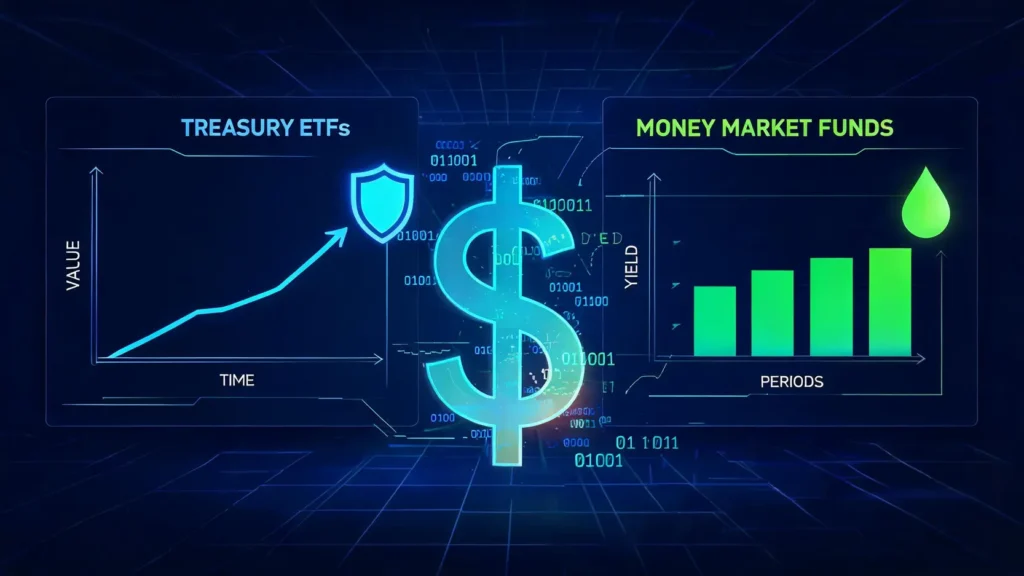
As the 2026 economic landscape continues to evolve with fluctuating interest rates, the strategic allocation of cash has become a paramount concern for astute investors. The decision between Treasury ETFs vs money market funds in 2026 is no longer a simple matter of preference; it’s a critical analysis of yield, safety, and tax efficiency. This guide provides a definitive breakdown of these two popular cash-equivalent instruments, examining the key differences in risk and safety and offering a clear comparison of yield and returns to help you determine the superior choice for your financial objectives.
Table of Contents
Understanding the Basics: What Are Treasury ETFs?
Treasury Exchange-Traded Funds (ETFs) are investment funds that are traded on stock exchanges, much like individual stocks. They hold a portfolio of U.S. Treasury securities—debt instruments issued by the United States government. These are considered among the safest investments in the world because they are backed by the full faith and credit of the U.S. government.
How They Work: Investing in a Basket of T-Bills
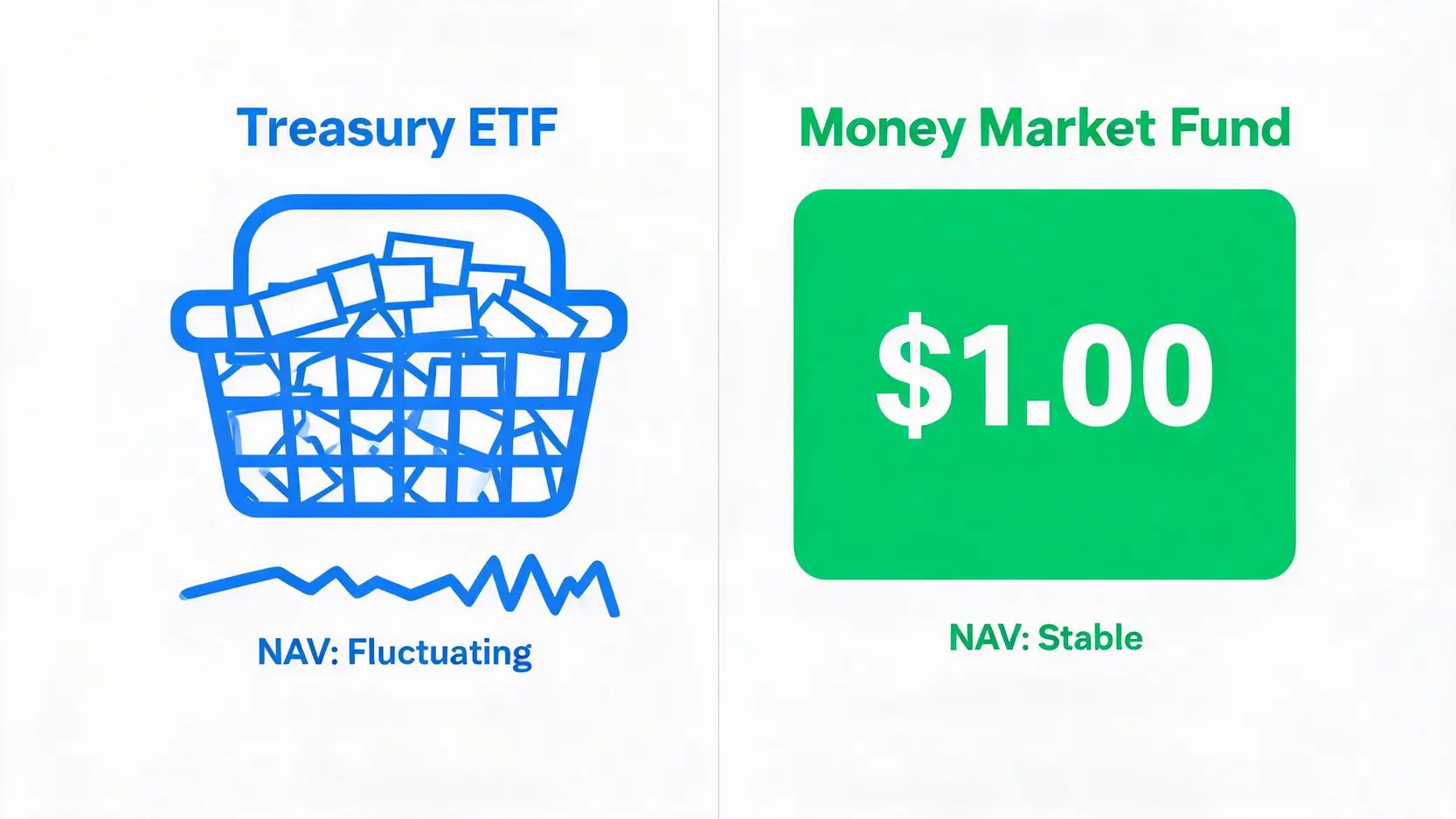
Instead of buying individual Treasury bills (T-bills), notes, or bonds directly, you can purchase shares of a Treasury ETF. This instantly gives you diversified exposure to a basket of government securities with varying maturities. For example, a short-term Treasury ETF might hold T-bills with maturities ranging from one to twelve months. This structure allows the fund to maintain a consistent, short-duration portfolio, making it a popular vehicle for cash management. As the U.S. Department of the Treasury explains, T-bills are short-term securities sold for terms ranging from a few weeks to 52 weeks, which form the bedrock of these ETFs.
Key Characteristics: Intraday Trading and NAV Fluctuation
Two defining features of Treasury ETFs are their liquidity and variable Net Asset Value (NAV):
- 📈 Intraday Trading: As an exchange-traded product, you can buy or sell shares of a Treasury ETF at any time during market hours. This offers a level of flexibility not available with traditional mutual funds, which only price once per day after the market closes.
- 📉 NAV Fluctuation: The share price (NAV) of a Treasury ETF fluctuates throughout the day based on supply and demand, as well as changes in interest rates. While short-term Treasury ETFs are designed to have very low volatility, their price is not fixed. A sudden spike in interest rates can cause the value of the underlying bonds to fall, leading to a temporary decrease in the ETF’s share price.
Understanding the Basics: What Are Money Market Funds?
Money market funds are a type of mutual fund developed as a low-risk, highly liquid investment tool. They invest in a portfolio of short-term, high-quality debt securities, such as government bonds, certificates of deposit (CDs), and commercial paper. Their primary objective is capital preservation and maintaining a stable share price.
How They Work: Aiming for a Stable $1.00 NAV
The hallmark of a money market fund is its goal to maintain a stable Net Asset Value (NAV) of $1.00 per share. This means that for every dollar you invest, you can expect to get one dollar back, plus any accrued interest (yield). While this stable value is the primary objective, it is not guaranteed. The fund achieves this stability by investing in debt with very short maturities (typically under 13 months) and extremely high credit quality. The interest earned by the fund’s holdings is distributed to shareholders as dividends.
Key Types: Government, Prime, and Treasury Funds
Money market funds are not all created equal. They fall into several categories based on their underlying assets:
- Government Funds: These funds invest at least 99.5% of their assets in cash, government securities, and repurchase agreements that are fully collateralized by cash or government securities. They are considered the safest category.
- Treasury Funds: A subset of government funds, these invest exclusively in U.S. Treasury securities.
- Prime Funds: These funds can invest in a broader range of debt, including short-term corporate debt (commercial paper). They may offer a slightly higher yield than government funds but carry incrementally more credit risk.
Understanding these distinctions is crucial, as the risk profiles differ, particularly in times of market stress. For those new to these concepts, exploring investment basics is a foundational step before allocating capital.
Head-to-Head Comparison: Treasury ETFs vs. Money Market Funds
When analyzing the Treasury ETFs vs money market funds 2026 debate, a direct comparison across key metrics is essential for making an informed decision. Here’s how they stack up.
| Feature | Treasury ETFs | Money Market Funds |
|---|---|---|
| 🥇 Safety & Risk | Extremely high safety, backed by U.S. government. Subject to minor interest rate risk and price fluctuation. | Designed for maximum stability with a target $1.00 NAV. Government funds are safest; Prime funds have slight credit risk. |
| 📊 Yield & Returns | Often slightly higher yield due to structure and lower expenses. Returns are a combination of interest income and price changes. | Yields are competitive but may be slightly lower. Returns are almost entirely from interest income. |
| 💧 Liquidity | High. Can be traded throughout the day on an exchange. | High. Transactions are processed at the end of the trading day (at the $1.00 NAV). |
| 💸 Expense Ratios | Typically very low, often ranging from 0.05% to 0.15%. | Generally low, but can sometimes be slightly higher than the cheapest Treasury ETFs. |
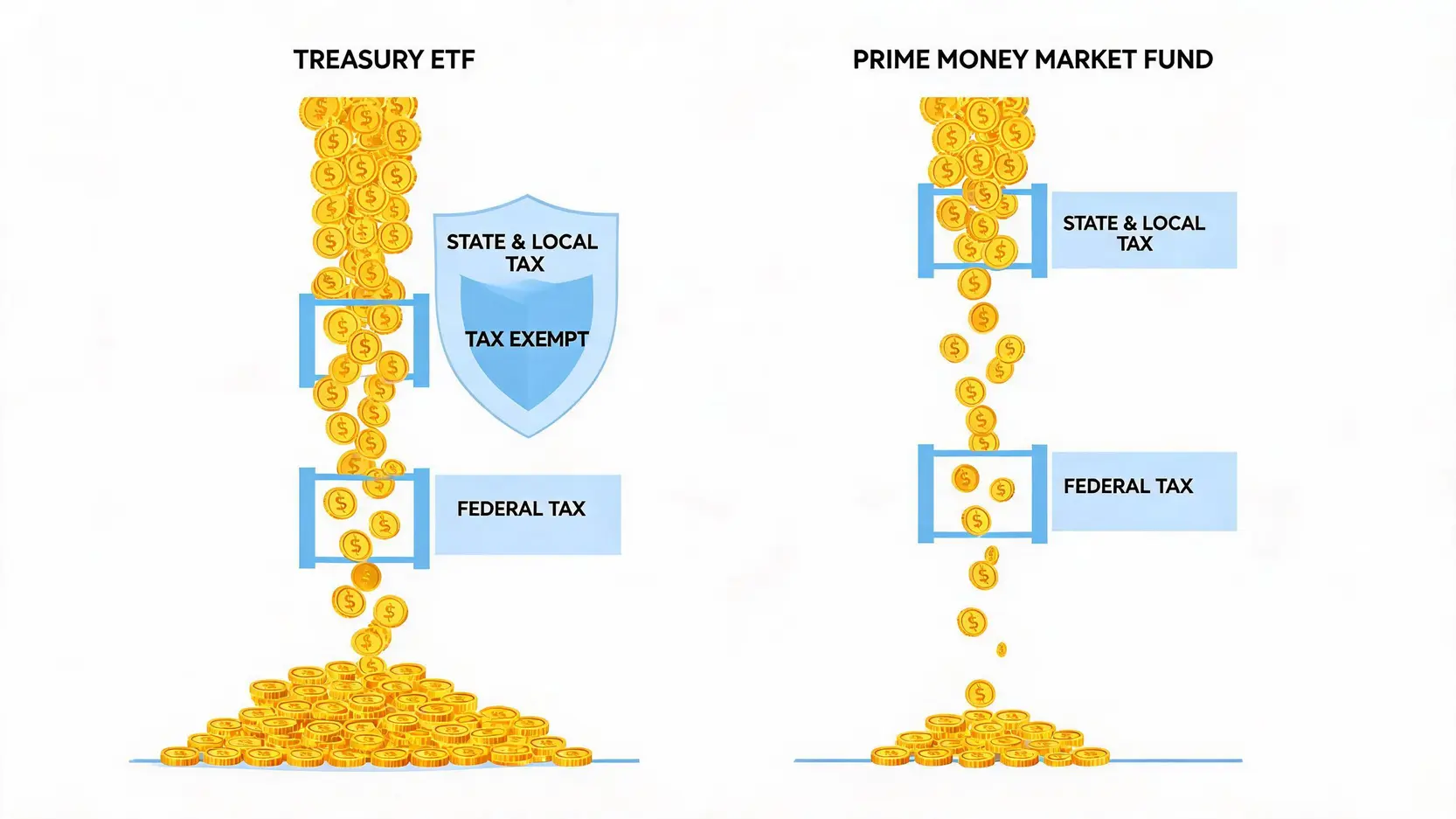
| 🧾 Tax Advantages | Significant. Income from U.S. Treasuries is exempt from state and local taxes. | Only funds that invest exclusively in Treasuries offer state and local tax exemption. Prime fund income is fully taxable. |
Safety & Risk: The Reality of ‘Breaking the Buck’
The greatest fear for a money market fund investor is the fund “breaking the buck”—an event where the NAV falls below $1.00. This is exceptionally rare, especially for government funds, but it has happened in moments of severe financial crisis (e.g., the 2008 collapse of Lehman Brothers affecting the Reserve Primary Fund). Treasury ETFs, on the other hand, do not promise a stable NAV. Their share price is expected to fluctuate. However, for an ETF holding very short-term T-bills, the price volatility is typically minimal, often moving by just a few cents.
Yield & Returns: Where You’ll Likely Earn More
Yield is a primary motivator. A key point of confusion is how yield is reported. Money market funds often advertise a 7-day SEC yield, which is a standardized calculation that reflects the fund’s annualized income over the past seven days. ETFs might show a distribution yield or a 30-day SEC yield. As an authoritative source like Investopedia explains, the SEC yield offers a more standardized comparison. In the current 2026 market, Treasury ETFs often edge out money market funds in yield, primarily because their ETF structure can be more cost-effective, passing on more income to investors.
Liquidity: Trading Flexibility vs. Stable Access
Both are highly liquid. The choice comes down to your needs. If you require the ability to exit a position at a specific price during the trading day, a Treasury ETF is superior. If your goal is simply to deposit or withdraw cash at a stable, predictable price at the end of the day, a money market fund is perfectly suitable and arguably simpler to manage.
Expense Ratios: Uncovering the Hidden Costs
Costs, however small, compound over time. Both investment tools are known for their low costs. However, the most competitive Treasury ETFs often feature expense ratios that are a few basis points lower than their mutual fund counterparts. For large cash balances, this small difference can translate into meaningful savings.
Tax Advantages: A Clear Winner for Some Investors
This is arguably the most significant differentiator. The interest income generated from U.S. Treasury securities is exempt from state and local income taxes. Since Treasury ETFs hold these securities directly, this tax benefit is passed through to the investor. For individuals in high-tax states like California or New York, this can create a substantial advantage, boosting the after-tax return significantly compared to a fully taxable money market fund. Understanding the tax implications of any investment is crucial to maximizing returns.
🆕 Which Is Right for You? A 2026 Decision Framework
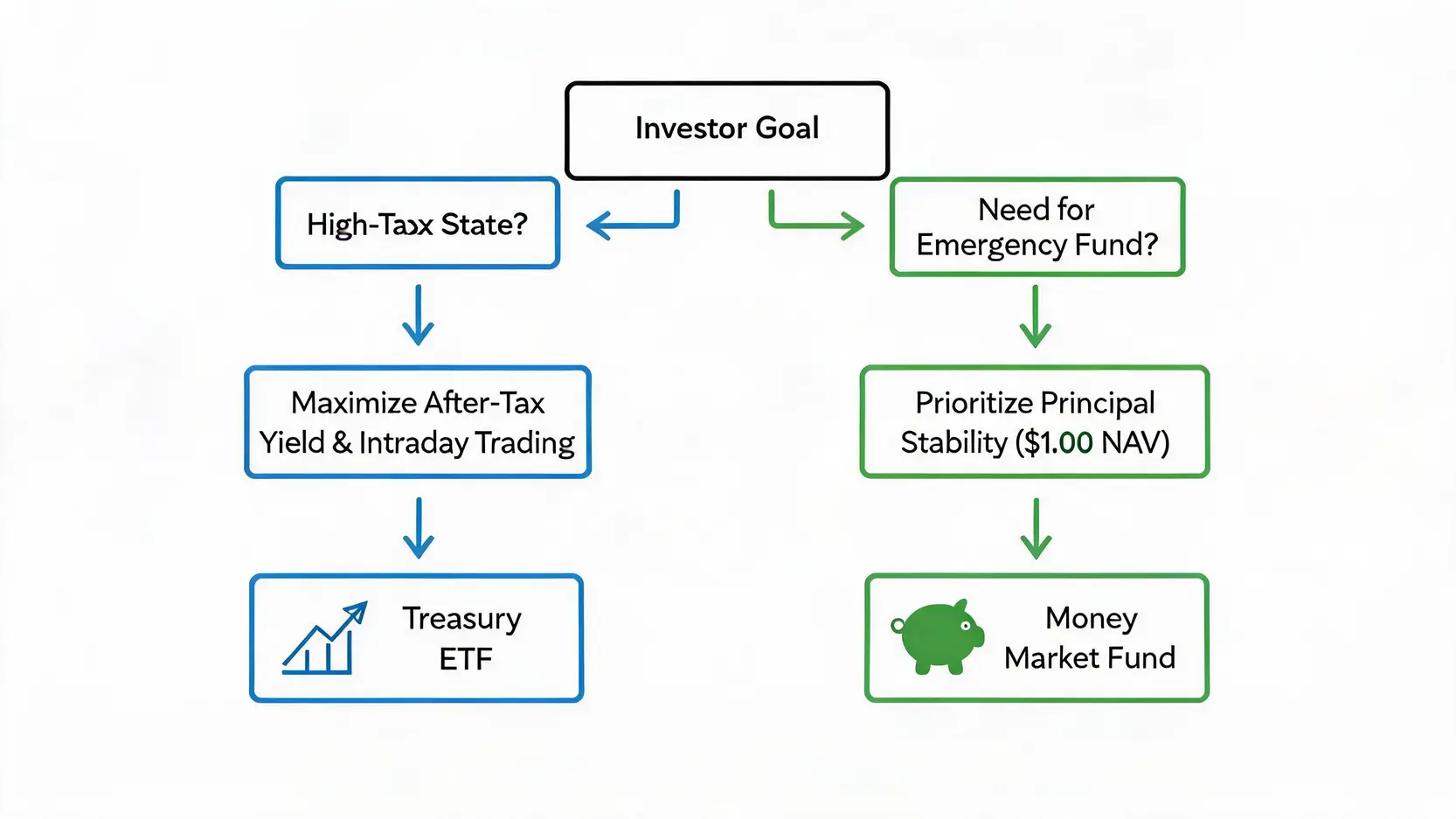
Choosing between these two excellent cash management tools depends entirely on your personal financial situation and investment philosophy. Use this framework to guide your decision.
Choose Treasury ETFs If…
- ✅ You live in a state with high income taxes and want to maximize your after-tax yield.
- ✅ You are an active trader who values the ability to buy and sell shares intraday.
- ✅ You are comfortable with very minor fluctuations in the share price and understand it will not be perfectly stable at $1.00.
- ✅ You are looking for the absolute lowest expense ratios available for a government-backed debt portfolio.
Choose Money Market Funds If…
- ✅ Your absolute highest priority is principal stability and a constant $1.00 NAV.
- ✅ You prefer the simplicity of a traditional mutual fund structure for deposits and withdrawals.
- ✅ The fund will serve as your primary emergency fund, where psychological comfort and immediate, predictable access are paramount.
- ✅ You live in a state with no or low income tax, where the tax benefits of Treasury ETFs are less impactful.
Scenario Analysis: The Best Option for an Emergency Fund vs. Short-Term Savings
Let’s consider two common scenarios:
- Building an Emergency Fund: For this purpose, a government money market fund is often the superior choice. Its unwavering focus on a stable $1.00 NAV provides the psychological security needed for funds that must be available without risk of loss during a crisis. The simplicity of transacting at a fixed value is ideal for emergency planning.
- Parking Cash for a Short-Term Goal (e.g., a house down payment in 12 months): Here, a short-term Treasury ETF may have the edge. Over a 6-12 month horizon, the slightly higher potential yield and significant tax advantages (in applicable states) can lead to a meaningfully larger sum of money, while the risk of principal loss from NAV fluctuation remains exceptionally low.
Conclusion
In the final analysis of Treasury ETFs vs money market funds in 2026, there is no single winner for every investor. The choice hinges on a careful evaluation of your individual priorities. For those who demand maximum stability, simplicity, and psychological comfort—especially for an emergency fund—a government money market fund remains an unparalleled choice. Conversely, for the tax-conscious investor in a high-tax state or anyone seeking to optimize yield on a significant cash position, a Treasury ETF presents a compelling, modern, and highly efficient alternative. By assessing your personal risk tolerance, tax circumstances, and liquidity requirements, you can make the most intelligent and strategic decision for your cash.
Frequently Asked Questions (FAQ)
Q: Are Treasury ETFs as safe as money market funds?
A: They are both considered extremely safe investments. However, they define “safety” differently. A government money market fund’s safety lies in its objective to maintain a stable $1.00 share price. A Treasury ETF’s safety comes from its underlying assets being backed by the U.S. government, though its share price will fluctuate with market conditions.
Q: Can you lose money in a Treasury ETF?
A: Yes, it is possible to lose money in the short term if the ETF’s share price drops after you buy it. This is typically caused by a sharp increase in interest rates. However, for ETFs that hold very short-term T-bills, any potential losses are generally very small and often temporary, as the fund’s portfolio is constantly maturing and reinvesting at new, higher rates.
Q: Which offers better tax benefits, Treasury ETFs or money market funds?
A: Treasury ETFs generally offer superior tax benefits. Because they hold U.S. Treasury securities, the income distributed to shareholders is exempt from state and local taxes. While some money market funds also invest solely in Treasuries and offer the same benefit, many (like Prime funds) do not, making their dividends fully taxable.
Q: What does it mean when a money market fund ‘breaks the buck’?
A: ‘Breaking the buck’ is a term used to describe the rare event when a money market fund’s Net Asset Value (NAV) per share falls below the stable $1.00 target. This signifies a loss of principal for investors. It is a very serious event in the financial world and has only happened a handful of times in history, typically during severe market-wide crises and primarily with funds holding riskier corporate debt.