
The year 2026 will be remembered as a period of significant market turbulence, headlined by a severe bond rout 2026 that sent shockwaves through the global financial system. This rapid surge in Treasury yields and corresponding collapse in bond prices was not an isolated event but the culmination of persistent inflationary pressures and decisive central bank actions. For investors, understanding the anatomy of this market sell-off is critical. This article breaks down the core causes of the 2026 bond rout, its widespread impact on the global market situation, and what it means for portfolio strategy moving forward.
Table of Contents
Understanding the Turmoil: What Exactly Is a Bond Rout?
To grasp the events of 2026, one must first understand the terminology. A bond rout is not merely a downturn; it’s a rapid and substantial decline in bond prices, which triggers a sharp increase in their yields. This phenomenon is often fueled by a sudden shift in investor sentiment, typically driven by fears of rising inflation or changes in monetary policy. Unlike a gradual bear market, a rout is characterized by its speed and intensity, often leading to panic selling as investors scramble to exit their positions to avoid further losses. For a detailed explanation, Investopedia offers a clear definition of a market rout and its implications for investors.
The Inverse Relationship: A Primer on Bond Prices and Yields
The fundamental principle of the bond market is the inverse relationship between prices and yields. When the price of a bond goes up, its yield goes down, and vice versa. Here’s a simple breakdown:
- Yield: The return an investor gets on a bond. If you buy a $1,000 bond with a 3% coupon, it pays $30 annually. Your yield is 3%.
- Price Fluctuation: If new bonds are issued with a 4% coupon due to rising interest rates, your 3% bond becomes less attractive. To sell it, you’d have to lower the price, say to $950. The new buyer still gets $30 annually, but their yield is now higher ($30 / $950 ≈ 3.16%).
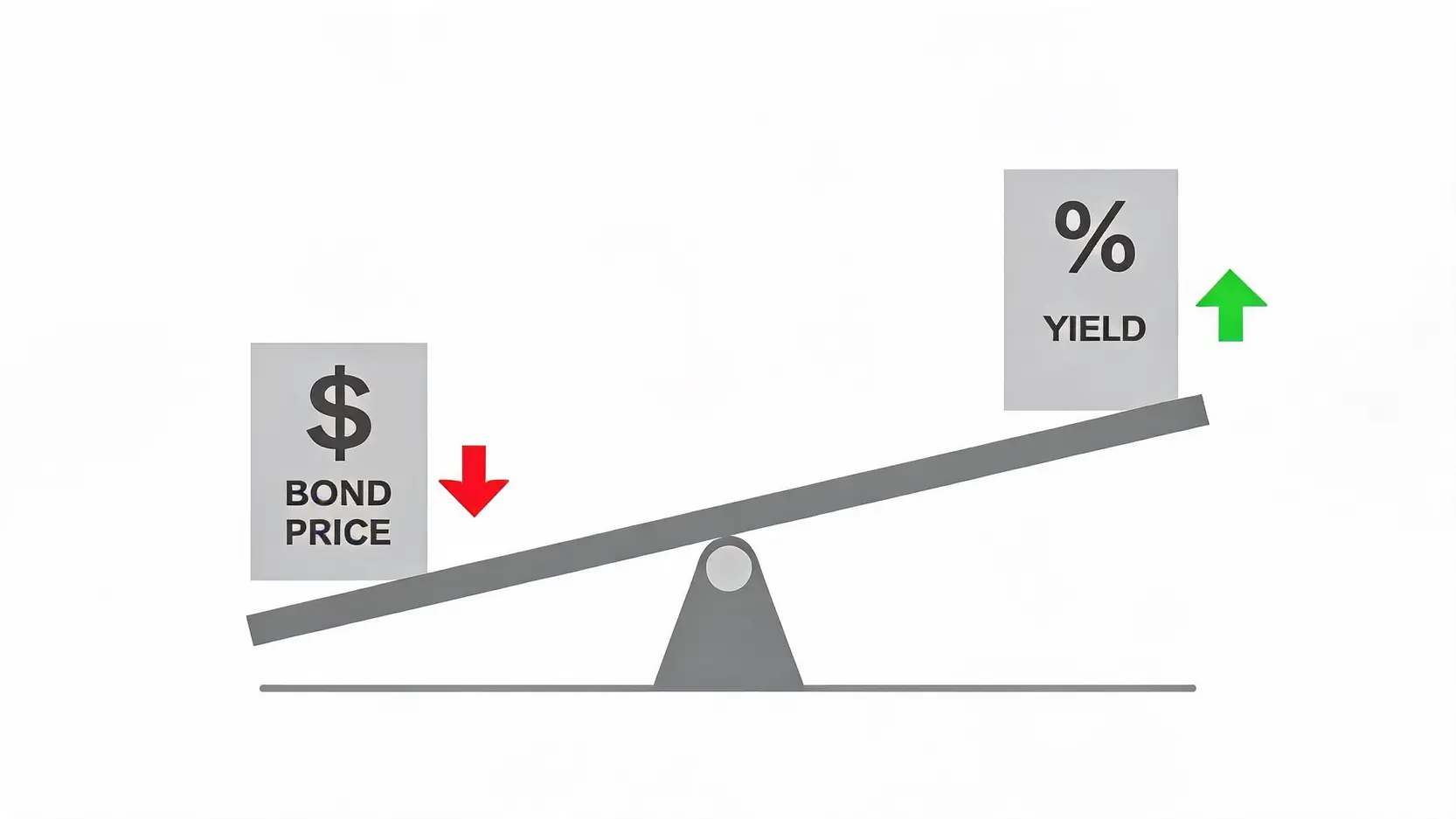
During the 2026 rout, a massive sell-off forced bond prices to plummet, causing yields to spike dramatically across the board.
From Sell-off to Rout: Identifying the Tipping Point in the Market
A market sell-off transitions into a rout when selling becomes disorderly and self-reinforcing. The tipping point in 2026 was reached when major institutional investors, facing mounting losses and margin calls, were forced to liquidate large fixed-income positions. This flood of supply overwhelmed demand, causing prices to gap down and creating a vicious cycle. Automated trading algorithms, programmed to sell on certain momentum indicators, further accelerated the decline, turning what might have been a correction into a full-blown rout.
The Perfect Storm: Key Drivers Behind the 2026 Bond Rout and Its Market Impact
The 2026 bond rout wasn’t caused by a single factor but by a confluence of economic pressures that had been building for months. Understanding these drivers is essential for identifying potential warning signs of future market instability.
Analyzing the Role of Inflation and Central Bank Policies
Persistent inflation was the primary antagonist. After a period of relatively accommodative monetary policy, global economies saw inflation metrics consistently overshoot central bank targets. The key triggers included:
- Stubborn Core Inflation: Services inflation, particularly, remained elevated due to tight labor markets and wage growth.
- Supply Chain Normalization Issues: While some pandemic-era bottlenecks eased, new geopolitical tensions created fresh disruptions, particularly in energy and key industrial metals.
- Aggressive Central Bank Response: The Federal Reserve and the European Central Bank, having signaled a hawkish pivot, were forced to implement a series of aggressive rate hikes and accelerate quantitative tightening (QT). This sharp withdrawal of liquidity was the direct catalyst that unmoored the bond market.
Global Economic Pressures and Geopolitical Triggers
Beyond inflation, other global factors created a fragile market environment. Geopolitical escalations in key regions added a significant risk premium to energy prices and disrupted trade flows. Furthermore, signs of a slowdown in major economies like China raised concerns about global growth, creating a stagflationary narrative that is particularly poisonous for bonds. This combination of high inflation and slowing growth left investors with nowhere to hide, prompting a flight from fixed-income assets that were perceived as offering negative real returns.
Analyzing the Ripple Effects: How the 2026 Bond Rout Impacted Global Stock Markets
The bond market is the bedrock of the financial system, and its convulsions were felt across all asset classes. The 2026 bond rout triggered significant volatility and repricing in equities, currencies, and commodities.
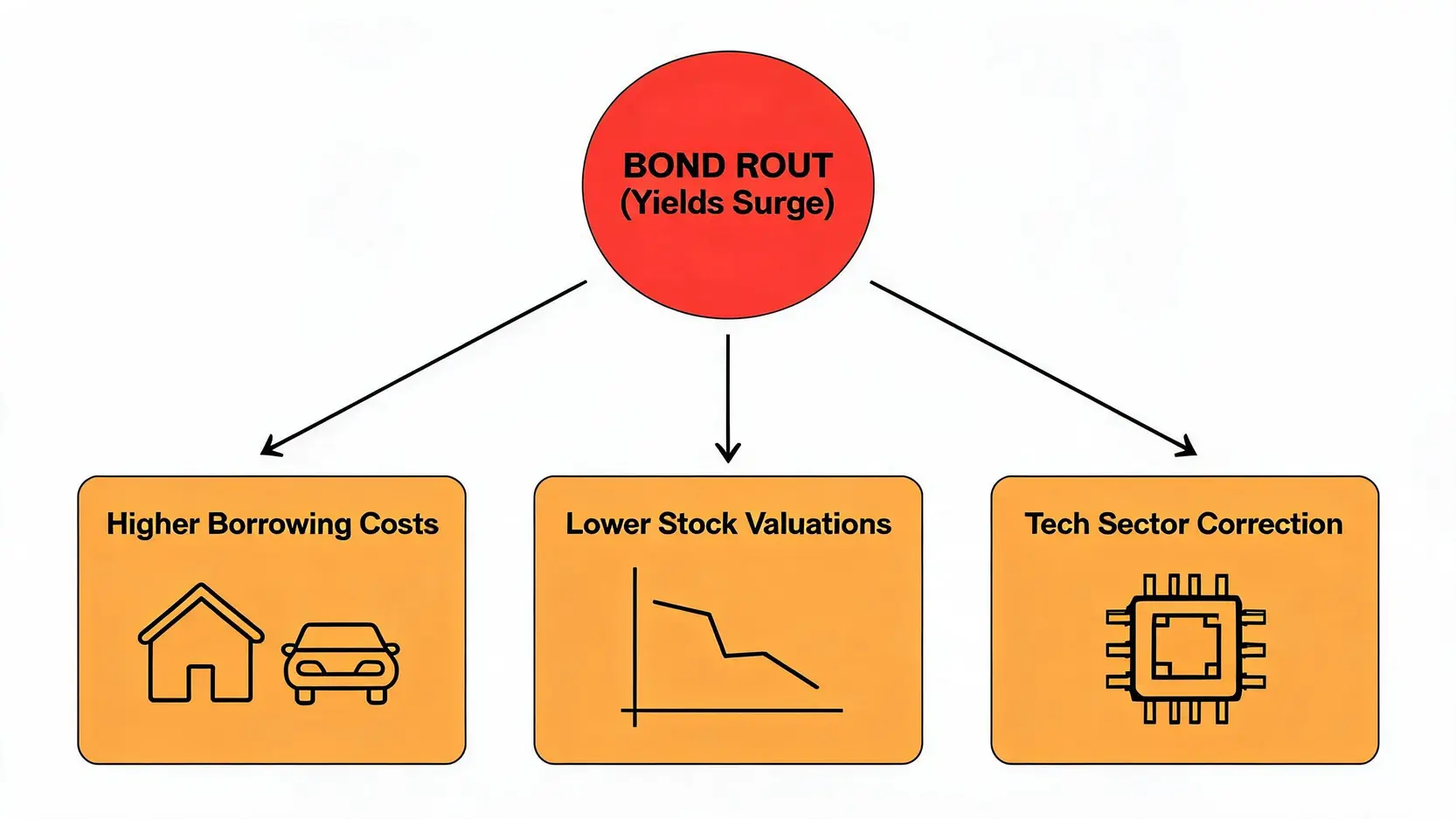
The Surge in 10-Year Treasury Yields
The yield on the U.S. 10-year Treasury note, a benchmark for borrowing costs worldwide, surged to multi-year highs. This had immediate consequences:
- Higher Borrowing Costs: Mortgage rates, corporate loan rates, and car loan rates all increased, putting a damper on consumer spending and corporate investment.
- Increased Government Debt Service Costs: Governments worldwide faced higher interest payments on their national debt, constraining fiscal spending.
- Discount Rate Adjustments: Higher risk-free rates meant that the discount rates used to value future corporate earnings increased, leading to lower stock valuations.
Spillover Effects on the Stock Market and Tech Sector
The stock market did not escape unscathed. The relationship between rising yields and equity performance became painfully clear. As analysis from institutions like BlackRock often highlights, higher yields make safer government bonds more attractive relative to riskier stocks. This dynamic hit growth-oriented sectors the hardest. The tech sector, whose valuations are heavily dependent on future earnings expectations, suffered a severe correction. Companies with weak balance sheets or those reliant on cheap capital to fund growth were disproportionately punished.
Navigating the Aftermath: Investment Strategies for the Post-Rout Economy
The aftermath of the 2026 bond rout requires a recalibration of investment strategies. The era of persistently low rates is definitively over, and portfolios must be adapted to this new paradigm of higher volatility and inflation.
For Conservative Investors: Reassessing Fixed-Income Strategy
For those focused on capital preservation, the rout was a painful lesson in interest rate risk (duration risk). However, the resulting higher yields now offer better income opportunities than have been seen in years. The focus should shift from chasing capital gains in bonds to building a resilient income stream.
- Shorten Duration: Reducing exposure to long-term bonds minimizes sensitivity to further rate hikes.
- Consider Floating-Rate Debt: Instruments like Collateralized Loan Obligations (CLOs), accessible via ETFs, offer yields that adjust with interest rates. Exploring a guide to CLO ETFs can provide valuable insights.
- Quality is Key: Stick to high-quality corporate and government debt to mitigate credit risk, especially if economic growth continues to slow.
For Growth Investors: Finding Opportunities Amidst Volatility
Volatility creates opportunity. For growth-oriented investors, the market correction has made valuations in certain sectors more attractive. The key is to be selective and focus on fundamental strength.
- Focus on Profitability: Invest in companies with strong balance sheets, consistent cash flow, and proven pricing power that can weather an inflationary environment.
- Value Over Growth: The valuation reset favors value stocks over speculative growth names. Look for quality companies trading at reasonable multiples.
- Commodities and Real Assets: Assets like gold, industrial metals, and real estate can offer a hedge against inflation and perform well in the current economic regime. Navigating this environment requires robust investment strategies for market volatility.
Expert Outlook: What Analysts Predict for the Post-Rout Economy
Looking ahead, the consensus among analysts is one of cautious optimism tempered with realism. The worst of the inflationary pressures may be easing, but a return to the pre-pandemic environment of low inflation and low rates is unlikely. Most experts predict a period of slower economic growth as the global economy absorbs the impact of higher borrowing costs. Central banks are expected to maintain a restrictive policy stance until inflation is definitively under control, meaning investors should prepare for a prolonged period of higher-for-longer interest rates. In this environment, active management and careful asset allocation will be paramount.
Conclusion
In summary, the 2026 bond rout was a critical financial event driven by a confluence of resurgent inflation, necessary policy shifts, and mounting global economic pressures. It served as a stark reminder of the risks embedded in fixed-income markets and fundamentally challenged traditional portfolio construction models. Understanding its dynamics—from the inverse relationship of bond prices and yields to the macroeconomic triggers—is crucial for building a resilient investment strategy. By learning from this event, investors can better position themselves to navigate future market cycles in an era of higher structural inflation and volatility.
Frequently Asked Questions (FAQ)
Q: What was the primary cause of the 2026 bond rout?
A: The primary cause was persistently high inflation that forced global central banks, including the U.S. Federal Reserve, to adopt aggressive monetary tightening policies. This involved rapid interest rate hikes and the withdrawal of market liquidity (quantitative tightening), which led to a sharp and sudden repricing of fixed-income assets.
Q: How did the bond rout in 2026 affect the average investor’s portfolio?
A: The average investor, particularly those with a traditional 60/40 stock-bond portfolio, experienced significant losses. Both asset classes fell in unison as rising yields punished bond prices and simultaneously compressed stock valuations. It highlighted the failure of bonds to act as a reliable diversifier during periods of high inflation.
Q: Are there warning signs for a future bond rout?
A: Yes. Key warning signs include unexpectedly persistent inflation data (especially in services), increasingly hawkish language from central bank officials, a rapid steepening of the yield curve, and large outflows from bond funds. Monitoring these indicators can help investors anticipate periods of heightened risk in the fixed-income market.
Q: Which assets performed well during the 2026 bond rout?
A: Assets that typically perform well during inflationary periods showed resilience. These included commodities (like oil and industrial metals), certain currencies, and alternative investments like floating-rate debt instruments. Value stocks with strong pricing power also outperformed speculative growth stocks.