
The landscape for India government bonds for foreign investors has fundamentally shifted, transforming from a niche opportunity into a strategic imperative for global portfolios. With India’s landmark inclusion in major global bond indices now fully integrated and pro-investment policy reforms taking root, the appeal is undeniable. As of 2026, the initial waves of capital have flowed in, but the long-term potential is just beginning to unfold. This guide provides a comprehensive analysis of the investment case, the operational steps, and the critical risk-reward calculus for international investors looking to capitalize on one of the world’s most dynamic economies through its sovereign debt market.
Table of Contents
Why Are International Investors Turning to Indian Government Bonds?
The surge in foreign interest isn’t speculative; it’s anchored in concrete, game-changing developments. For years, structural hurdles kept large-scale foreign capital at bay. However, recent strategic decisions by Indian policymakers and recognition from global financial institutions have unlocked the market’s vast potential, making the investment process for foreigners more streamlined and attractive.
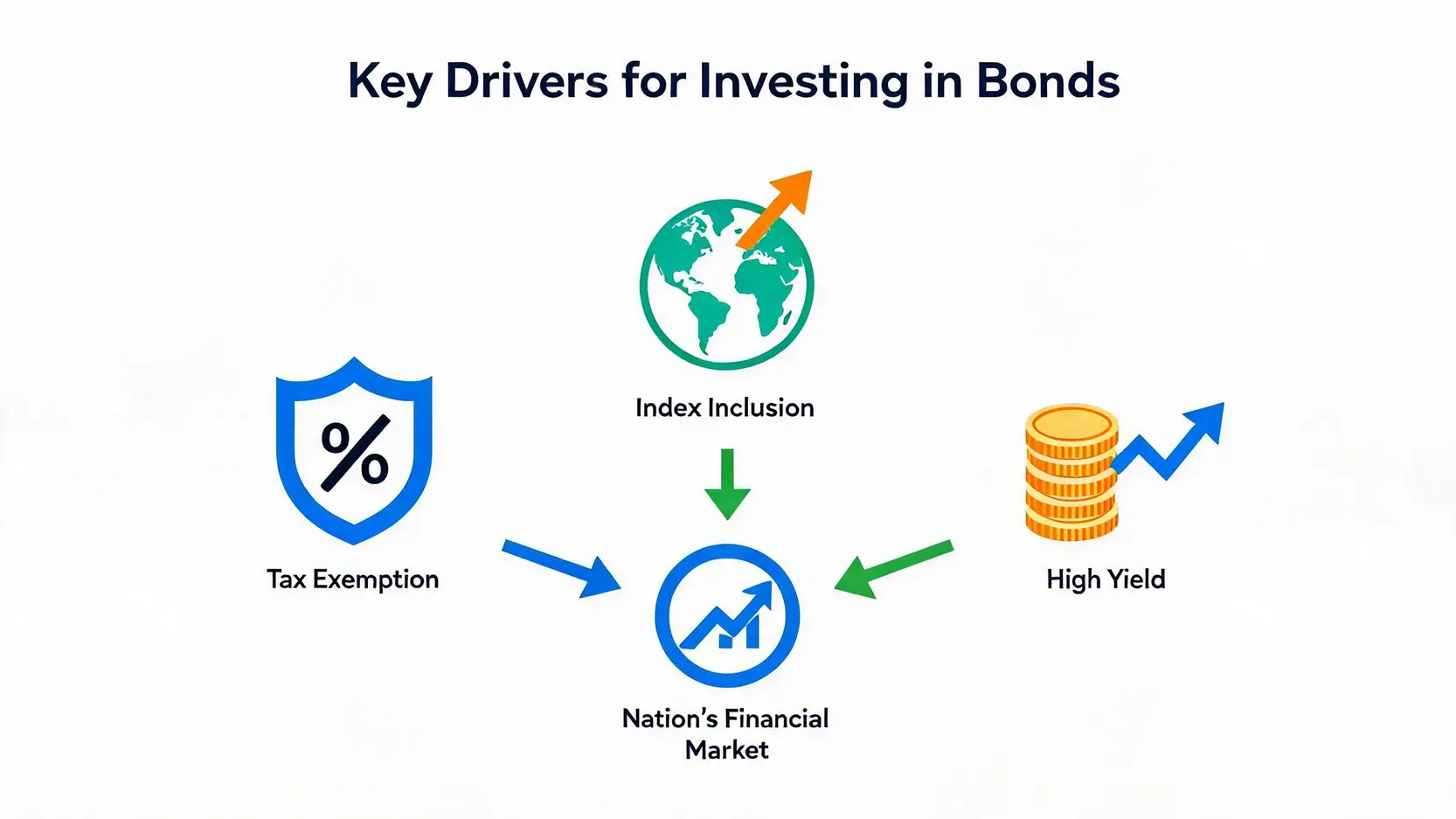
Major Policy Shift: The Removal of Capital Gains Tax
One of the most significant catalysts was the government’s forward-thinking decision to exempt foreign investors from capital gains tax on government securities. This move, implemented to smooth the path for index inclusion, has drastically improved the net returns for offshore investors. By removing this fiscal friction, India has signaled its commitment to attracting long-term, stable foreign capital, directly enhancing the total return proposition of its sovereign bonds compared to other emerging markets where such taxes can erode gains.
The Game Changer: Inclusion in JPMorgan’s GBI-EM Index
The inclusion of Indian Government Bonds (IGBs) into the JPMorgan Government Bond Index-Emerging Markets (GBI-EM), which commenced in June 2024, was a watershed moment. As of 2026, India’s full weight in the index has been realized, compelling passive and active funds tracking this benchmark to allocate billions of dollars into IGBs. This has several profound effects:
- Sustained Capital Inflows: Index inclusion provides a steady, structural demand for IGBs, reducing market volatility and supporting bond prices.
- Enhanced Liquidity: The influx of foreign capital has significantly deepened the market, making it easier for large institutional investors to execute trades without causing major price disruptions.
- Global Validation: Being part of a major global index is a seal of approval, boosting investor confidence in India’s macroeconomic management and market infrastructure.
Attractive Yields and Economic Stability
Beyond the technical market drivers, India’s fundamental economic story remains a core attraction. In a world where developed market yields offer minimal returns, India provides a compelling yield pick-up. IGBs consistently offer higher interest rates than U.S. Treasuries or German Bunds. This is backed by:
- Robust GDP Growth: India continues to be one of the fastest-growing major economies, underpinning its fiscal stability and ability to service debt.
- Managed Inflation: The Reserve Bank of India (RBI) has demonstrated a credible track record in managing inflation, which is crucial for preserving the real returns on bond investments.
- Stable Rupee (INR): While currency risk is always a factor, the RBI’s proactive management and strong foreign exchange reserves have contributed to a relatively stable currency compared to other EM peers.
A Step-by-Step Guide: How to Invest in Indian Bonds as a Foreigner
Navigating the investment process for Indian bonds from abroad has become significantly easier. The regulatory framework is designed to facilitate access while ensuring market stability. Here is a breakdown of the essential steps for foreign investors.
Understanding FPI (Foreign Portfolio Investor) Requirements
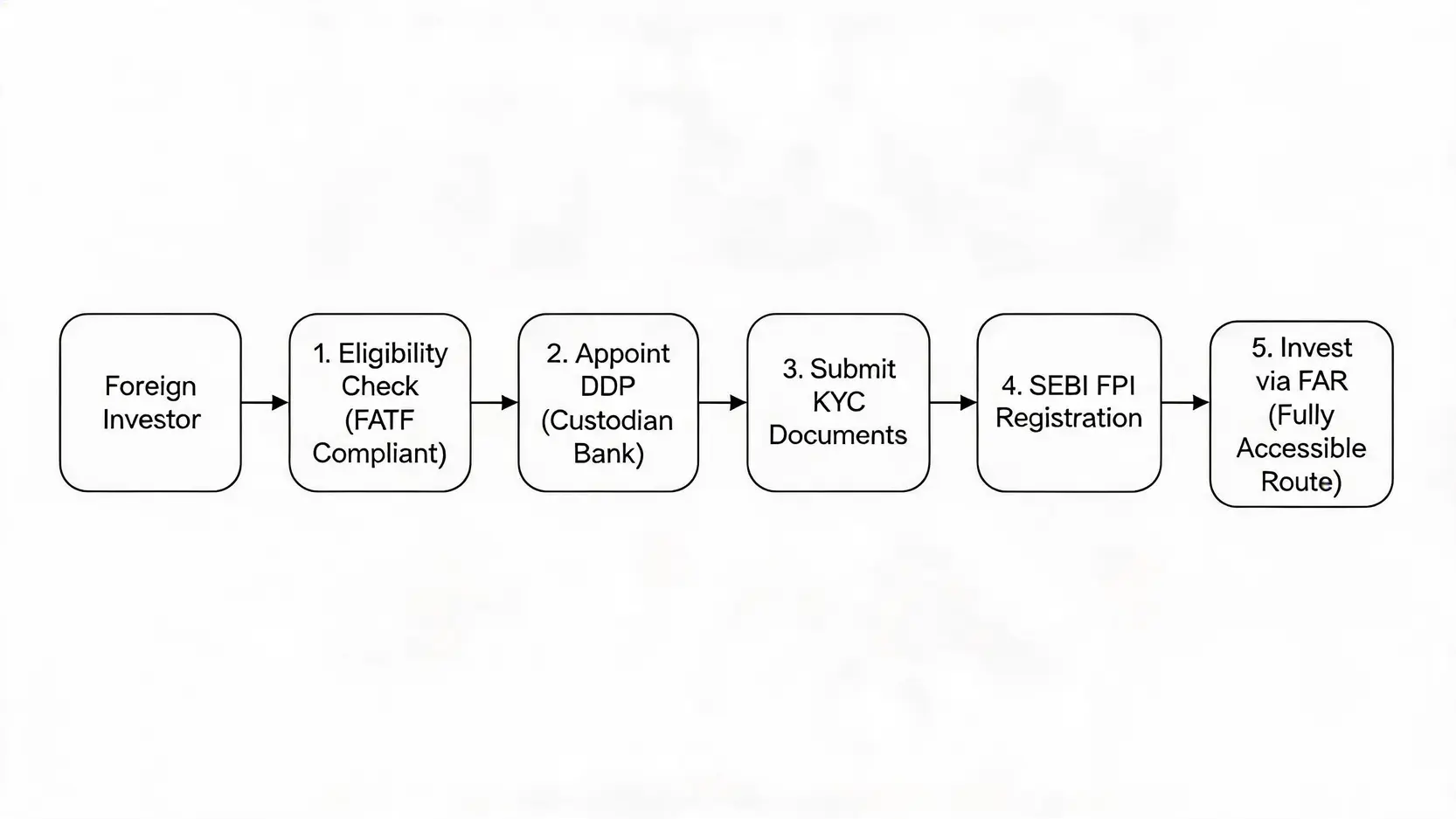
To invest directly in Indian securities, a foreign entity or individual must register as a Foreign Portfolio Investor (FPI) with the Securities and Exchange Board of India (SEBI). The process involves:
- Eligibility Assessment: The applicant must meet specific criteria, typically meaning they are not an Indian resident and are from a country compliant with the Financial Action Task Force (FATF) standards.
- Appointing a DDP: The application is submitted through a Designated Depository Participant (DDP), which is usually a custodian bank in India that acts as an intermediary.
- KYC Documentation: A comprehensive set of Know Your Customer (KYC) documents is required, including proof of identity, address, and financial standing.
While this process requires due diligence, DDPs have streamlined it to make it as efficient as possible for serious investors.
Choosing a Custodian and Brokerage Platform
The custodian (DDP) is the cornerstone of your investment operations in India. They provide essential services such as trade settlement, safekeeping of securities, dividend/interest collection, and regulatory reporting. Major global banks and domestic Indian banks offer these services. When selecting a custodian and broker, consider:
- Expertise in the FPI regime.
- Technological platform and reporting capabilities.
- Fee structure and foreign exchange conversion rates.
The Fully Accessible Route (FAR) for Investment
A key innovation that has opened the floodgates for foreign investment is the Fully Accessible Route (FAR). Under this route, specific government securities (often referred to as ‘FAR securities’) are made available to non-resident investors without any investment ceiling. This is the primary channel through which most index-related flows have entered the market. Investing via FAR simplifies the process, as it removes the complexity of tracking and adhering to various investment limits that apply to other securities.
Navigating the Landscape: Types of Indian Government Bonds
Understanding the different types of government bonds available is crucial for building a strategy that aligns with your investment horizon and risk appetite. India’s sovereign debt market is well-developed, offering a range of instruments.
Treasury Bills (T-Bills): Short-Term Investments
T-Bills are short-term debt instruments issued by the Government of India with maturities of 91 days, 182 days, and 364 days. They are zero-coupon securities, meaning they are issued at a discount to their face value and redeemed at par. T-Bills are ideal for investors with a low-risk tolerance and a short-term investment horizon, often used for managing cash and liquidity.
Dated Government Securities (G-Secs): Long-Term Bonds
These are the workhorses of the Indian bond market. Dated G-Secs are long-term bonds with maturities ranging from 2 to 40 years. They carry a fixed or floating coupon (interest rate) paid on a half-yearly basis. These are the primary instruments included in global indices and are preferred by long-term investors like pension funds and insurance companies seeking stable, predictable returns.
State Development Loans (SDLs)
SDLs are bonds issued by state governments in India to finance their fiscal deficits. While they are not sovereign debt in the strictest sense, they are considered quasi-sovereign and carry very low default risk due to the implicit support from the central government. SDLs typically offer a slightly higher yield (spread) over central government G-Secs of similar maturity, making them an attractive option for investors seeking to enhance their returns.
Risk vs. Reward: A Balanced View for Foreign Investors
No investment, particularly in emerging markets, is without risk. A prudent investor must weigh the substantial rewards of investing in Indian government bonds against the potential challenges. A thorough risk vs reward analysis for foreign investors is critical.

Potential Risks: Currency Fluctuation and Regulatory Changes
- 📉 Currency Risk: This is the most significant risk for a foreign investor. Any depreciation in the Indian Rupee (INR) against your home currency (e.g., USD, EUR) can erode your returns. While the INR has been relatively stable, it is still an emerging market currency susceptible to global risk sentiment. Hedging strategies can mitigate this risk but come at a cost.
- ⚖️ Regulatory Risk: While the current policy direction is highly favorable, future changes in government, tax laws, or FPI regulations could alter the investment landscape. Investors must stay informed about the political and regulatory environment.
- 📈 Interest Rate Risk: Like all bonds, IGBs are subject to interest rate risk. If the RBI raises interest rates to combat inflation, the price of existing bonds will fall.
Potential Rewards: High Returns and Portfolio Diversification
- 💰 High Yields: The primary reward is the attractive yield offered by IGBs, which provides a significant income stream, especially in a low-yield global environment.
- 🌏 Portfolio Diversification: Indian bonds have a low correlation with developed market assets. Including them in a global portfolio can reduce overall volatility and enhance risk-adjusted returns. For anyone exploring emerging market bond investing strategies, India now represents a core, non-negotiable allocation.
- 🚀 Economic Growth Participation: Investing in a country’s sovereign bonds is a direct play on its economic stability and growth trajectory. As India’s economy continues to expand, the creditworthiness of its government improves, further supporting bond valuations.
Comparing Indian Bonds to Other Emerging Markets
When benchmarked against other large emerging markets, India stands out for its unique combination of scale, growth, and improving market accessibility. While countries like Brazil or South Africa may occasionally offer higher yields, they often come with greater political volatility and currency risk. India’s strong domestic investor base and the RBI’s orthodox policy framework provide a layer of stability that is highly valued by institutional investors.
Conclusion
The case for investing in India government bonds for foreign investors is stronger than ever. The confluence of index inclusion, the removal of capital gains tax, and robust economic fundamentals has created a powerful, long-term opportunity. The structural inflows from index-tracking funds provide a strong technical tailwind, while the attractive yields offer a compelling return proposition. For global investors seeking meaningful diversification and enhanced yields, allocating a portion of their fixed-income portfolio to India is no longer just an option—it is a strategic necessity for navigating the financial landscape of 2026 and beyond.
Frequently Asked Questions (FAQ)
Q: What is the minimum investment for foreign investors in Indian government bonds?
A: Technically, there is no mandated minimum investment amount set by the regulator for FPIs. However, the practical minimum is determined by the custodian banks and brokerage platforms that facilitate the investment. Due to the administrative and setup costs associated with FPI registration, most platforms cater to institutional investors or high-net-worth individuals, with practical minimums often starting in the range of several hundred thousand to millions of US dollars.
Q: Are there any lock-in periods for these investments?
A: No, for FPIs investing through the Fully Accessible Route (FAR), there are generally no lock-in periods. The investments are highly liquid, and investors can buy or sell the bonds on the secondary market at any time. This flexibility is a key feature that makes the Indian bond market attractive to global fund managers who require daily liquidity.
Q: How is the interest income on Indian government bonds taxed for foreigners now?
A: Following recent policy changes, the tax regime has been simplified. While capital gains tax has been removed for foreign investors on these securities, interest income (coupon payments) is still subject to taxation. The applicable withholding tax rate can vary depending on the double taxation avoidance agreement (DTAA) between India and the investor’s country of residence. Custodians typically handle the tax withholding and compliance. It is crucial for investors to consult with a tax advisor to understand the specific implications based on their jurisdiction.
Q: What is the main difference between investing in Indian government bonds and Indian corporate bonds?
A: The primary difference lies in the issuer and the associated credit risk. Government bonds (G-Secs) are issued by the sovereign Government of India and are considered to have zero default risk, making them the safest debt instruments in the country. Corporate bonds are issued by companies and carry varying degrees of credit risk depending on the financial health of the issuer. Consequently, corporate bonds offer higher yields to compensate for this additional risk. For most foreign institutional investors, government bonds are the preferred entry point due to their high security and liquidity.