
The Nikkei 225 has captured global investor attention, shattering multi-decade highs and sparking a critical question: is this rally sustainable into 2026? As we stand in mid-2026, this is no longer a theoretical exercise. This comprehensive Nikkei 225 forecast 2026 consolidates expert analysis on specific price targets, dissects the primary economic drivers like the ongoing AI boom, and evaluates the potential impacts of the Bank of Japan’s policy shifts. We will delve into the bullish and bearish scenarios to provide a clear framework for investment strategy.
Table of Contents
2026 Nikkei 225 Forecasts: A Roundup of Major Financial Institutions
After decades of stagnation, the Japanese stock market is experiencing a structural renaissance. Major financial institutions have turned increasingly bullish, citing fundamental shifts in Japan’s economy. However, opinions diverge on the exact trajectory for the remainder of 2026, leading to a fascinating bull-versus-bear debate.
The Bull Case: Why Analysts See the Nikkei Reaching 65,000 – 75,000
The optimistic outlook is underpinned by a belief that Japan is finally breaking free from its deflationary past. Several powerful tailwinds support this view:
- Corporate Reforms Bearing Fruit: The Tokyo Stock Exchange’s push for improved capital efficiency is forcing companies to unlock value. We are witnessing record share buybacks and dividend payouts, directly benefiting investors.
- The AI Supercycle: Japan is a linchpin in the global semiconductor supply chain. Companies involved in chip-making equipment, materials, and robotics are direct beneficiaries of the sustained global investment in Artificial Intelligence. This provides a powerful, long-term earnings growth driver. Explore our AI Stocks investment guide for deeper insights into this trend.
- Monetary Policy Normalization: The Bank of Japan’s exit from negative interest rates is viewed as a vote of confidence in the economy’s health. As one Goldman Sachs analysis suggests, a central bank rate hike can actually boost the stock market by signaling a return to a normal, inflationary environment.
- Influx of Foreign Capital: Global investors, once underweight on Japan, are now flocking back. The narrative has shifted from a story of decline to one of revival and value, attracting significant capital inflows.
The Bear Case: Potential Headwinds and a Target of 55,000
Conversely, the cautious perspective focuses on external risks and the potential for policy missteps. A slide back toward 55,000 isn’t out of the question if certain headwinds intensify:
- A Rapidly Appreciating Yen: While the BOJ’s policy normalization is positive, an overly aggressive tightening cycle could cause the yen to strengthen too quickly. This would directly erode the profits of Japan’s export-heavy corporate sector.
- Global Economic Slowdown: The Nikkei 225 is highly sensitive to global demand. A recession in the U.S. or a significant slowdown in China would inevitably impact Japanese corporate earnings, particularly in the automotive and technology sectors.
- Geopolitical Flare-ups: As an energy-importing nation, Japan is vulnerable to spikes in oil prices caused by geopolitical instability. Renewed conflicts or supply chain disruptions could reignite inflationary pressures and dampen investor sentiment.
- Wage Growth Stagnation: For Japan’s recovery to be sustainable, wage growth must keep pace with inflation to fuel domestic consumption. If the impressive gains from the annual “Shunto” wage negotiations falter, the domestic demand story could weaken.
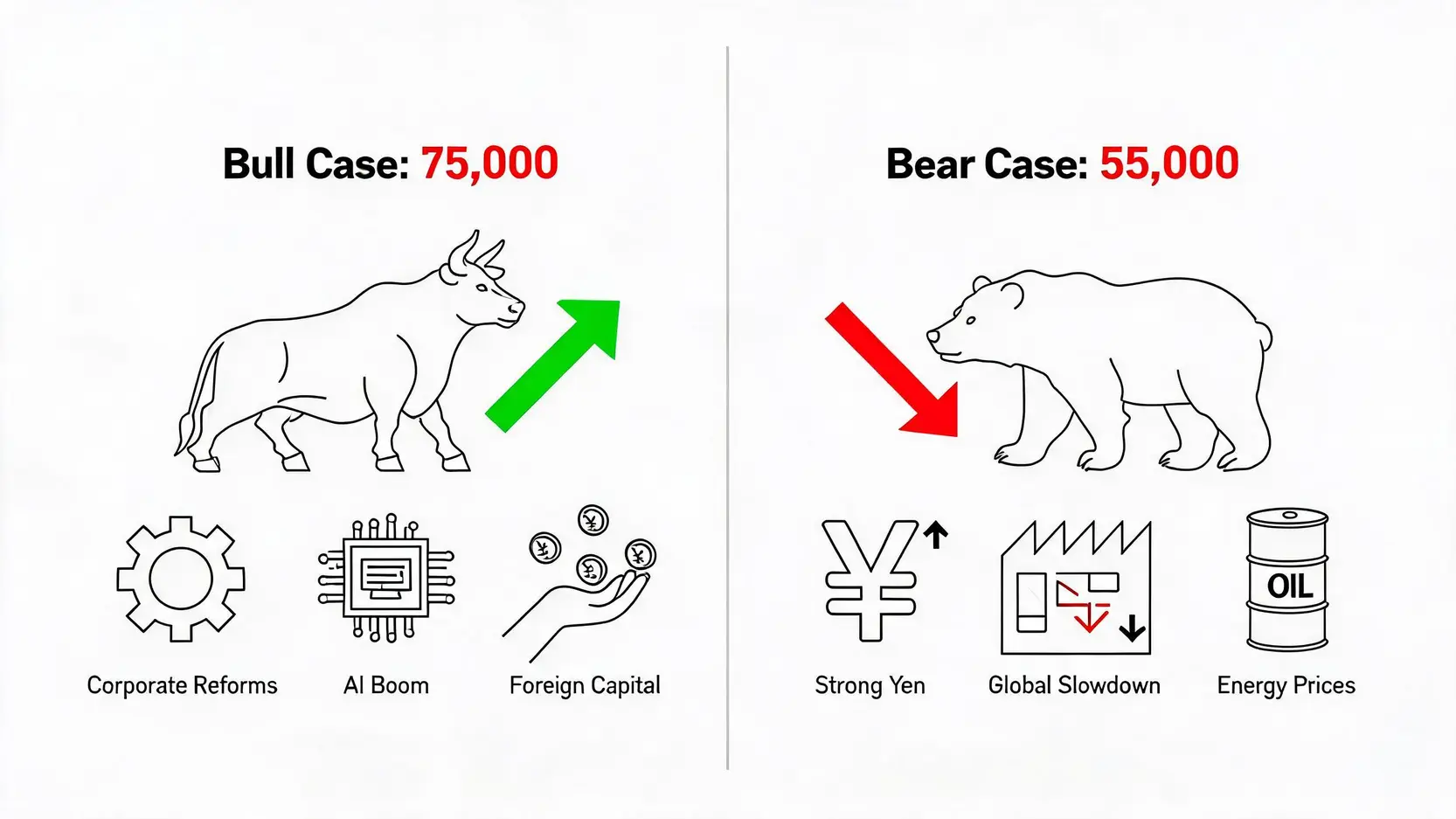
Table: Side-by-Side Comparison of 2026 Predictions
To provide a clearer picture, here is a summary of year-end 2026 price targets for the Nikkei 225 from leading financial institutions.
| Institution | Year-End 2026 Target | Key Rationale |
|---|---|---|
| Goldman Sachs | 72,000 | Strong corporate earnings, benefits from AI boom, and successful monetary policy normalization. |
| J.P. Morgan | 70,000 | Continued corporate governance improvements and attractive valuations relative to U.S. peers. |
| Vanguard | 65,000 | Positive but more cautious outlook, factoring in potential for global slowdown and yen volatility. |
| Morgan Stanley | 58,000 | Bearish view, emphasizing risks of a strong yen and sensitivity to external demand shocks. |
Top 5 Key Drivers Influencing the Nikkei 225’s price prediction in 2026
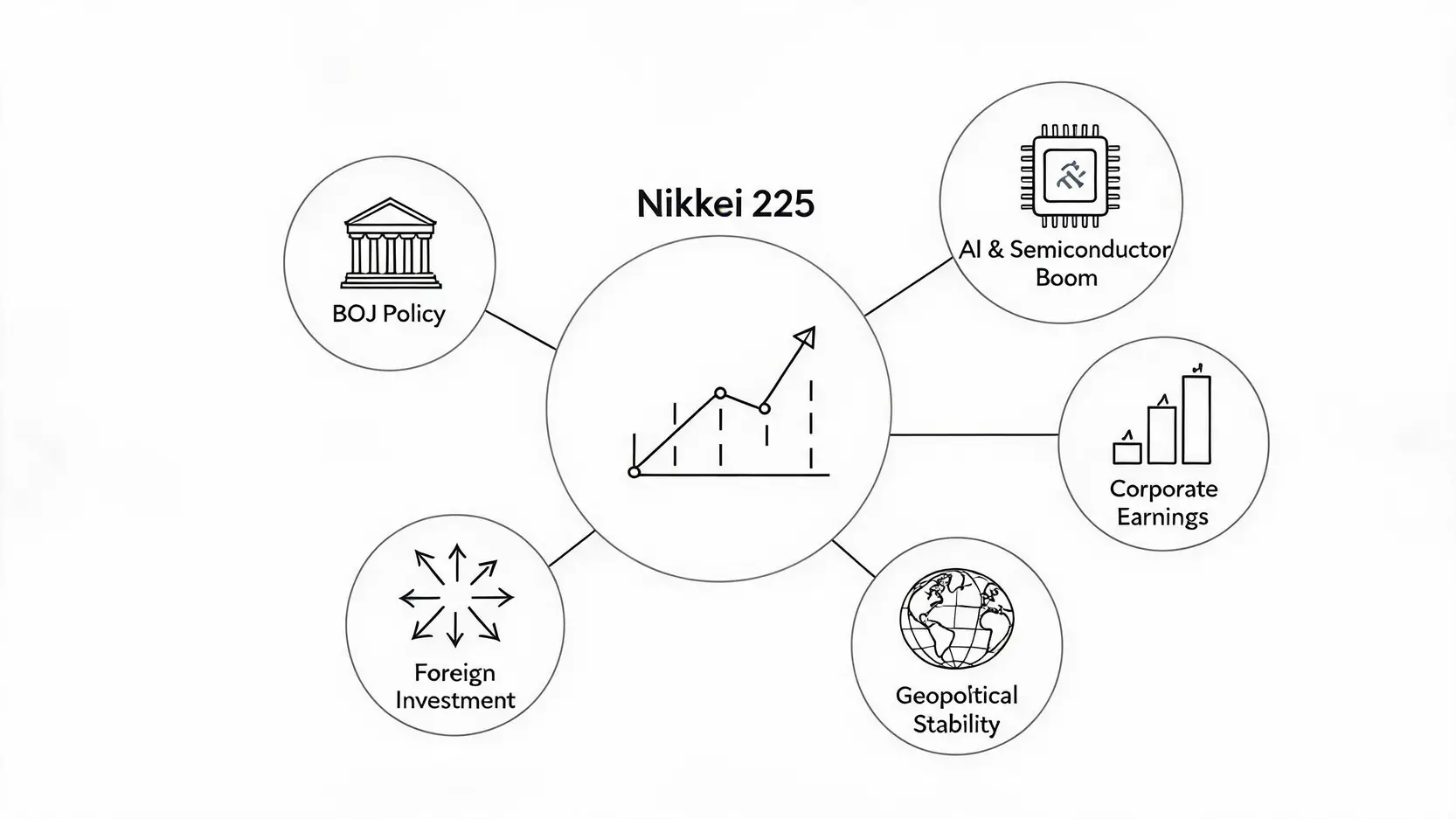
Understanding the Nikkei 225’s direction requires a deep dive into the macroeconomic and structural forces at play. Here are the five most critical factors determining the index’s performance for the rest of the year.
Driver 1: Bank of Japan’s Monetary Policy and the Yen’s Value
The Bank of Japan (BOJ) is the single most important actor. Having ended its negative interest rate policy (NIRP) and yield curve control (YCC), the central bank is now on a path of gradual policy normalization. The market is closely watching for the timing of the next rate hike. As the BOJ’s own outlook report confirms, the economy is recovering moderately, giving them scope to act. A slow, well-telegraphed hiking cycle would be bullish, signaling economic strength. However, any surprises could lead to a sharp appreciation in the Yen (JPY), which acts as a headwind for the large exporters that dominate the Nikkei 225.
Driver 2: The Global AI and Semiconductor Boom
The artificial intelligence revolution is not just a U.S. phenomenon. Japan sits at a crucial node of the semiconductor value chain, producing essential machinery, chemicals, and components. Companies like Tokyo Electron and Shin-Etsu Chemical are indispensable to global chipmakers. Sustained high demand for AI-related hardware directly translates into robust earnings for a significant portion of the Nikkei 225, making this a powerful secular growth driver.
Driver 3: Corporate Earnings Growth and Shareholder Returns
For the first time in decades, Japanese companies are laser-focused on shareholder value. Buoyed by a weaker yen in previous years and strong global demand, corporate profits are at record highs. More importantly, this cash is being returned to shareholders via dividends and buybacks at an unprecedented rate. This trend is a direct result of corporate governance reforms and is crucial for keeping investor interest high.
Driver 4: Geopolitical Stability and Energy Prices
As a major net importer of energy, Japan’s economy is highly sensitive to global energy prices. Geopolitical stability, particularly in the Middle East, is a key variable. A calm geopolitical landscape keeps energy costs in check, reduces inflationary pressure, and supports both corporate margins and consumer spending. Any disruption to this equilibrium poses a significant risk to the Nikkei 225 forecast.
Driver 5: Inflow of Foreign Investment
The ‘Warren Buffett effect’ continues to reverberate. High-profile investments have put a spotlight on the value proposition of Japanese equities. Foreign capital inflows have been a primary engine of the rally. The continuation of this trend depends on Japan’s ability to demonstrate that its structural reforms are permanent and that its economic revival is self-sustaining. Tracking foreign investor flow data is a key indicator of market sentiment.
🆕 Is Japan’s Economy Different This Time? Key Macro-Trends to Watch
The phrase “this time is different” is often a dangerous one in financial markets. However, in Japan’s case, there are compelling structural arguments that 2026 represents a genuine turning point after the ‘lost decades’.
The End of Deflation: Impact of Rising Wages and Inflation
The most significant change is the return of modest, sustained inflation. For years, falling prices disincentivized investment and suppressed consumption. Now, a tight labor market and aggressive union negotiations have led to the most significant wage increases in 30 years. This creates the potential for a virtuous cycle: higher wages lead to higher consumption, which allows companies to raise prices, further boosting profits and wages. This is the holy grail the BOJ has been seeking for over two decades.

Corporate Governance Reforms: A Structural Shift
The pressure from the Tokyo Stock Exchange (TSE) on companies with a price-to-book (P/B) ratio below 1x to improve capital efficiency cannot be overstated. This is a fundamental rewiring of Japan’s corporate culture. An analysis by Reuters highlights how these governance reforms are set to unlock a $1.8 trillion corporate cash hoard. Companies are no longer rewarded for hoarding cash; instead, they are actively deploying it through investment, M&A, and shareholder returns, creating a more dynamic and investor-friendly market.
Navigating Demographic Challenges and Domestic Demand
Japan’s aging population remains a long-term structural headwind. However, this is not a new story. In 2026, the focus is on how corporations are adapting. We are seeing a massive push into automation and robotics to offset labor shortages. Furthermore, many large-cap Nikkei companies are global players, earning a significant portion of their revenue from faster-growing overseas markets. This global footprint provides a crucial buffer against sluggish domestic demographics.
How to Invest and Trade the Nikkei 225 Based on the 2026 Outlook
Translating a market forecast into an actionable strategy depends on your investment horizon and risk tolerance. Whether you are a long-term investor or an active trader, there are various instruments to gain exposure to the Japanese market.
Strategy 1: For Long-Term Investors (ETFs & Mutual Funds)
For investors who believe in the long-term structural revival of Japan, the most straightforward approach is through diversified investment vehicles. Exchange-Traded Funds (ETFs) offer a low-cost, liquid way to buy the entire market.
- Broad Market ETFs: Look for ETFs that track the Nikkei 225 or broader indices like the Topix. Examples include the iShares MSCI Japan ETF (EWJ) and the WisdomTree Japan Hedged Equity Fund (DXJ) for those looking to neutralize currency risk.
- Thematic ETFs: Consider funds focused on specific growth areas like Japanese semiconductor companies, robotics, or firms with strong corporate governance scores.
Our comprehensive ETF Investing Guide provides a deeper look into selecting the right fund for your portfolio.
Strategy 2: For Active Traders (Futures & CFDs)
For those with a shorter time horizon looking to capitalize on volatility, derivatives such as futures and Contracts for Difference (CFDs) are powerful tools. These instruments allow traders to speculate on the price movements of the Nikkei 225 without owning the underlying assets.
- Leverage: CFDs and futures enable traders to control a large position with a relatively small amount of capital. This magnifies both potential profits and potential losses.
- Going Long or Short: Unlike stock investing, you can easily take a short position if your analysis suggests a market downturn, allowing you to profit from falling prices.
- Hedging: Active traders can use Nikkei 225 CFDs to hedge existing positions in individual Japanese stocks against a broad market decline.
Due to the inherent risks of leverage, these instruments are best suited for experienced traders. Our CFD Trading Guide offers essential insights on risk management and strategy.
Conclusion
The Nikkei 225 forecast for 2026 presents a compelling, albeit complex, picture. The bull case is supported by powerful, structural transformations: the end of deflation, aggressive corporate governance reforms, and Japan’s key role in the global AI boom. These factors suggest that the rally has a solid foundation and that targets of 70,000 or higher are plausible.
However, significant risks remain on the horizon. The index’s fate is closely tied to the Bank of Japan’s policy dexterity, the trajectory of the yen, and the health of the global economy. Investors must weigh the profound domestic changes against these persistent external vulnerabilities. While the momentum appears sustainable, a disciplined approach to risk management and a clear understanding of the key market drivers will be essential to successfully navigating the Japanese market for the remainder of the year.
Frequently Asked Questions (FAQ)
Q: What is a realistic price target for the Nikkei 225 by the end of 2026?
A: Based on a consensus of major financial institutions, a realistic median forecast points to a range of 62,000 to 65,000. However, the bull case scenario, driven by a strong global economy and successful domestic reforms, sees a potential surge past 70,000. The bear case, triggered by a global slowdown or policy error, suggests a possible pullback to the 55,000 level.
Q: What are the biggest risks to investing in the Japanese stock market in 2026?
A: The three primary risks are: 1) A rapid, uncontrolled appreciation of the Japanese Yen, which would hurt exporter profits. 2) A sharp global economic downturn, as Japan’s market is highly cyclical and dependent on international demand. 3) A faster-than-expected monetary tightening by the Bank of Japan, which could choke off the economic recovery before it becomes fully entrenched.
Q: How does the weak yen affect the Nikkei 225 forecast?
A: A weak yen is a double-edged sword. Historically, it has been a significant tailwind for the Nikkei 225 because it increases the value of profits earned overseas by Japan’s multinational exporters when converted back into yen. This boosts their stock prices. However, a persistently weak yen also raises the cost of imported goods, especially energy and raw materials, which can fuel inflation and squeeze domestic consumers.
Q: Are Japanese stocks still cheap in 2026?
A: While the Nikkei 225 has rallied significantly, Japanese equities, as a whole, still trade at a considerable valuation discount to their U.S. counterparts. The forward price-to-earnings (P/E) ratio for the Topix index remains below its long-term average and significantly lower than the S&P 500. Furthermore, over a third of Japanese companies still trade below their book value, suggesting that the corporate reform story has more room to run.