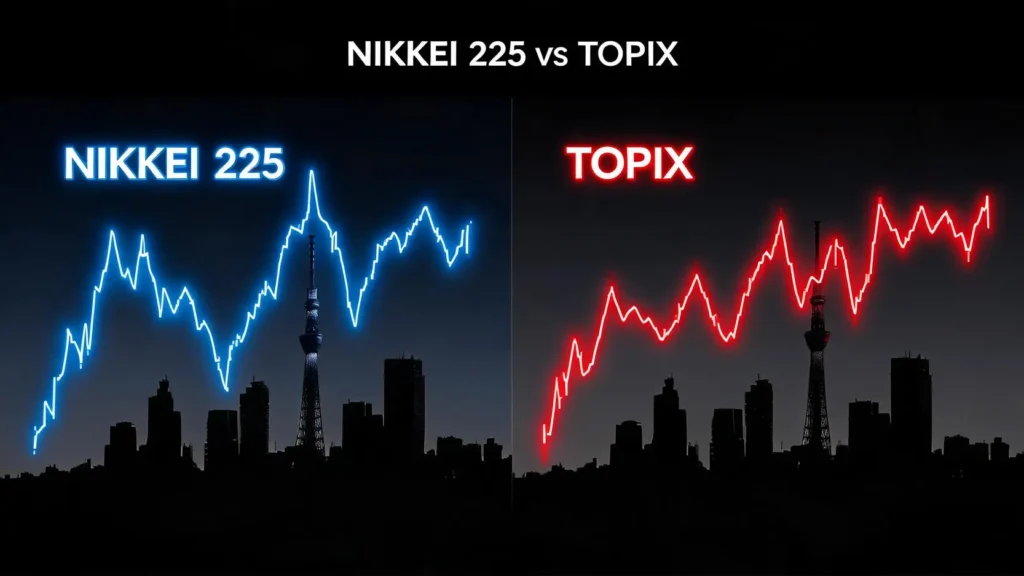
For any analyst or investor turning their attention to the Japanese stock market in 2026, two benchmarks immediately come to the forefront: the Nikkei 225 and the TOPIX. The enduring Nikkei 225 vs TOPIX debate is central to understanding the nuances of this critical market. While both serve as barometers for Japan’s economic health, their methodologies and compositions present starkly different pictures. This guide offers a definitive breakdown of their critical differences, analyzes historical performance patterns, and clarifies how to choose the right index for a robust investment strategy.
Table of Contents
What is the Nikkei 225 Index?
The Nikkei 225, officially the Nikkei Stock Average, is the most widely quoted index for the Japanese stock market. Established in 1950, it has a long history and holds significant brand recognition globally, often being compared to the Dow Jones Industrial Average (DJIA) in the United States due to its calculation method and blue-chip focus.
Composition: The 225 Blue-Chip Stocks
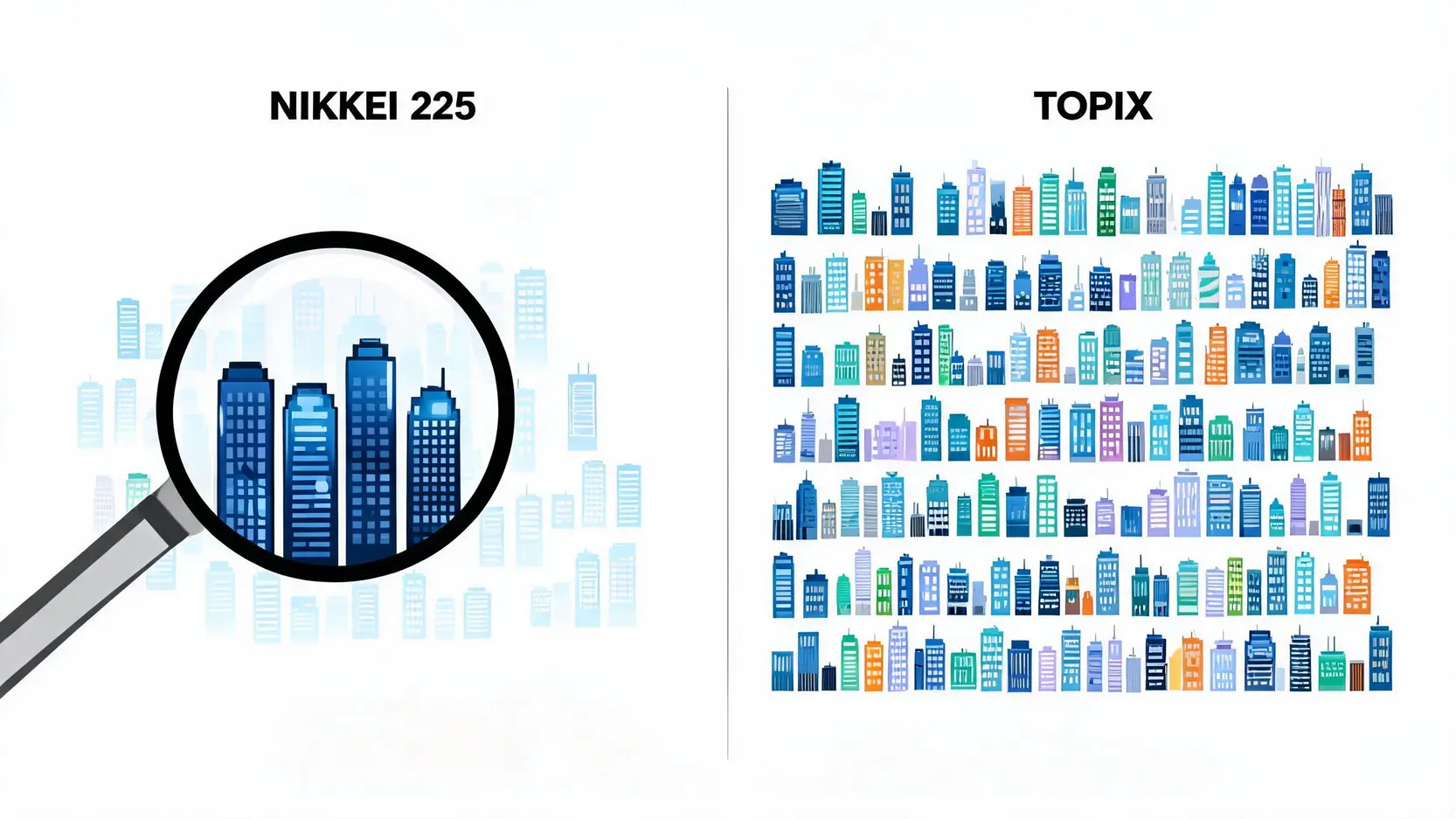
The Nikkei 225 comprises 225 large, actively traded stocks selected from the Prime Market of the Tokyo Stock Exchange (TSE). These companies are often referred to as Japan’s ‘blue-chip’ stocks, representing established leaders across various industrial sectors. The selection is reviewed annually, focusing on liquidity and sector balance to maintain its status as a representative sample of Japan’s corporate giants. For investors looking to focus on established market leaders, a guide to investing in blue-chip stocks can provide valuable foundational knowledge.
Calculation Method: The Price-Weighted Approach Explained
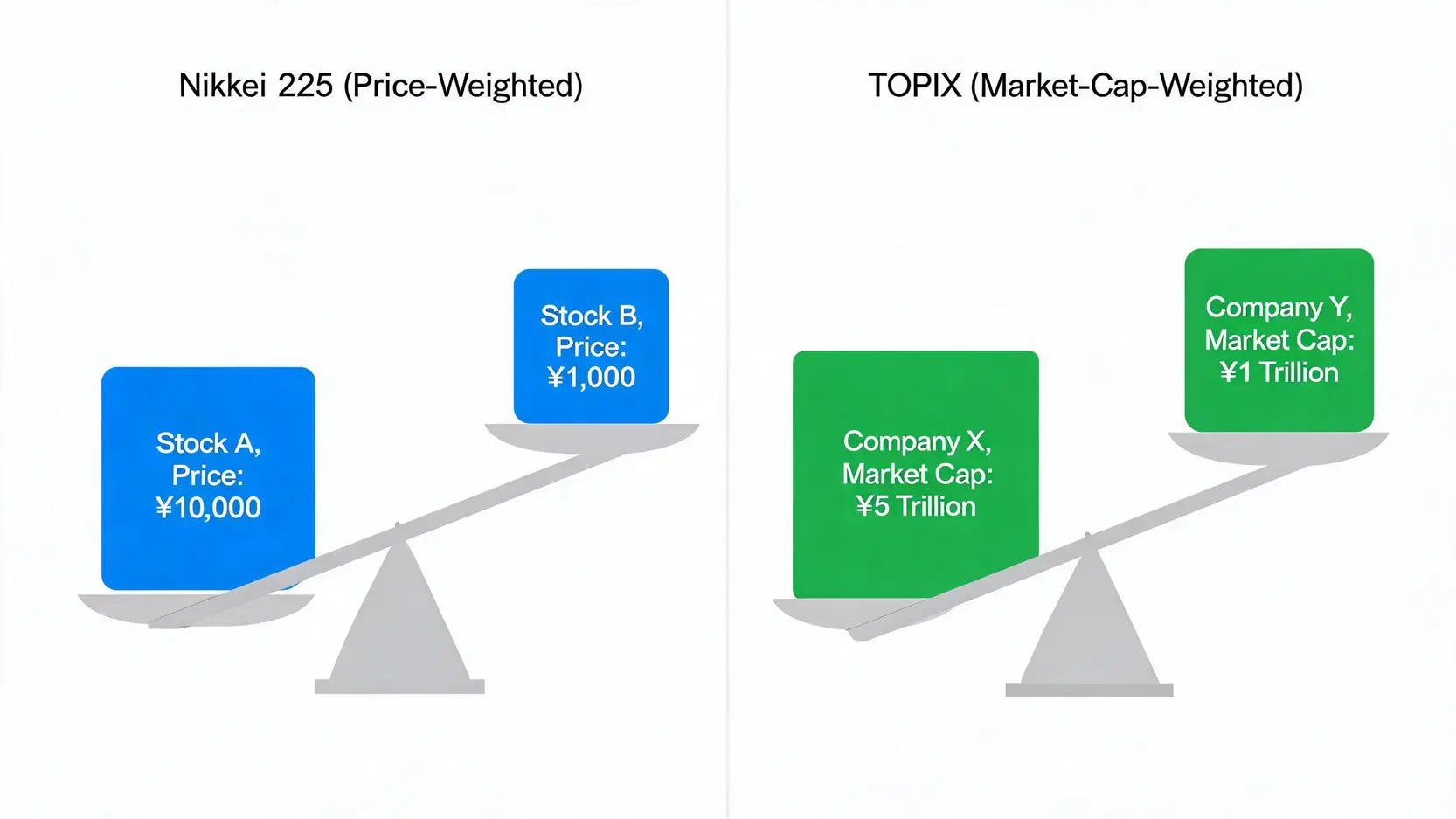
A defining characteristic of the Nikkei 225 is its price-weighted calculation. This means that stocks with higher share prices have a greater impact on the index’s value, regardless of the company’s actual size or market capitalization. For instance, a stock trading at ¥10,000 will have ten times the influence of a stock trading at ¥1,000. This methodology, while simple, can lead to distortions where the performance of a few high-priced stocks can disproportionately sway the entire index, masking the broader market trend.
What is the TOPIX (Tokyo Stock Price Index)?
The TOPIX, or Tokyo Stock Price Index, is the other major Japanese stock market index. Calculated by the Tokyo Stock Exchange itself, it is designed to provide a much broader and more accurate representation of the entire Japanese stock market. It is often compared to the S&P 500 in the U.S. due to its comprehensive scope and modern calculation methodology.
Composition: A Broad View of the Entire Market
Unlike the selective nature of the Nikkei 225, the TOPIX includes all domestic common stocks listed on the TSE’s Prime Market. As of 2026, this amounts to over 2,000 individual companies. This comprehensive inclusion means the TOPIX captures the performance of a vast range of companies, from small-cap firms to mega-corporations, offering a true panoramic view of the Japanese economy’s health and direction.
Calculation Method: The Market-Cap-Weighted Standard
The TOPIX employs a free-float adjusted market-capitalization-weighted methodology. This is the global standard for major indices. In this system, each company’s weight in the index is determined by its market capitalization (share price multiplied by the number of outstanding shares). The ‘free-float’ adjustment further refines this by only considering shares that are readily available for trading on the open market. This ensures that the largest and most valuable companies have the most significant impact on the index’s movement, providing a more balanced and representative measure of the market. Understanding this concept is key, as explained in this article about market-capitalization-weighted indices.
Key Differences: Nikkei 225 vs. TOPIX Head-to-Head
To truly grasp the implications of the Nikkei 225 vs TOPIX comparison, a direct analysis of their core differences is essential. These distinctions influence everything from performance measurement to how they are used in investment products like ETFs and futures.
Weighting Methodology: Price vs. Market Capitalization
This is the most fundamental difference. The Nikkei’s price-weighting is an older, simpler method that can be skewed by arbitrary factors like stock splits or the nominal price of a share. The TOPIX’s market-cap weighting is a more robust and logical approach that reflects a company’s actual economic footprint, which is why it is the preferred method for institutional analysis and modern index construction. As authoritative sources like Moomoo explain, this difference is central to how each index behaves.
Number of Constituents: 225 vs. Over 2,000
The Nikkei 225 is a snapshot of 225 elite companies. The TOPIX is a comprehensive photograph of the entire Prime Market. This means the TOPIX is inherently more diversified and captures the performance of mid-cap and smaller large-cap companies that are excluded from the Nikkei, offering a hedge against sector-specific downturns that might affect the giants in the Nikkei 225.
Market Representation: Blue-Chip Sentiment vs. Overall Economy
The Nikkei 225 is often seen as a gauge of sentiment for Japan’s largest, export-oriented industrial companies. Its movements can reflect global trade dynamics and the health of specific sectors like technology and automotive. The TOPIX, by contrast, provides a much more accurate reflection of the domestic Japanese economy, incorporating sectors like banking, retail, and real estate in proportion to their market size.
Side-by-Side Comparison Table
| Feature | Nikkei 225 | TOPIX |
|---|---|---|
| Calculation Method | Price-Weighted | Free-Float Market-Cap-Weighted |
| Number of Stocks | 225 | All Prime Market Stocks (~2,100+) |
| Sponsor | Nikkei Inc. (a media company) | Tokyo Stock Exchange (TSE) |
| Represents | Sentiment of large, industrial blue-chips | The overall Japanese stock market |
| Global Analogue | Dow Jones Industrial Average (DJIA) | S&P 500 |
| Institutional Use | Widely quoted, but less used for benchmarking | Preferred benchmark for professional investors |
Performance Analysis: A Historical Perspective of Nikkei 225 vs TOPIX
Historically, the Nikkei 225 and TOPIX have often moved in the same general direction, but their performance can diverge significantly over time due to their different compositions. During periods when high-priced technology or industrial stocks rally, the Nikkei 225 can outperform the TOPIX. Conversely, during broad-based market rallies where value is created across multiple sectors, the TOPIX tends to provide a more accurate and often stronger performance picture.
How They Behave in Different Market Conditions
In a risk-on environment favoring large-cap growth stocks, the Nikkei 225 might show stronger gains. However, its concentration risk also makes it more vulnerable. For example, a negative event impacting a single high-priced component like Fast Retailing (Uniqlo) can drag down the entire index. The TOPIX is more resilient to single-stock shocks due to its diversification. It tends to perform well when the broader economy is healthy and multiple sectors are advancing, making it a better indicator of underlying economic strength.
Pros and Cons for the Modern Investor
Choosing between the two indices depends entirely on an investor’s objectives, risk tolerance, and desired market exposure.
Why Choose the Nikkei 225? (Pros & Cons)
- ✅ Pros:
- High Recognition: It is the most famous Japanese index, making it easy to follow and find related news.
- Liquidity: Futures and options on the Nikkei 225 are highly liquid, making it a favorite for traders.
- Blue-Chip Focus: Offers direct exposure to Japan’s most prominent and globally recognized companies.
- ❌ Cons:
- Flawed Methodology: The price-weighting can provide a distorted view of the market.
- Concentration Risk: Overly sensitive to the performance of a few high-priced stocks.
- Not Representative: Does not accurately reflect the breadth of the Japanese economy.
Why Choose the TOPIX? (Pros & Cons)
- ✅ Pros:
- True Market Representation: Offers a comprehensive and accurate measure of the entire Japanese Prime Market.
- Diversification: Spreads risk across over 2,000 stocks and multiple sectors.
- Standard Methodology: Its market-cap weighting aligns with global standards, making it the choice for institutional investors and passive index funds.
- ❌ Cons:
- Lower Name Recognition: Less known among retail investors compared to the Nikkei.
- Can Be Dominated by Giants: While broad, mega-cap stocks like Toyota can still have a significant influence on its performance.
Which Index Should You Follow?
The decision in the Nikkei 225 vs TOPIX dilemma is a strategic one. There is no universally ‘correct’ answer, only the one that aligns with your specific investment thesis.
For Tracking Top Performers: The Nikkei 225
If your strategy is to gain a quick, concentrated exposure to the largest and most well-known industrial names in Japan, the Nikkei 225 is a suitable tool. It acts as a proxy for the health of Japan Inc.’s most powerful global players.
For Broad Market Exposure: The TOPIX
If you are a long-term investor seeking to capture the growth of the entire Japanese economy, the TOPIX is the superior choice. It offers diversification, a more accurate performance picture, and a structure that is better suited for passive investment strategies through index funds and ETFs.
A Note on Other Japanese Indices like the JPX Prime 150
It’s important for investors in 2026 to look beyond the two main indices. A newer and increasingly relevant benchmark is the JPX Prime 150 Index. Launched in 2023, this index is designed to track 150 Japanese companies selected based on their potential to create value, focusing on metrics like return on equity (ROE) and price-to-book value (P/B). It represents a shift towards a ‘quality’ focus, aiming to highlight companies with strong capital efficiency, offering a compelling alternative for investors looking to bet on Japan’s most promising enterprises.
Conclusion
In the Nikkei 225 vs TOPIX analysis, it’s clear there is no single ‘better’ index; the right choice is contingent on an investor’s goals. The Nikkei 225 offers a simple, albeit flawed, snapshot of Japan’s leading industrial giants and remains a powerful name in global finance. In contrast, the TOPIX provides a comprehensive, methodologically sound, and diversified view of the entire market, making it the benchmark of choice for serious, long-term analysis and investment. Understanding this core difference—a focused but skewed lens versus a broad and balanced picture—is the first and most critical step to making an informed decision for your Japanese market investment portfolio.
Frequently Asked Questions (FAQ)
Q: How can I invest in the Nikkei 225 or TOPIX?
A: The most common and efficient way for both retail and institutional investors to gain exposure to these indices is through Exchange-Traded Funds (ETFs). There are numerous ETFs listed on global exchanges that track the performance of either the Nikkei 225 or the TOPIX. More sophisticated investors can also use futures and options contracts for hedging or speculative purposes.
Q: Which index is more volatile?
A: While both are subject to market volatility, the Nikkei 225 can sometimes exhibit higher volatility due to its price-weighted nature. A sharp move in one or two high-priced components can cause a significant swing in the index value, which may not reflect the broader market. The TOPIX, being more diversified, tends to have smoother movements that are more representative of the overall market’s stability.
Q: Do institutional investors prefer the Nikkei or TOPIX?
A: The overwhelming preference among institutional investors, professional fund managers, and analysts is for the TOPIX. Its market-capitalization-weighted methodology and comprehensive coverage make it a far more reliable and accurate benchmark for performance measurement and portfolio construction. The Nikkei 225 is more often referenced in financial media due to its historical legacy.
Q: Does the Bank of Japan’s ETF purchase program target both indices?
A: Yes, historically, the Bank of Japan (BOJ) has purchased ETFs linked to both the Nikkei 225 and the TOPIX as part of its monetary easing policies. However, in recent years, the BOJ shifted its focus to primarily purchasing TOPIX-linked ETFs. This was a deliberate move to mitigate the market distortions caused by supporting the price-weighted Nikkei 225 and to spread its investment across the broader market more effectively.