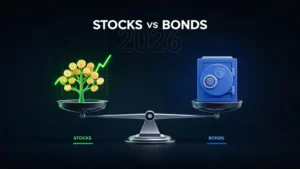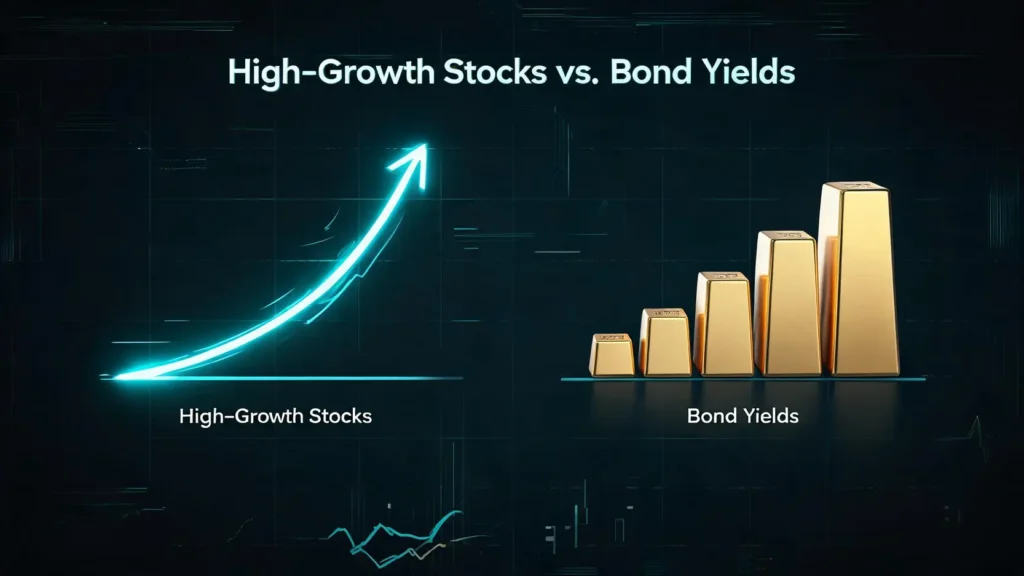
As the 2026 investment landscape unfolds, market participants face a pivotal strategic crossroads. The central dilemma involves navigating the tense relationship between high growth stocks vs bond yields for 2026, a dynamic that profoundly influences portfolio construction. Should capital be allocated to innovative, high-octane growth equities promising substantial returns, or is a pivot towards the perceived safety and income of bonds the more prudent course amidst fluctuating yields? This guide provides a definitive analysis of the impact of rising bond yields on stock valuations, offering a clear framework to navigate the complexities of the current market and make informed decisions.
Table of Contents
Understanding the Core Relationship: Why Bond Yields Affect Stock Valuations
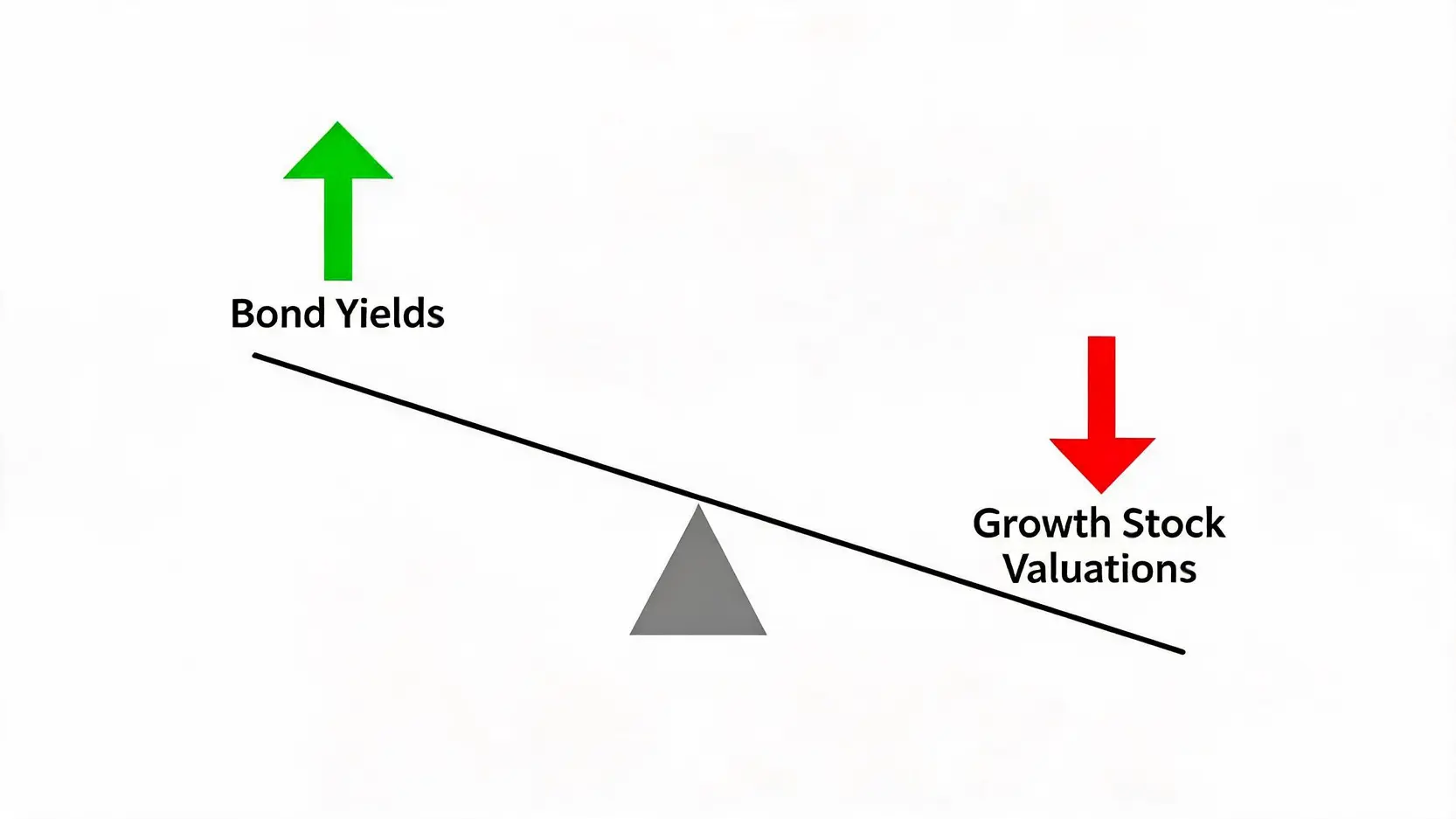
The interplay between bond yields and stock prices, particularly for high-growth companies, is one of the most fundamental concepts in modern finance. It’s not arbitrary; rather, it is rooted in the mathematical and psychological principles of valuation and risk assessment. As yields on government bonds rise, the entire financial calculus for valuing other assets shifts, creating headwinds for equities that are priced for perfection and long-term growth.
The ‘Risk-Free Rate’ Explained: How Treasury Yields Set the Bar
At the heart of this relationship is the concept of the ‘risk-free rate’. This is the theoretical rate of return of an investment with zero risk. In practice, the yield on U.S. Treasury securities (often the 10-year Treasury note) is used as the benchmark for this rate. Why? Because the U.S. government is considered to have a negligible risk of default. This risk-free rate serves as the foundational layer upon which the expected return of every other investment is built. For an investor to take on the additional risk of owning a stock, they must be compensated with a potential return significantly above the risk-free rate. This additional potential return is known as the equity risk premium. When Treasury yields rise, the baseline return available to investors increases, making the relative appeal of risky assets like stocks diminish unless they can offer even higher potential returns.
Discounted Cash Flow (DCF): Why Future Profits of Growth Stocks Are So Sensitive to Rates
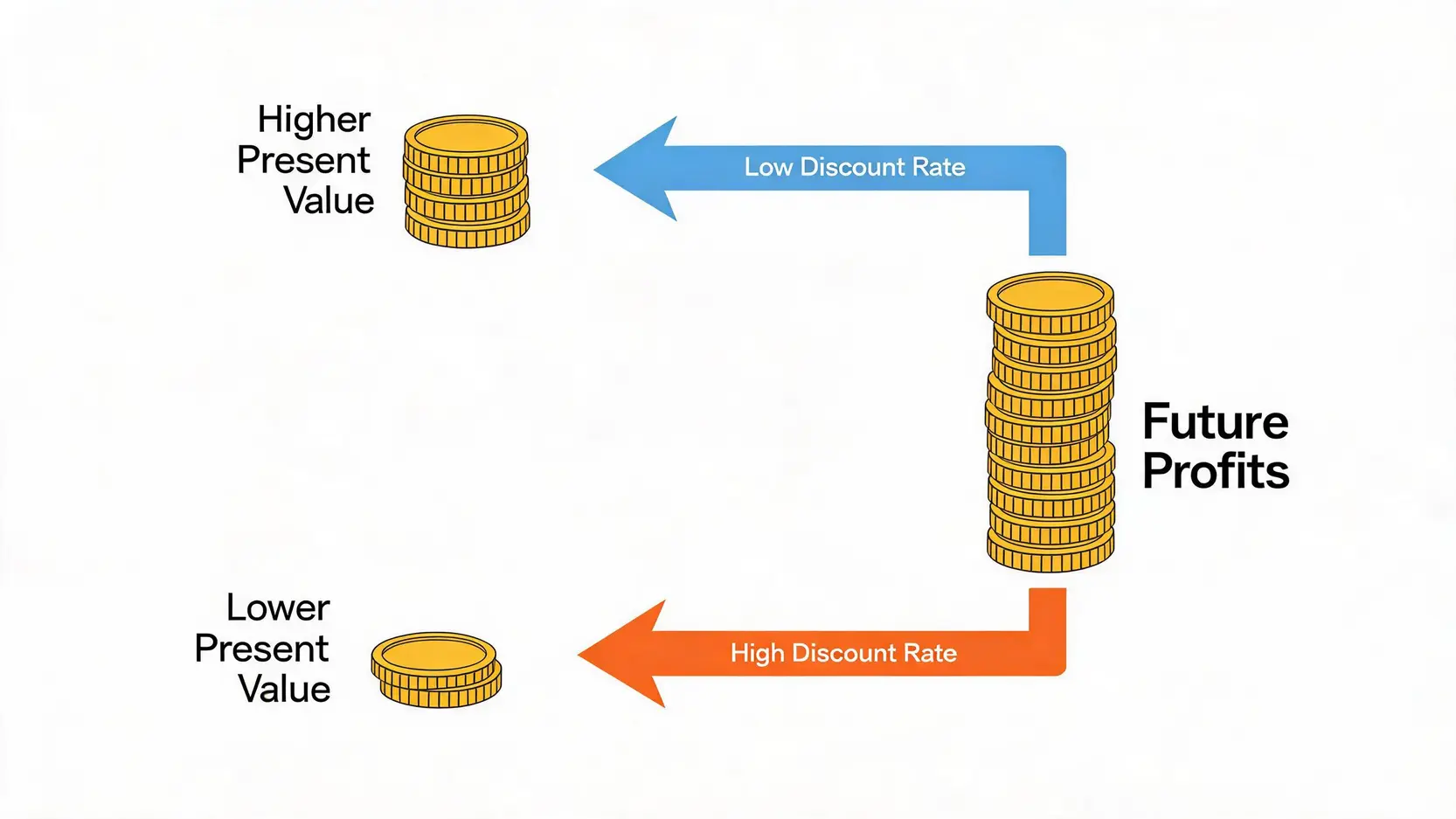
The sensitivity of growth stocks to interest rates is best explained through the Discounted Cash Flow (DCF) model. This valuation method estimates a company’s current worth by projecting its future cash flows and then ‘discounting’ them back to their present value. The discount rate used is heavily influenced by the risk-free rate.
- High-Growth Stocks: These companies, often in tech or biotech, are valued based on the promise of significant profits far into the future. The bulk of their value is derived from these long-term expectations.
- The Impact of Higher Rates: When bond yields rise, the discount rate in the DCF model increases. A higher discount rate means that those distant future profits are worth significantly less in today’s money. This effect is magnified for growth stocks because their cash flows are heavily weighted towards the future. A 1% increase in the discount rate has a much more dramatic negative impact on the present value of a profit expected in 10 years than on a profit expected next year.
The TINA (‘There Is No Alternative’) Effect and Its Potential Reversal
For much of the past decade, low interest rates created an environment nicknamed TINA, or “There Is No Alternative” to stocks. With bond yields near zero, investors seeking any meaningful return were compelled to move into equities, pushing valuations higher. However, as we stand in 2026, this paradigm has shifted. With bond yields offering competitive returns, the alternative is very much present. This reversal means stocks no longer have the monopoly on investor attention. Capital can now flow more freely into fixed-income assets, creating a more challenging environment for stock market appreciation and increasing the importance of discerning stock selection.
2026 Market Outlook: Expert Predictions for Yields and Economic Growth
Forecasting the market is an exercise in probabilities, but by analyzing central bank policies, inflation data, and economic projections, we can build a strategic framework. The outlook for 2026 hinges on the delicate balance between controlling inflation and fostering sustainable economic growth, a task primarily shouldered by the Federal Reserve.
Projected Inflation Trajectory and Federal Reserve Policy in 2026
After a period of significant price pressures, the primary question for 2026 is the trajectory of inflation and the resulting monetary policy. According to the latest Federal Reserve economic projections from March 2026, the median forecast for PCE inflation is expected to moderate towards the 2.2% – 2.5% range. This suggests that while the most aggressive phase of monetary tightening is behind us, the Federal Reserve will likely maintain a cautious stance. The market consensus points towards a policy of holding rates steady for a period to ensure inflation is firmly anchored before contemplating any significant cuts. This ‘higher-for-longer’ interest rate scenario is a critical variable for the high growth stocks vs bond yields 2026 debate.
Forecasts for the 10-Year Treasury Yield and Its Implications
The 10-Year Treasury yield is the market’s bellwether. In the current economic climate, forecasts for the 10-year yield in 2026 are clustering in a range of 3.8% to 4.5%. This level represents a significant shift from the near-zero rates of the previous era. For investors, this has two main implications:
- Higher Hurdle for Stocks: A 4% risk-free return forces a re-evaluation of equity risk. Stocks must offer a compelling growth story to justify their inherent volatility.
- Attractive Income from Bonds: Bonds are no longer just for capital preservation. They now offer a respectable income stream, making them a dual-purpose asset in a balanced portfolio.
Global Economic Growth Projections and Their Impact on Corporate Earnings
Global GDP growth is projected to be modest but stable in 2026, with most developed economies avoiding a deep recession but not achieving runaway expansion. This environment of slower, more deliberate growth puts pressure on corporate earnings. Companies that can demonstrate robust earnings growth and margin expansion in a slow-growth world will be rewarded. This puts the focus squarely on quality—strong balance sheets, sustainable competitive advantages, and pricing power. The era of revenue growth at any cost is over; profitability is now paramount, a factor that will heavily influence the performance of growth stocks.
Head-to-Head for 2026: High-Growth Stocks vs. Bonds
The decision between allocating capital to high-growth stocks or bonds in 2026 is not a simple binary choice. It requires a nuanced understanding of the arguments for and against each asset class, set against the macroeconomic backdrop we’ve discussed. Here’s a head-to-head comparison of the investment cases for this pivotal year.
The Bull Case for High-Growth Stocks: Innovation and Disruption
Despite the headwinds from higher rates, the argument for owning high-growth stocks remains compelling. The primary driver is the relentless pace of technological innovation and market disruption. 📈
- Secular Growth Trends: Fields such as Artificial Intelligence (AI), biotechnology, renewable energy, and cybersecurity are not merely cyclical plays; they are undergoing profound, long-term structural shifts. Companies leading these transformations have the potential to generate earnings growth that far outstrips the broader economy, regardless of the interest rate environment.
- Market Leadership and Pricing Power: Top-tier growth companies often hold dominant market positions, creating wide economic moats. This allows them to command pricing power, protecting their margins even during inflationary periods.
- High Reward Potential: While riskier, the potential for exponential returns from a successful growth stock can significantly enhance a portfolio’s overall performance over the long term. Identifying the next market leader can deliver returns that no fixed-income instrument can match.
The Bear Case for High-Growth Stocks: Valuation Risks in a High-Yield Environment
The primary risk for high-growth stocks in 2026 is valuation. As we’ve established, higher bond yields make future earnings less valuable today. This creates a challenging environment for stocks trading at high price-to-earnings (P/E) or price-to-sales (P/S) multiples.
- Compressed Multiples: In a high-yield world, the market is less willing to pay a premium for future growth. Even if a company meets its earnings expectations, its stock price can fall if its valuation multiple contracts.
- Profitability Pressure: Many earlier-stage growth companies are not yet profitable. A tougher funding environment, with higher costs of capital, can make their path to profitability more precarious. The market is now showing a clear preference for growth companies that also demonstrate a clear and credible path to generating positive cash flow.
The Appeal of Bonds in 2026: Capital Preservation and Income Generation
For the first time in over a decade, bonds offer a genuinely attractive alternative. Their appeal in 2026 is twofold: providing a reliable income stream and acting as a portfolio diversifier. 🛡️
- Attractive Yields: With yields on government and high-quality corporate bonds offering returns in the 4-6% range, investors can lock in a solid income stream. This is particularly appealing for those in or nearing retirement, or any investor seeking to lower their portfolio’s overall risk profile.
- Capital Preservation: High-quality bonds carry significantly less risk of capital loss than stocks. In the event of an economic downturn, bonds (especially U.S. Treasuries) often appreciate in value as investors seek safe havens.
- Diversification Benefit: The correlation between stocks and bonds, while recently positive, is historically negative. Re-establishing bonds as a core holding can help cushion a portfolio during periods of stock market volatility.
Strategic Portfolio Allocation for the 2026 Environment
Navigating the 2026 market requires a more sophisticated approach than simply choosing one asset class over the other. The optimal strategy lies in intelligent allocation, identifying pockets of opportunity, and managing risk in a way that aligns with your personal financial goals. This is where forward-thinking portfolio construction sets successful investors apart.
Identifying Resilient Growth Sectors Less Sensitive to Rate Hikes
Not all growth is created equal. The key is to find ‘resilient growth’—companies whose business models are not entirely dependent on cheap capital or a booming economy. Focus on sectors with inelastic demand and strong secular tailwinds:
- Cybersecurity: As digital threats escalate, spending on cybersecurity becomes non-discretionary for businesses, regardless of the economic climate.
- Healthcare Innovation: Companies developing breakthrough drugs or medical devices often have their growth trajectory tied to clinical trial results and demographics (like an aging population) rather than interest rates.
- Enterprise Software (SaaS with high retention): Businesses rely on mission-critical software. Companies with subscription-based models and high net retention rates exhibit utility-like revenue streams, making them more durable.
Building a ‘Barbell’ Strategy: Combining Growth Stocks and Bonds
One of the most effective approaches for this environment is the ‘barbell’ strategy. This involves concentrating your portfolio on two extremes: high-risk, high-growth assets on one side, and very low-risk, stable assets (like short-term Treasury bonds) on the other. You intentionally avoid the ‘middle ground’ of moderately risky assets.
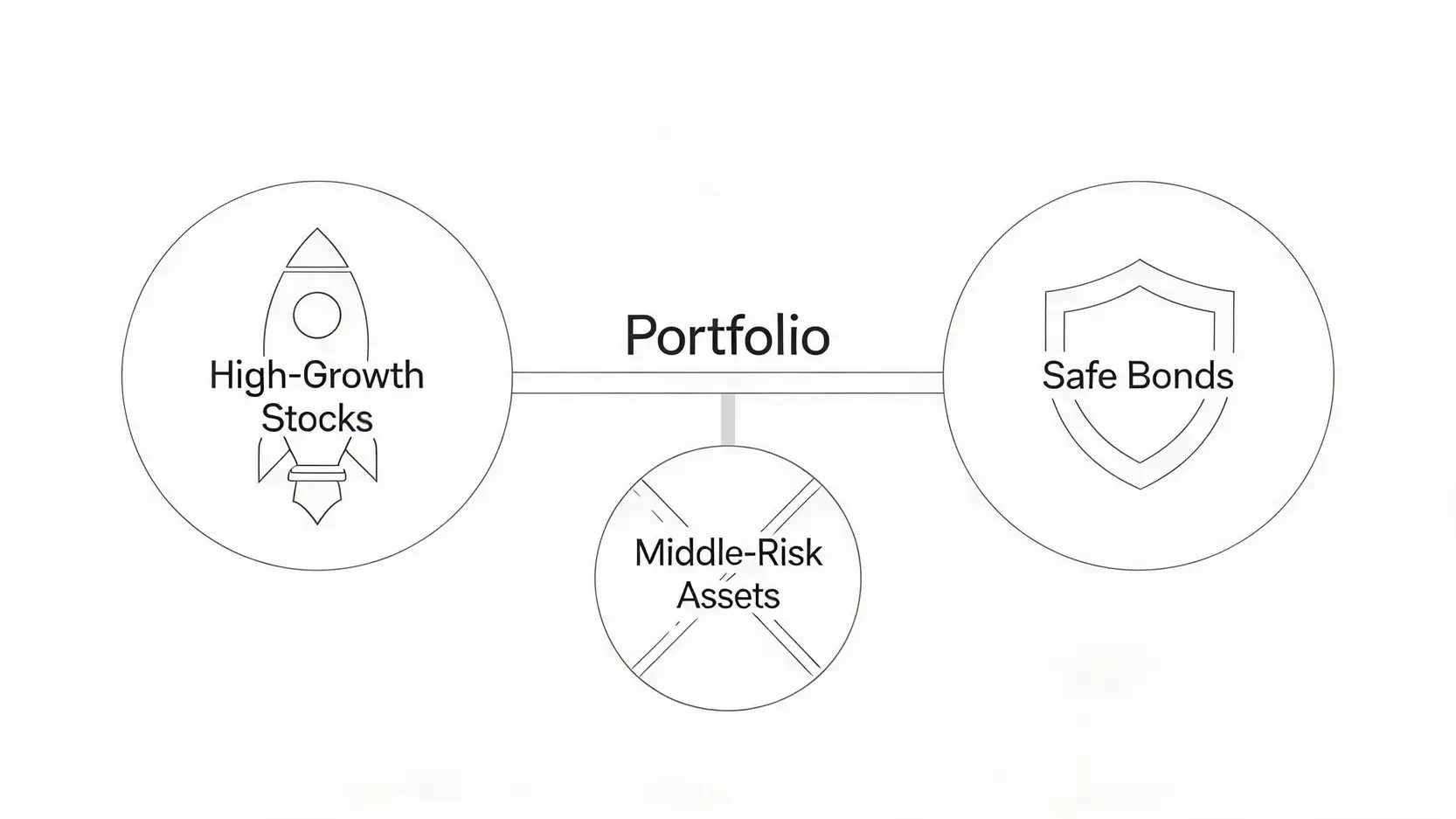
- How it Works: One end of the barbell (e.g., a curated basket of innovative tech stocks) provides the potential for significant upside. The other end (e.g., a ladder of short-duration government bonds) provides stability, income, and capital preservation.
- Why it’s Suited for 2026: This strategy is designed for uncertain times. It allows you to participate in market upside while simultaneously hedging against a downturn. The stable bond portion of the portfolio can be used to rebalance and buy more growth stocks if they sell off. For further reading, an in-depth look at this approach is available in our guide to the barbell investment strategy.
How to Assess Your Personal Risk Tolerance for the 2026 Market
No strategy is one-size-fits-all. Before making any allocation decisions, you must perform an honest self-assessment of your risk tolerance. Consider these factors:
- Time Horizon: How long until you need to access this capital? A 30-year-old investing for retirement can stomach far more volatility than someone who is five years away from it.
- Financial Situation: Do you have a stable income and a robust emergency fund? A solid financial foundation allows you to take on more investment risk.
- Psychological Fortitude: How would you react if your portfolio dropped 20% in a month? Be honest. Making emotional decisions during market downturns is one of the biggest destroyers of wealth. If volatility makes you lose sleep, your allocation is likely too aggressive.
A well-defined understanding of your own risk profile is the essential final piece of the puzzle, guiding how you balance the compelling opportunities in both growth stocks and bonds for the year ahead.
Conclusion
In conclusion, the debate between high growth stocks vs bond yields in 2026 does not yield a one-size-fits-all answer. The investment landscape has fundamentally shifted away from the TINA environment of the past decade. Bonds have re-emerged as a formidable asset class, offering both income and a potential hedge against volatility. Simultaneously, secular growth trends in technology and healthcare ensure that innovative companies will continue to present compelling opportunities for outsized returns. The optimal strategy depends on a clear-eyed assessment of the evolving economic conditions and, most importantly, on your individual financial goals, time horizon, and tolerance for risk. By understanding the dynamics we’ve outlined—the inverse relationship between yields and valuations, the importance of profitability, and the power of strategic allocation—investors can construct a resilient portfolio designed to balance risk and reward in the complex market of 2026.
Frequently Asked Questions (FAQ)
Q: What happens to growth stocks when bond yields go up?
A: When bond yields go up, growth stocks typically face downward pressure. This is primarily due to the Discounted Cash Flow (DCF) valuation principle. Higher yields increase the ‘discount rate’ used to calculate the present value of a company’s future earnings. Since growth stocks derive most of their value from profits expected far in the future, a higher discount rate makes those future earnings worth less today, leading to lower stock valuations.
Q: Are bonds a safe investment if inflation remains high in 2026?
A: Bonds are safer than stocks in terms of price volatility, but they are not entirely without risk, especially from inflation. If inflation remains persistently higher than the yield on your bond, your ‘real return’ (your return after accounting for inflation) will be negative, meaning your investment loses purchasing power. To combat this, investors can consider Treasury Inflation-Protected Securities (TIPS), whose principal value adjusts with inflation, or short-duration bonds, which are less sensitive to interest rate changes driven by inflation fears.
Q: Which stock sectors are most vulnerable to rising bond yields?
A: The most vulnerable sectors are typically those with the highest valuations and the longest-duration earnings profiles. This includes: 1) Non-profitable technology and biotech companies, which are highly dependent on future growth expectations. 2) Consumer discretionary stocks, as higher borrowing costs can dampen consumer spending on non-essential goods. 3) Real estate (especially REITs), as higher bond yields make their dividend yields less attractive and increase their borrowing costs.
Q: How does the TINA (‘There Is No Alternative’) effect change in 2026?
A: In 2026, the TINA effect has largely reversed. With 10-year Treasury yields hovering around 4% and high-quality corporate bonds offering even more, there is now a very clear and viable alternative to stocks for generating returns. This means stocks must compete for capital. Investors are no longer forced into equities to seek yield, leading to more disciplined valuations and a greater emphasis on corporate profitability and fundamentals.