
Navigating the complex macroeconomic landscape of July 2026 requires a highly disciplined approach, particularly when analyzing the trajectory of Gold and Silver ETFs After NFP. The Non-Farm Payrolls report remains the most scrutinized economic indicator globally, possessing the inherent power to reset market expectations for Federal Reserve monetary policy.
For institutional and retail market participants alike, understanding the NFP impact on metals is no longer optional—it is the bedrock of strategic asset allocation. Delving into the underlying mechanics reveals exactly how jobs data drives GLD and SLV, providing a statistical edge in an environment characterized by sudden liquidity shifts and algorithmic volatility.
As the Federal Reserve navigates the delicate balance between maximum employment and price stability in 2026, the labor market serves as the ultimate barometer for future inflationary pressures. A robust jobs report often triggers a chain reaction: surging Treasury yields, a strengthening US Dollar (DXY), and an immediate repricing of non-yielding assets.
Consequently, precious metal exchange-traded funds experience aggressive repricing. By dissecting historical price actions, ETF fund flows, and the intricate relationship between real interest rates and bullion valuations, traders can construct robust frameworks to capitalize on these high-impact macroeconomic events.
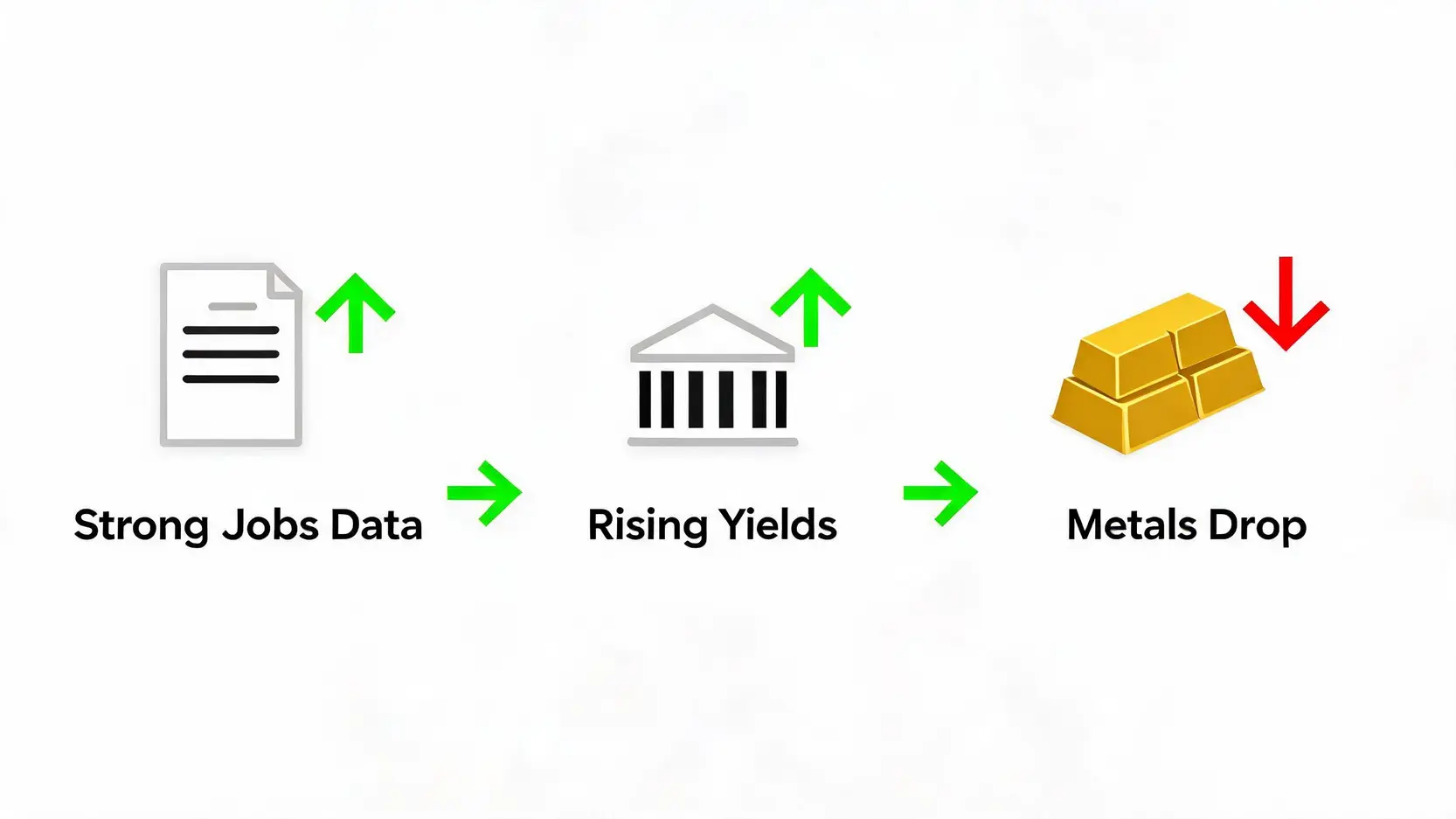
Table of Contents
Analyzing the NFP Impact on Metals: Are Gold and Silver ETFs a Buy Now?
To accurately gauge the NFP impact on metals, one must first deconstruct the components of the employment report. The headline jobs number often dictates the initial algorithmic response, but the granular data—specifically average hourly earnings and the labor force participation rate—dictates the sustained trend for precious metal ETFs. In the current 2026 economic cycle, where the Federal Reserve remains highly data-dependent, wage growth is heavily scrutinized as a leading indicator of sticky services inflation.
When the NFP report indicates job creation significantly above consensus estimates coupled with accelerating wage growth, the bond market swiftly prices in a “higher for longer” interest rate environment. Since gold and silver yield no interest, rising real yields increase the opportunity cost of holding the SPDR Gold Trust (GLD) and the iShares Silver Trust (SLV). The immediate reaction is typically a wave of institutional distribution.
Conversely, a substantial miss in the payrolls data, especially if accompanied by downward revisions to previous months, acts as a potent catalyst for bullion. To fully understand these dynamics, it is highly beneficial to study how Fed funds rate hikes influence gold prices, as the core principles remain directly applicable to employment-driven yield fluctuations.
Assessing whether Gold and Silver ETFs are a definitive buy leading into or immediately following the NFP release requires evaluating the prevailing macroeconomic baseline. If the market is heavily skewed towards rate cuts and the NFP data disappoints, the structural tailwinds for GLD and SLV intensify. However, buying blindly into the immediate post-NFP volatility is fraught with risk, as initial price spikes are often subjected to aggressive mean reversion once the European market close approaches.
Why Gold and Silver ETFs See Massive Volatility After NFP Data
The sheer magnitude of price swings in GLD and SLV following the 8:30 AM EST release of the jobs report is a manifestation of modern market microstructure. Why Gold and Silver ETFs see massive volatility after NFP can be attributed to three primary factors: liquidity withdrawal, algorithmic execution, and rapid delta hedging by options market makers. In the seconds preceding the data release, top-tier liquidity providers often widen their spreads or temporarily pull quotes to mitigate directional risk. This liquidity vacuum ensures that market orders executed at the release trigger exaggerated price gaps.
Furthermore, quantitative trading models programmed to parse the NFP headline figures execute massive block trades across Treasury futures, currency pairs, and commodity ETFs simultaneously. If the data deviates from the median Bloomberg consensus by more than two standard deviations, the resulting algorithmic stampede can push GLD and SLV through critical technical support or resistance levels within milliseconds. 📈

| NFP Scenario | Wage Growth (MoM) | DXY Reaction | GLD Implication | SLV Implication |
|---|---|---|---|---|
| Substantial Beat (>250k) | Above 0.4% | Strongly Bullish | Bearish (Yields Spike) | Bearish (Macro Tightening) |
| In-Line (150k – 200k) | 0.2% – 0.3% | Neutral | Consolidation | Slightly Bullish |
| Severe Miss (<100k) | Below 0.2% | Strongly Bearish | Highly Bullish | Mixed (Recession Fears) |
Market participants must also account for the options market. Large concentrations of call and put options expiring on the day of the NFP report force market makers to dynamically hedge their exposures. When GLD approaches a major strike price post-NFP, gamma hedging can either dampen the volatility or aggressively accelerate the breakout, depending on the dealer positioning.
GLD vs SLV: Trading Gold and Silver ETFs Around NFP Reports
While GLD and SLV often move in tandem due to their shared status as precious metal proxies, trading GLD vs SLV during NFP week requires a nuanced understanding of their diverging fundamental drivers. Gold is predominantly a monetary asset, acting as a hedge against currency debasement and systemic risk. Consequently, GLD is highly sensitive to the US Dollar Index and the 10-year Treasury yield. When the NFP data shifts the probability of Federal Reserve rate adjustments, GLD responds with clean, macro-driven directional moves.
Silver, on the other hand, possesses a dual identity. It is both a monetary metal and a critical industrial commodity, heavily utilized in the booming 2026 green energy transition and photovoltaic manufacturing sectors. Therefore, when evaluating SLV around NFP reports, traders must process two contrasting narratives. A significantly weak NFP report might boost SLV due to falling interest rates and a weaker dollar, but if the jobs data is so abysmal that it signals an impending, deep economic recession, industrial demand destruction fears can cap silver’s upside. This divergence is why the Gold-Silver ratio often experiences elevated volatility in the immediate aftermath of the employment data.

For tactical positioning, traders often employ ratio trades, simultaneously going long GLD and short SLV if they anticipate a stagflationary environment where yields drop but industrial demand collapses. Conversely, in a “Goldilocks” scenario where NFP shows stable, moderate job growth with cooling wages, SLV frequently outperforms GLD as economic optimism fuels industrial accumulation alongside an accommodative monetary backdrop.
Fundamental Mechanisms: How Jobs Data Drives GLD and SLV Prices
The exact transmission mechanism of how jobs data drives GLD and SLV prices relies on the continuous recalibration of forward interest rate curves. Institutional models ingest the NFP data to project the terminal Federal Funds Rate. This projection immediately alters the real yield—the nominal Treasury yield minus expected inflation. Precious metal ETFs exhibit an intense, negative correlation with real yields.
- Real Yield Expansion: A hot jobs report implies that inflation could remain entrenched, forcing the Fed to maintain restrictive policy. Nominal yields spike faster than inflation expectations, expanding real yields. This triggers algorithmic selling in GLD and SLV.
- Dollar Dominance: Exceptional US employment data reinforces American economic exceptionalism compared to Europe and Asia. The resultant capital inflows strengthen the US Dollar. Because GLD and SLV are dollar-denominated assets, a stronger greenback mathematically suppresses their valuation.
- ETF Inventory Flows: Authorized Participants (APs) monitor the authorized creation and redemption of ETF shares. Sustained post-NFP trends dictate capital flows. If a weak NFP confirms a rate-cut cycle, institutional capital flows into GLD and SLV, forcing APs to purchase physical bullion to back the newly created shares, creating a reflexive upward price spiral.
By monitoring the CME FedWatch Tool immediately after the NFP release, astute analysts can quantify the exact probability shifts in rate policy, allowing for highly calibrated entries into Gold and Silver ETFs rather than relying on emotional reactions to the headline numbers.
The Post-NFP Outlook: What is Next for Gold and Silver ETFs?
Establishing a definitive post-NFP outlook for Gold and Silver ETFs requires analyzing the data within the broader context of the business cycle. The immediate 24-hour reaction is merely noise; the true signal emerges when the market establishes a new trading range by the following weekly close. If a shock NFP print breaks GLD out of a multi-month consolidation pattern, it often dictates the directional bias for the remainder of the quarter.
Looking ahead in 2026, the structural arguments for holding precious metal ETFs remain robust. Unprecedented sovereign debt levels, persistent geopolitical fragmentation, and central bank diversification away from fiat reserves provide a strong underlying bid for physical metals. Therefore, when a strong NFP report causes a sharp, transient sell-off in GLD or SLV, institutional accumulators frequently view these dips as high-probability zones for capital deployment. 🛡️
Risk management remains paramount. Implementing strict position sizing and utilizing options structures—such as selling out-of-the-money put spreads on Gold and Silver ETFs during periods of elevated post-NFP implied volatility—can generate yield while positioning for longer-term macroeconomic trends.
Conclusion
The intricate dance between employment metrics and bullion valuations defines modern macroeconomic trading. The phenomenon of Gold and Silver ETFs After NFP reveals the market’s hyper-sensitivity to Federal Reserve policy trajectories and real yield fluctuations. By thoroughly analyzing the NFP impact on metals, distinguishing the fundamental differences between GLD vs SLV, and recognizing exactly how jobs data drives GLD and SLV, market participants can elevate their strategic approach from reactive speculation to calculated institutional execution. As the 2026 financial landscape continues to evolve, maintaining a rigorous, data-dependent framework will be the defining factor for capturing alpha in precious metal ETF markets.
Frequently Asked Questions
What is the typical reaction of GLD immediately following a hot NFP report?
Historically, a hotter-than-expected Non-Farm Payrolls report leads to an immediate decline in the GLD ETF. Robust job creation implies persistent inflationary pressures and a resilient economy, reducing the probability of Federal Reserve rate cuts. This drives up Treasury yields and the US Dollar, creating a highly bearish short-term environment for non-yielding gold assets.
Why does SLV exhibit higher volatility than GLD after employment data releases?
SLV tracks silver, a metal with significant industrial applications alongside its monetary properties. While gold reacts almost purely to macroeconomic and monetary variables, silver must also price in future industrial demand. A jobs report that severely misses expectations might boost gold on rate-cut hopes but could simultaneously trigger industrial recession fears, causing conflicting signals and higher volatility in SLV.
Can traders rely on the post-NFP outlook to establish long-term ETF positions?
While the initial reaction creates massive volatility and can be prone to “whipsaw” movements, the settled trend established in the days following the NFP report provides critical insights into institutional positioning. Analyzing the sustained shifts in the bond market post-NFP offers a highly reliable foundation for establishing medium to long-term positions in precious metal ETFs.
How do wage growth metrics within the NFP report impact precious metal ETFs?
Average hourly earnings directly feed into the Federal Reserve’s inflation models. Even if headline job creation is weak, unexpectedly high wage growth can trigger hawkish policy expectations, causing real yields to rise and putting downward pressure on both GLD and SLV valuations.
Are Gold and Silver ETFs a buy ahead of the next jobs report?
Pre-positioning before a major economic release like the NFP is inherently speculative and exposes portfolios to massive binary risk. Sophisticated market participants generally prefer to wait for the data to print, allowing the initial liquidity shock to subside before committing capital based on the newly established macroeconomic trajectory and real yield pricing.