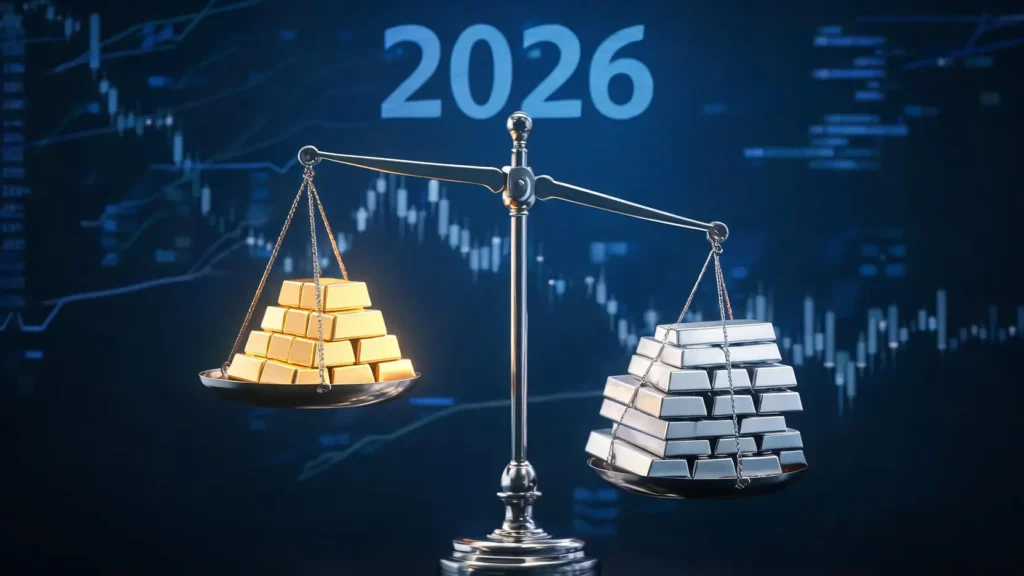
The debate over whether is silver still undervalued compared to gold in 2026 has become more nuanced following a powerful rally in precious metals. While silver may still offer considerable upside compared with gold, it is no longer automatically cheap. Prudent traders and investors must now look beyond simple historical comparisons and incorporate a more sophisticated framework.
Evaluating the gold-silver ratio, relative momentum, real yields, and industrial demand data is crucial to determining whether silver remains undervalued or if its current price has already factored in excessive optimism. This analysis provides a structured approach to answering this critical investment question for 2026.
Table of Contents
The 2026 Verdict: Has the Silver Rally Closed the Valuation Gap?
Silver is likely less undervalued than it was before its recent significant price appreciation. If the gold-silver ratio has contracted towards its long-term average, the argument for silver being ‘cheap’ weakens considerably. Therefore, traders seeking to capitalise on relative value must find additional confirmation beyond the ratio itself before concluding that a significant undervaluation persists in 2026.
Assessing Silver’s Price After the Recent Rally
A substantial price rally inherently changes the investment thesis. The primary question for investors examining if is silver still undervalued compared to gold in 2026 is one of sustainability. Early-stage bull markets are often characterised by deep undervaluation, where assets trade significantly below their historical norms.
However, as a rally matures, prices begin to reflect improved fundamentals and positive sentiment. By 2026, silver will have likely moved from a phase of ‘deep value’ to one of ‘momentum’. This transition means that while further gains are possible, the risk of a correction increases.
Investors must analyse the drivers of the rally: was it driven by monetary factors (falling real yields, a weaker dollar), a surge in industrial demand, or speculative investment flows? A rally built on a broad base of fundamental support is more durable than one driven purely by speculation, which is a key consideration when deciding if is silver still undervalued compared to gold in 2026.
Why Silver May Still Offer Upside Compared to Gold
Despite the rally, several factors could support continued outperformance for silver relative to gold.
Firstly, during sustained precious metal bull markets, the gold-silver ratio tends to compress significantly, often overshooting its historical average to the downside. If the ratio in 2026 remains above the lows seen in previous cycles (e.g., below 40), an argument can be made for further silver strength.
Secondly, silver’s dual nature as both a monetary and industrial metal provides a unique catalyst.
A global economic expansion, particularly in green energy sectors like solar panels and electric vehicles, could fuel industrial demand, providing a tailwind that gold does not possess. This industrial component is central to the long-term analysis of whether is silver still undervalued compared to gold in 2026.
What the Gold-Silver Ratio Actually Tells Traders
The gold-silver ratio is a tool for assessing relative value, not an absolute buy or sell signal. It simply measures how many ounces of silver are required to purchase one ounce of gold. While a high ratio suggests silver is historically cheap relative to gold, it does not guarantee a reversal or predict the timing of such a move. It is a powerful sentiment and valuation indicator that must be used in conjunction with other market data.
Defining the Gold-Silver Ratio Simply
At its core, the ratio is a simple calculation: the current price of gold divided by the current price of silver. For example, if gold is trading at £2,000 per ounce and silver is at £25 per ounce, the ratio is 80 (2000 / 25).
This means it takes 80 ounces of silver to buy one ounce of gold. This figure provides a historical yardstick. By comparing the current ratio to its long-term average and its historical highs and lows, traders can gauge whether one metal is over or undervalued relative to the other.
This context is fundamental to understanding if is silver still undervalued compared to gold in 2026.
How to Interpret a Falling vs. Rising Ratio
The direction of the ratio is as important as its absolute level. A deep understanding of its movements is essential for anyone asking is silver still undervalued compared to gold in 2026.
- Falling Ratio: This indicates that silver is outperforming gold. The price of silver is rising faster than the price of gold, or the price of gold is falling faster than silver. This is typically seen during periods of strong economic growth and high investor appetite for risk, often referred to as ‘risk-on’ environments.
- Rising Ratio: This signifies that gold is outperforming silver. Gold’s price is rising more quickly, or silver’s price is falling more sharply. This often occurs during times of economic uncertainty, recession, or geopolitical stress, as investors seek the relative safety and liquidity of gold—a ‘risk-off’ environment.
Using Historical Averages to Identify Extremes
The long-term average of the gold-silver ratio over the 20th century was approximately 50-60. When the ratio moves significantly above this range (e.g., to 80, 90, or even over 100), it signals that silver is historically inexpensive compared to gold.
Conversely, when the ratio drops well below this average (e.g., to 40 or 30), it suggests silver has become relatively expensive. These extremes can present strategic opportunities. A trader might consider a pairs trade—buying silver and selling gold—when the ratio is at a historical high, betting on a ‘reversion to the mean’.
This historical context is a cornerstone of the argument for those who believe is silver still undervalued compared to gold in 2026, but its predictive power is not absolute.
Why Silver Can Outperform Gold in Bullish Precious Metal Cycles
Silver often behaves like a high-beta version of gold due to its smaller market size and significant industrial demand component. During periods of broad-based strength in precious metals, investment flows have a more pronounced impact on the silver price, leading to more aggressive upward movements. This volatility is a double-edged sword but is the primary reason silver can generate superior returns.
The Impact of Market Size and Investment Flows
The total silver market is substantially smaller than the gold market. Consequently, a similar-sized capital inflow from investors (e.g., into ETFs or physical bullion) will have a much larger percentage impact on the silver price than on gold.
This market dynamic means that when sentiment turns positive for precious metals, silver can attract a wave of investment that causes its price to accelerate rapidly.
This leverage effect is a key reason why discussions about whether is silver still undervalued compared to gold in 2026 often focus on its potential for explosive gains.
Industrial Demand as a Unique Bullish Driver for Silver
Over half of all silver consumed annually is used in industrial applications, a characteristic not shared by gold, which is predominantly a monetary and jewellery asset. This industrial demand creates a solid price floor and a unique growth driver. Sectors at the forefront of the green energy transition, such as solar energy (photovoltaic cells) and electric vehicles, are highly silver-intensive.
As global governments and corporations continue to invest in these technologies, the structural demand for silver is expected to grow. This provides a compelling, long-term bullish narrative that is independent of investor sentiment and central to determining if is silver still undervalued compared to gold in 2026.
Silver as a High-Beta Play on Gold
‘Beta’ measures an asset’s volatility relative to a benchmark. In the context of precious metals, silver typically exhibits a higher beta than gold. When the macroeconomic environment is favourable for gold (e.g., falling real interest rates, geopolitical instability), investors often pile into silver seeking amplified returns.
They view it as ‘leveraged gold’. This behaviour means that during strong uptrends, silver not only rises but often does so at a faster pace than gold. However, the reverse is also true.
In downturns, silver’s higher beta means it can fall further and faster, making its risk profile significantly different from that of gold.
Key Signals That Silver is No Longer Undervalued
The argument for silver being undervalued weakens significantly when the gold-silver ratio approaches its historical average, price gains decouple from industrial demand, or market stress causes a flight to the safety of gold. Recognising these signals is critical for risk management and for avoiding buying into an overextended market. The core question, is silver still undervalued compared to gold in 2026, must be revisited when these conditions emerge.
When the Gold-Silver Ratio Returns to Historical Norms
The most straightforward indicator that the undervaluation gap is closing is the gold-silver ratio itself. If a period of silver outperformance drives the ratio down from extremes (e.g., 90+) to its long-term average range of 50-60, the ‘cheapness’ argument evaporates. At this point, the trade is no longer about relative value but about outright momentum.
Continuing to hold or initiate long silver positions requires a different thesis, one based on expectations of continued broad market strength rather than a simple valuation correction. A ratio in the 40s or below would historically suggest that silver has become overvalued relative to gold.
Analysing Divergence Between Price and Industrial Demand
A significant red flag emerges if silver’s price rises dramatically while data on industrial demand remains stagnant or weakens. For example, if Purchasing Managers’ Index (PMI) data from major economies like China and the US begins to decline, suggesting a manufacturing slowdown, it could undermine a key pillar of silver’s value. A price rally driven solely by investment demand without the support of industrial consumption is less sustainable.
This divergence increases risk, as investment sentiment can be fickle, while industrial demand provides a more stable baseline. Monitoring this relationship is key to a sophisticated analysis of whether is silver still undervalued compared to gold in 2026.
Why Investors Prefer Gold During Market Stress
In times of acute financial crisis or a sudden spike in market volatility (a ‘risk-off’ event), capital tends to flow towards the highest-quality, most liquid safe-haven assets. In the precious metals space, that asset is gold. Central banks hold gold as a reserve asset, not silver. Its market is deeper and more liquid. Because of silver’s industrial component and higher volatility, it is often treated as a riskier asset during these periods.
Consequently, a sharp economic downturn or a credit event could cause the gold-silver ratio to rise abruptly as investors sell silver and buy gold, regardless of the prevailing undervaluation narrative.
How to Build a Gold-Silver Ratio Trading Plan for 2026
A robust trading plan for 2026 should integrate gold-silver ratio signals with macroeconomic data, focusing on trend strength and risk management. The ratio should be used to identify potential opportunities and to signal when momentum may be shifting, rather than as a standalone timing tool. Contextualising the ratio’s movements is essential for success.
The following table provides a framework for interpreting and acting on signals from the gold-silver ratio, a crucial element for anyone deciding if is silver still undervalued compared to gold in 2026.
| Ratio Signal | Possible Meaning | Trader Focus |
| Ratio is high (>85) and falling | Silver is outperforming gold from a historically cheap level. Bullish momentum is building. | Confirming the trend with rising investment flows and positive industrial data. Focus on trend strength and entry points. |
| Ratio is mid-range (55-70) and falling | The outperformance trend is mature. The ‘easy money’ from the valuation gap has been made. | Monitoring for signs of trend exhaustion. Focus on risk management and trailing stops. |
| Ratio is flat or consolidating | Gold and silver are moving in tandem, or the market is pausing. No clear relative value signal. | Patience is key. Wait for a confirmed breakout in the ratio (up or down) before making a directional bet. |
| Ratio is low (<50) and rebounding | Silver’s momentum is weakening or reversing. Gold is beginning to outperform. | High risk of a pullback in silver. Consider taking profits on long silver positions or initiating pairs trades (long gold, short silver). |
| Ratio is surging (rising sharply) | A risk-off event is likely underway. Defensive demand heavily favours gold. | High downside risk for silver. Avoid long silver positions until the ratio stabilises. Gold is the preferred safe haven. |
Combining Ratio Signals with Real Yields and Dollar Data
No market signal works in a vacuum. The predictive power of the gold-silver ratio is magnified when confirmed by other key macroeconomic indicators. Precious metals, which offer no yield, tend to perform best when real yields (government bond yields minus inflation expectations) are falling. A falling ratio accompanied by declining real yields is a very potent bullish signal for silver.
Similarly, since precious metals are priced in US dollars, a weakening dollar generally acts as a tailwind. A trader in 2026 should look for confluence: a falling ratio, negative or falling real yields, and a stable-to-weaker US dollar to provide the highest conviction for a long silver position.
Conclusion: A More Cautious Outlook for 2026
In summary, the crucial question of whether is silver still undervalued compared to gold in 2026 requires a qualified answer. After a significant rally, the deep undervaluation that may have previously existed has likely diminished.
While silver may still possess upside potential relative to gold, particularly if industrial demand remains robust and the macroeconomic backdrop is supportive, the argument is no longer as clear-cut. Traders should evolve their approach from a simple ‘reversion to the mean’ strategy based on the gold-silver ratio to a more comprehensive analysis.
By integrating ratio analysis with data on real yields, the US dollar, and industrial activity, investors can build a more resilient framework for navigating the precious metals market in 2026 and beyond. Relying on the ratio as a standalone signal is a strategy fraught with risk; its true power lies in its ability to confirm or contradict a broader market thesis.
Frequently Asked Questions (FAQ)
Is silver still undervalued compared to gold in 2026?
It is less undervalued than before its recent rally. By 2026, if the gold-silver ratio has moved closer to its historical average (e.g., 50-60), the valuation discount will have narrowed significantly. Its potential for outperformance will then depend more on continued momentum and strong industrial demand rather than just being ‘cheap’.
What is the gold-silver ratio?
The gold-silver ratio measures how many ounces of silver are needed to purchase one ounce of gold. It is calculated by dividing the price of gold by the price of silver. A high ratio suggests silver is relatively cheap compared to gold, while a low ratio suggests it is relatively expensive.
Does a lower gold-silver ratio mean silver is stronger?
Yes. A falling or lower ratio indicates that silver is outperforming gold. This happens when silver’s price increases at a faster rate than gold’s, or when gold’s price falls more sharply than silver’s. It is a sign of silver’s relative strength in the market.
Is silver a riskier investment than gold in 2026?
Yes, silver is generally considered a riskier and more volatile investment than gold. Its smaller market size means prices can move more dramatically. Furthermore, its significant industrial use makes it more sensitive to the global economic cycle. During market downturns, investors typically favour gold’s safe-haven status, which can lead to larger price drops for silver.