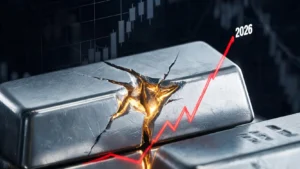
The question of will silver prices drop in 2026 has become increasingly pertinent for investors navigating the complexities of the commodities market. After a period of significant upward momentum, the prospect of a price correction looms. It is critical to understand that silver prices could indeed fall in 2026, even whilst the long-term supply and demand narrative remains fundamentally bullish. The market’s vulnerability stems from several macroeconomic factors, including potential US dollar rebounds, persistently high interest rates, and a cyclical downturn in industrial demand.
These elements, combined with natural profit-taking from traders, create a compelling bearish setup that warrants careful examination. The pivotal question is not whether silver possesses a strong long-term story, but whether the market has already priced in an excess of optimism, leaving it exposed to a significant pullback.
This analysis will dissect the primary risks and provide a framework for identifying the difference between a healthy market consolidation and a more dangerous trend reversal, directly addressing the core concern: will silver prices drop in 2026?
Table of Contents
Will Silver Prices Drop in 2026 After the Recent Rally?
Yes, silver prices are susceptible to a significant drop in 2026, particularly if key macroeconomic headwinds intensify. A strengthening US dollar, a resurgence in real yields, or a slowdown in global industrial activity could each act as a powerful catalyst for a downward correction. After any prolonged rally, an asset becomes more sensitive to shifts in market sentiment and underlying economic data.
A period of price consolidation or a pullback is a natural and often healthy market mechanism, allowing for the absorption of new information and the repositioning of market participants. Therefore, a potential price drop should not be automatically interpreted as the end of silver’s long-term bullish prospects. It may simply signify that the market advanced too far, too quickly, and a recalibration is necessary.
The critical task for investors is to distinguish between a temporary setback and a fundamental shift in the primary trend. The factors explored in this article provide a robust checklist for making that distinction. Understanding these nuances is key to answering if will silver prices drop in 2026 in a way that is actionable for a portfolio.
The narrative that will silver prices drop in 2026 is not about refuting the long-term case for the metal, which is underpinned by finite supply and growing demand from green technologies. Instead, it is an acknowledgement of market dynamics where valuations can overshoot fundamentals. Speculative froth, driven by momentum traders, can create an unstable price structure.
When the macroeconomic environment turns less favourable, this froth can quickly dissipate, leading to sharp price declines. For traders, this environment presents both risk and opportunity. For long-term investors, it underscores the importance of not being swayed by short-term volatility and focusing on the underlying drivers.
The analysis of whether will silver prices drop in 2026 requires a multi-faceted approach, considering monetary policy, currency markets, and industrial health in equal measure.
Factor 1: A Stronger U.S. Dollar Could Pressure Silver Prices
A primary catalyst that could cause silver prices to drop in 2026 is a sustained rebound in the U.S. dollar. The inverse relationship between the dollar and precious metals is one of the most reliable in financial markets. As the world’s reserve currency, major commodities, including silver, are priced in U.S. dollars. Consequently, when the dollar strengthens against other currencies, it takes fewer dollars to purchase an ounce of silver.
More importantly, it makes silver more expensive for investors holding other currencies, such as the Pound Sterling, Euro, or Yen. This reduction in foreign purchasing power can directly dampen international demand, putting downward pressure on prices. Traders must closely monitor the U.S. Dollar Index (DXY), which measures the dollar’s strength against a basket of major currencies.
A decisive break above key resistance levels in the DXY would be a significant bearish signal for silver and a strong indicator that will silver prices drop in 2026 is a scenario that is actively unfolding.
The Inverse Relationship Between the DXY Index and Silver
The DXY’s movements are often a reflection of the U.S. Federal Reserve’s monetary policy relative to other central banks. If the Fed maintains a more hawkish stance—keeping interest rates higher for longer to combat inflation—while other central banks like the European Central Bank or the Bank of England begin to ease policy, capital is likely to flow into dollar-denominated assets. This drives up the value of the dollar.
For silver, this creates a dual headwind: not only does it become more expensive in foreign currency terms, but the higher interest rates associated with a strong dollar also increase the opportunity cost of holding a non-yielding asset like silver.
Historical analysis consistently shows periods of significant dollar strength coinciding with stagnation or declines in silver prices. Any forecast questioning will silver prices drop in 2026 must place the trajectory of the DXY at the centre of its analysis.
Factor 2: High Interest Rates Increase the Opportunity Cost of Holding Silver
Elevated real yields represent a fundamental threat to silver’s valuation and are a core reason why silver prices could drop in 2026. Silver, like gold, is a non-yielding asset. It does not pay interest or dividends. Therefore, its attractiveness as an investment is heavily influenced by the returns available from interest-bearing assets, such as government bonds. When real yields—the return on a government bond after accounting for inflation—are high, the opportunity cost of holding silver increases.
Investors may prefer the safety and guaranteed return of a bond over the price speculation of silver. If sticky inflation forces central banks to delay expected rate cuts or even signal further tightening, bond yields could rise, making silver a less appealing store of value. This dynamic is crucial; a shift in interest rate expectations can trigger a rapid reallocation of capital away from precious metals. The debate over will silver prices drop in 2026 is, in many ways, a debate about the future path of global interest rates.
The Critical Role of Real Yields in Silver Valuation
Investors must focus on real yields, not just nominal interest rates. Real yield is calculated as the nominal yield minus the rate of inflation. Silver tends to perform best in environments of negative real yields, where inflation is higher than bond yields, causing bond investors to lose purchasing power. In this scenario, silver’s role as a tangible store of value becomes highly attractive.
Conversely, if central banks successfully bring inflation under control while keeping nominal rates relatively high, real yields will rise. A positive and rising real yield is one of the most bearish environments for silver. Any trader assessing will silver prices drop in 2026 must have a clear view on the direction of both inflation and central bank policy to accurately gauge the likely trajectory of real yields.
Factor 3: Industrial Demand Weakness Could Hurt Silver More Than Gold
A slowdown in industrial activity is a unique and potent risk for silver that could trigger a price drop in 2026, causing it to underperform gold significantly. This is silver’s key point of differentiation. While gold’s value is overwhelmingly derived from its monetary role as a safe-haven asset and store of value, silver has a dual identity. Over 50% of silver’s annual demand comes from industrial applications. This makes the metal highly sensitive to the global economic cycle.
If manufacturing activity, as measured by Purchasing Managers’ Indexes (PMIs), begins to contract, or if key sectors like solar panel production, electronics manufacturing, or the automotive industry face a downturn, demand for physical silver will fall. This industrial component, which acts as a powerful support during economic expansions, can quickly become a major source of price pressure during a recession. This cyclical vulnerability is a compelling reason to believe the answer to will silver prices drop in 2026 could be yes.
Key Industrial Sectors to Monitor
To assess the risk of an industrially-driven price drop, investors should monitor the health of several key sectors:
- Photovoltaics (Solar Panels): The green energy transition has been a massive driver of silver demand. Any slowdown in solar installations due to subsidy changes, supply chain issues, or economic recession would significantly impact silver consumption.
- Electronics and 5G Technology: Silver’s superior conductivity makes it essential in everything from mobile phones to advanced circuitry. A slump in consumer electronics sales is a direct negative for silver demand.
- Automotive Sector: Modern vehicles, particularly electric vehicles (EVs), contain significant amounts of silver in their electrical components. A downturn in global car sales would reduce demand.
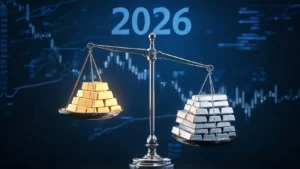
A simultaneous weakening across these sectors would provide a clear and bearish answer to the question of will silver prices drop in 2026, potentially causing the gold-silver ratio to rise as silver underperforms its sister metal.
How Traders Can Distinguish a Healthy Pullback from a Dangerous Reversal
For traders, the most critical skill is to differentiate between a normal, healthy price correction within an uptrend and the beginning of a more dangerous, sustained reversal. Not all price drops are equal. A healthy pullback often occurs on lower volume and serves to shake out weaker hands before the next leg up.
A reversal, however, is typically characterised by a fundamental shift in the underlying market drivers and is accompanied by strong selling pressure. By monitoring a checklist of key intermarket signals, traders can better assess the nature of a price drop and make more informed decisions.
The following table provides a framework for interpreting market signals to determine if a silver price drop is a buying opportunity or a warning sign to reduce exposure. This framework is essential for navigating the uncertainty around if will silver prices drop in 2026.
| Pullback Type | What to Watch | Trader Takeaway |
|---|---|---|
| Healthy Pullback | Stable USD, low real yields, falling gold-silver ratio, support holds on light volume. | Trend still intact. Dip may be a buying opportunity. |
| Dangerous Pullback | Rising DXY, higher real yields, gold-silver ratio rebounds, weak copper/industrial metals. | Bullish momentum is fading. Downside risk is increasing. |
| False Breakdown | Support breaks briefly, then price quickly closes back above it on strong volume. | Potential bear trap. Quick recovery signals buyer strength. |
| Confirmed Reversal | Major support fails with heavy selling, weak industrial data, rising real yields, strong USD. | Bearish shift confirmed. Rallies may be sold. |
In conclusion, while the long-term fundamentals for silver may point towards higher prices, the potential for a significant drop in 2026 cannot be ignored. The confluence of a strengthening U.S. dollar, rising real interest rates, and a slowdown in industrial demand creates a formidable set of headwinds. A price drop is not only possible but is a probable outcome if these bearish factors align. However, a pullback does not automatically signify the end of the bull market.
For traders and investors, the key is not to predict the future with certainty but to prepare for different scenarios. By carefully monitoring the signals outlined above—the dollar’s trajectory, the behaviour of real yields, the gold-silver ratio, and key industrial data—market participants can effectively distinguish between a temporary dip and a lasting downturn, allowing for more strategic and informed decision-making.
Frequently Asked Questions (FAQ)
Will silver prices drop in 2026?
Yes, it is plausible that will silver prices drop in 2026, especially if specific macroeconomic conditions materialise. A price drop could be triggered by a combination of a resurgent US dollar (tracked by the DXY), rising real interest rates (as government bond yields outpace inflation), and a cyclical slowdown in global industrial demand, which accounts for over half of silver’s use.
What are the main triggers for a silver price correction in 2026?
The three primary triggers are: 1) Monetary Policy: A more hawkish stance from central banks like the U.S. Federal Reserve, leading to higher-for-longer interest rates. 2) Currency Markets: A sustained period of U.S. dollar strength, which makes silver more expensive for foreign buyers. 3) Economic Growth: A global manufacturing recession that curbs demand for silver in sectors like solar, electronics, and automotive.
Is a potential silver price drop in 2026 a buying opportunity?
It depends on the nature of the drop. If the pullback is a ‘healthy correction’ where long-term fundamentals remain intact (e.g., dollar is stable, real yields are low), it could be a buying opportunity. However, if the drop is a ‘dangerous reversal’ driven by a fundamental shift (e.g., soaring real yields, industrial recession), it would signal further downside and would not be an ideal entry point.
How can traders effectively spot a silver trend reversal?
Traders can spot a reversal by looking for a confluence of signals. This includes price breaking below major technical support on high volume, a rising US Dollar Index (DXY), increasing real yields, a rising gold-silver ratio (indicating silver is underperforming gold), and negative reports from industrial data sources like PMI surveys. A single signal can be misleading, but when they occur together, the probability of a trend reversal is much higher.