The silver price forecast 2026 remains a subject of intense debate among investors and analysts. The market is caught in a powerful tug-of-war between bullish fundamentals, such as a persistent supply deficit and robust industrial demand, and significant macroeconomic headwinds, including the potential for a stronger U.S. dollar and elevated real interest rates.
For traders and investors in the UK, the primary question extends beyond how high silver can climb; it centres on whether the current rally is sustainable, driven by tangible demand, or merely speculative momentum. This analysis provides a trader-focused framework for navigating the conflicting signals, examining the bull and bear cases, and identifying the key indicators that will likely shape the silver price forecast 2026.
Table of Contents
Silver Price Forecast 2026: Why Are Analysts So Divided?
Analyst forecasts for silver prices in 2026 diverge significantly because the metal possesses a unique dual identity. It acts as both a precious metal, sensitive to monetary policy and investor sentiment, and an industrial commodity, responsive to the cycles of the global economy. This dual nature means its valuation depends on a wider, and often conflicting, set of variables compared to gold.
Comparing Forecasts: J.P. Morgan, World Bank, and Reuters Estimates
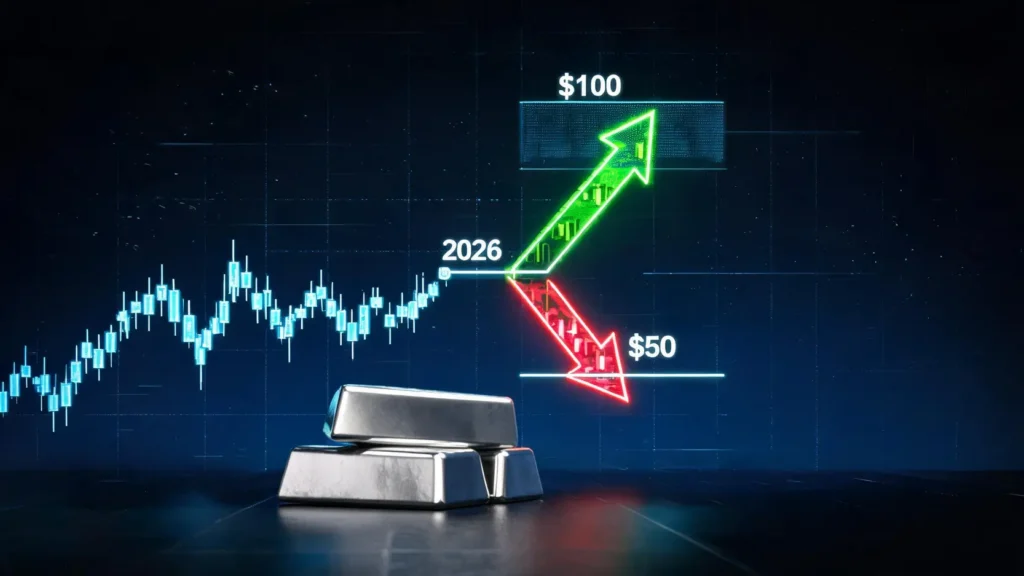
The division in outlook is best illustrated by comparing projections from major financial institutions. Each institution places different weights on monetary policy, industrial demand, and supply dynamics, leading to a wide range for the silver price forecast 2026. Some analysts prioritise the ongoing supply deficit and green energy transition, leading to highly bullish targets.
In contrast, others focus on the risk of sustained high interest rates and a resilient U.S. dollar, which traditionally act as headwinds for precious metals. The table below highlights the stark differences in recent institutional price targets.
| Institution | 2026 Silver Price Forecast (per ounce) | Implied Market Stance |
| J.P. Morgan Global Research | $81 | Strongly Bullish |
| Reuters Analyst Poll (Median) | ~$79.50 | Moderately Bullish |
| World Bank | ~$38 | Conservative / Bearish |
The Dual Nature of Silver: Precious Metal vs. Industrial Commodity
Understanding silver’s dual character is fundamental to interpreting any silver price forecast 2026. More than 50% of silver’s annual demand comes from industrial applications, a stark contrast to gold, where industrial use is less than 10%.
- As a Precious Metal: Silver is viewed as a store of value and a hedge against inflation and currency debasement. In this role, its price is heavily influenced by interest rates (particularly U.S. real yields) and the strength of the U.S. dollar. Lower real yields reduce the opportunity cost of holding non-yielding assets like silver, making it more attractive.
- As an Industrial Commodity: Silver is a critical component in some of the world’s fastest-growing industries, including solar panels (photovoltaics), electric vehicles (EVs), 5G mobile technology, and artificial intelligence (AI) hardware. Strong global economic growth and progress in the green energy transition directly translate to higher physical demand for silver, supporting its price regardless of monetary conditions.
This conflict is central to the varied 2026 outlook. A scenario with slowing economic growth might weaken industrial demand, but if it prompts central banks to lower interest rates, investment demand could surge. Conversely, a booming economy could drive industrial demand higher while simultaneously encouraging tighter monetary policy, creating a challenging environment for investors to navigate.
The Bull Case for Silver: Supply Deficit and Investment Demand
The primary bull case for a higher silver price forecast 2026 is anchored in a persistent and deepening structural supply deficit. For several consecutive years, global silver demand has significantly outstripped total supply from mine production and recycling, forcing a drawdown of existing above-ground inventories. This fundamental imbalance provides a strong structural support for prices.
Analysing the Structural Supply Deficit in the Silver Market
Data from The Silver Institute consistently highlights this deficit, which exceeded 200 million ounces in recent years. This shortfall is not a temporary anomaly but a structural trend driven by two key factors:
- Stagnant Mine Production: Global silver mining output has struggled to grow. A decade of underinvestment in exploration and development following the price collapse after 2011 has limited the pipeline of new projects. Furthermore, a significant portion of silver is produced as a by-product of lead, zinc, and copper mining, meaning its supply is often inelastic to its own price.
- Surging Industrial Demand: As noted, demand from the green energy and technology sectors is accelerating. The global push to expand solar capacity is particularly significant, as photovoltaics are a major source of silver consumption. This demand is largely price-inelastic, as the cost of silver is a small fraction of the total cost of a solar panel or an electric vehicle.
This enduring deficit suggests that any significant increase in investment demand could create a ‘squeeze’ in the physical market, leading to a rapid and potentially explosive upward movement in price, a key component of any bullish silver price forecast 2026.
The Role of ETF Inflows and Physical Investment Demand
While industrial demand provides a high floor for prices, investment demand acts as a powerful accelerator. When investors’ appetite for silver grows, it can quickly overwhelm the already-tight physical market. Key indicators of this demand include:
- Exchange-Traded Fund (ETF) Holdings: Inflows into silver-backed ETFs, such as the iShares Silver Trust (SLV), remove large quantities of physical silver from the market and place it into secure vaults. A sustained period of inflows is a strong bullish signal.
- Retail Demand for Bars and Coins: Sales of physical silver products from sovereign mints (like The Royal Mint) and private dealers reflect grassroots investor sentiment. Spikes in demand for these products often precede or coincide with significant price rallies.
Should macroeconomic conditions in 2026 shift towards a weaker dollar and lower rates, investment capital is likely to flow aggressively into precious metals, where silver, being a much smaller market than gold, could see its price move disproportionately higher.
The Bear Case: Dollar Strength, High Rates, and Profit-Taking Risk
Despite the compelling supply-demand story, a bearish silver price forecast 2026 cannot be dismissed. The primary risks are macroeconomic and stem from the actions of central banks, particularly the U.S. Federal Reserve. A scenario where inflation remains stubbornly high, forcing the Fed to maintain or even increase interest rates, would be highly detrimental to silver prices.
How a Stronger U.S. Dollar Could Pressure Silver Prices
Silver, like most commodities, is priced in U.S. dollars globally. Consequently, the value of the dollar has a direct and inverse impact on its price. A strengthening U.S. Dollar Index (DXY) makes silver more expensive for holders of other currencies, which can dampen demand, particularly in key consumer markets like India and China.
If the U.S. economy outperforms its global peers in 2026, leading to a stronger dollar, it would create a significant headwind for silver, potentially overriding the bullish supply fundamentals in the short to medium term.
The Impact of Real Yields on Non-Yielding Assets
Perhaps the most critical factor for any precious metal is the real yield. This is the return an investor can expect from a government bond after accounting for inflation (e.g., the yield on a 10-year U.S. Treasury note minus the inflation rate). Silver provides no yield, so when real yields on safe assets like government bonds are high and rising, the opportunity cost of holding silver increases.
Investors may prefer to earn a guaranteed, risk-free return from a bond rather than holding a non-yielding, volatile asset. A sustained period of high real yields in 2026 would severely undermine the investment case for silver and could trigger significant outflows from ETFs, placing downward pressure on the silver price forecast 2026.
Furthermore, silver is notoriously more volatile than gold. Following a sharp price rally, the risk of profit-taking and liquidation by hedge funds and other speculative traders is high. This can lead to sharp and rapid pullbacks, even if the long-term fundamental picture remains bullish.
Key Signals for Traders to Watch in 2026
For traders, the most effective approach is not to rely on a single silver price forecast 2026 but to build a framework for monitoring key confirmation signals. These indicators provide real-time insight into whether the bull or bear case is gaining ascendancy. By tracking these data points, traders can make more informed decisions and adapt to changing market conditions.
| Signal | Bullish Meaning | Bearish Meaning |
| U.S. Dollar Index (DXY) | A weakening dollar (DXY falling below key support levels) makes silver cheaper in other currencies, supporting global demand. | A strengthening dollar (DXY rising above key resistance) creates a major headwind for all commodities, including silver. |
| Real Yields | Falling real yields (e.g., below 1%) reduce the opportunity cost of holding silver, boosting its appeal as an investment. | Rising real yields make risk-free bonds more attractive and pressure non-yielding assets like silver and gold. |
| Gold-Silver Ratio | A falling ratio indicates silver is outperforming gold, a classic sign of a strong bull market in precious metals. | A rising ratio signals that silver is underperforming gold, suggesting weaker speculative or industrial momentum. |
| Industrial Metals | Strong prices for copper and other base metals confirm healthy global industrial activity, which supports physical silver demand. | Weakness in copper prices can be a leading indicator of a global economic slowdown, signalling pressure on industrial demand for silver. |
| ETF Flows | Consistent and significant inflows into silver ETFs confirm strong financial demand from institutional and retail investors. | Sustained outflows from ETFs indicate that investors are liquidating positions, either for profit-taking or due to a change in sentiment. |
Silver Price Scenarios for 2026: Bull, Base, and Bear Outlooks
Synthesising the bull and bear cases, we can construct three potential scenarios for the silver price forecast 2026. Each scenario is contingent on the evolution of the key signals identified above. This framework allows for a more dynamic approach than a static price target.
| Scenario | Trigger | Silver Price Logic |
| Bull Case | The Federal Reserve begins a clear easing cycle, causing the U.S. dollar to weaken and real yields to fall. The supply deficit tightens further due to accelerating green-tech demand. | Silver could break past previous highs, potentially targeting the upper range of analyst forecasts like J.P. Morgan’s $81/oz level or higher, as both investment and industrial demand fire simultaneously. |
| Base Case | The market remains conflicted. Tight physical supply provides support, but sticky inflation keeps monetary policy restrictive, limiting investment inflows. Economic growth is moderate but not booming. | Silver may trade in a wide and volatile range. The price would be caught between the high floor set by industrial demand and the ceiling imposed by macroeconomic pressures, leading to sharp swings but no sustained trend. |
| Bear Case | Stubborn inflation prompts the Fed to hold rates higher for longer, leading to a strong dollar rebound. A global economic slowdown simultaneously hits industrial demand, leading to ETF outflows and position unwinding. | A significant pullback risk emerges. Silver could fall to test lower support levels, potentially moving towards the more conservative forecasts issued by institutions like the World Bank (sub-$40/oz). |
Conclusion: A Structurally Bullish but Tactically Volatile Outlook
The silver price forecast 2026 presents a compelling but complex picture. The long-term outlook is structurally bullish, underpinned by an undeniable supply deficit that is unlikely to resolve soon and ever-growing demand from essential future-facing industries. This provides a solid foundation for prices and suggests that the path of least resistance over the coming years is upwards.
However, traders and investors must respect the significant tactical volatility that macroeconomic factors can impose. Silver’s path will not be a straight line. The direction of the U.S. dollar and real yields will act as the primary gatekeepers for significant investment-led rallies. A disciplined approach is therefore essential.
Instead of fixating on a single price target, the prudent strategy is to utilise a framework of confirmation signals—monitoring the dollar, real yields, the gold-silver ratio, and ETF flows—to validate the prevailing trend and manage risk effectively in what promises to be an eventful year for the silver market.
Frequently Asked Questions (FAQ)
What is the consensus silver price forecast for 2026?
There is no clear consensus. Forecasts are widely divided, reflecting silver’s dual nature. Bullish analysts like J.P. Morgan target levels around $81 per ounce, citing supply deficits. More conservative bodies like the World Bank project prices closer to $38 per ounce, emphasising macroeconomic risks like high interest rates.
Can silver reach new highs in 2026?
Yes, it is possible under a specific set of bullish conditions. This would likely require a pivot to easier monetary policy from the U.S. Federal Reserve, leading to a weaker U.S. dollar and falling real yields. If this coincides with the ongoing supply deficit and strong industrial demand, the combination could trigger strong investment inflows and push prices toward, or beyond, previous record highs.
Why are silver price predictions so different?
Predictions differ because analysts place varying importance on silver’s two key roles. Those who focus on its industrial applications—in solar, EVs, and electronics—and the persistent supply shortfall tend to have very bullish forecasts. Conversely, analysts who prioritise its role as a precious metal are more cautious, focusing on headwinds from a strong U.S. dollar and high interest rates, which increase the opportunity cost of holding silver.
What are the most important signals for traders to watch before buying silver?
Traders should monitor a dashboard of key indicators rather than a single signal. The most critical are: the U.S. Dollar Index (DXY), as an inverse relationship is typical; U.S. real yields, as falling yields are bullish; the gold-silver ratio, where a falling number indicates silver is outperforming; and ETF investment flows, where consistent inflows signal strong investor sentiment.