As the financial landscape of 2026 unfolds, the persistent signs of US dollar weakness present a critical inflection point for global investors. This environment demands more than passive observation; it calls for a proactive US dollar weakness ETF strategy to both shield assets and seize emerging opportunities. For those looking to implement effective hedging strategies against dollar depreciation, understanding the nuanced impact of a weak dollar on international investments is the first step toward building a resilient and profitable portfolio. This guide provides a detailed playbook, breaking down five actionable ETF strategies designed for navigating this specific economic climate.
Table of Contents
Understanding the Impact: Why a Weak Dollar Matters for Investors
A depreciating US dollar sends ripples across the global financial markets, creating distinct headwinds and tailwinds for different asset classes. For a US-based investor, a weaker greenback means that foreign assets, when converted back into dollars, are worth more. This currency translation effect is a primary driver of returns in a weak-dollar period. Beyond this, the effects permeate corporate earnings and commodity markets, creating a complex but navigable environment.
How a Weaker Dollar Boosts International Stock Returns
The most direct benefit of a weakening dollar for US investors is the enhanced return from international equities. Imagine a European stock portfolio that gains 10% in Euro terms. If, during the same period, the Euro appreciates 5% against the US dollar, the total return for the US investor after converting the proceeds back to dollars is approximately 15%. This currency tailwind can significantly amplify gains from foreign markets, making unhedged international exposure a potent strategy.
The Effect on U.S. Multinational Corporations’ Earnings
Many large-cap US companies listed on indices like the S&P 500 are global behemoths, generating a substantial portion of their revenue overseas. When the dollar weakens, the euros, yen, or yuan earned abroad translate into more dollars on the income statement. This boosts reported earnings, often leading to stock price appreciation. Companies in the technology and consumer staples sectors are prime examples. Therefore, a weak dollar can provide a surprising lift to ostensibly domestic stock investments.
The Inverse Relationship with Commodity Prices (e.g., Gold)
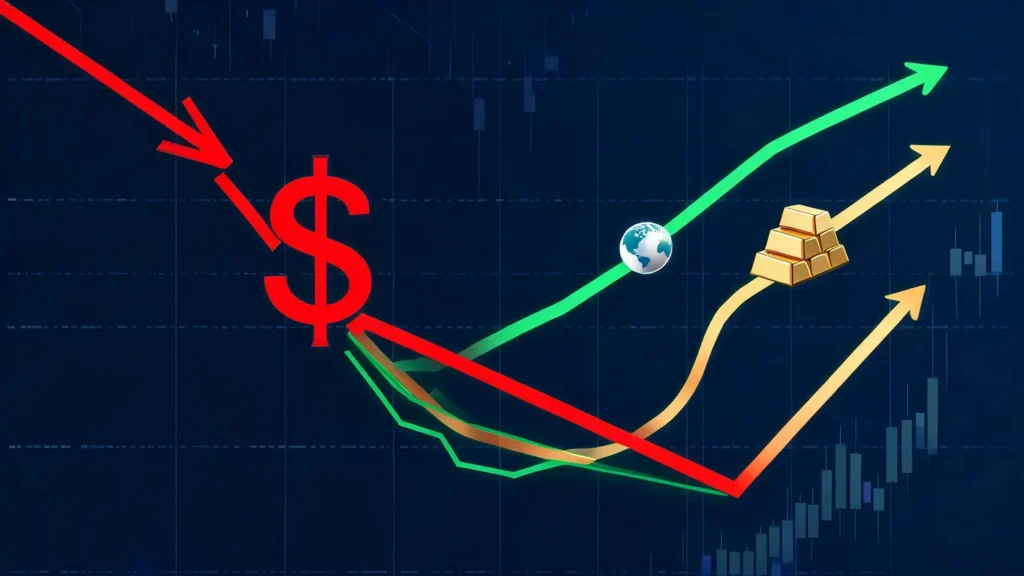
Commodities, particularly precious metals like gold, are priced in US dollars globally. Consequently, an inverse relationship typically exists. When the dollar’s value falls, it takes more dollars to purchase the same amount of a commodity, pushing its price higher. For foreign buyers, a weaker dollar makes commodities cheaper in their local currency, stimulating demand. This dynamic solidifies assets like gold and oil as classic hedges against dollar depreciation.
Core ETF Strategies for a Weak Dollar Environment
To capitalize on the dynamics of a falling dollar, investors can utilize several categories of Exchange-Traded Funds (ETFs). Each offers a unique form of exposure, risk, and potential reward. The key is to select strategies that align with your portfolio’s objectives and risk tolerance.
Strategy 1: Broad International Equity ETFs (VEA, IXUS)
The simplest and most foundational strategy is to gain unhedged exposure to developed international markets. ETFs like the Vanguard FTSE Developed Markets ETF (VEA) and the iShares CORE MSCI Total International Stock ETF (IXUS) offer diversified portfolios of stocks across Europe, Japan, Canada, and Australia. By holding these, you directly benefit from the currency translation effect when the dollar weakens, capturing both the performance of the underlying equities and the currency appreciation.
Strategy 2: Emerging Markets ETFs (VWO, IEMG)
For investors with a higher risk appetite, emerging markets ETFs can offer amplified returns during periods of dollar weakness. A falling dollar often eases financial conditions for emerging economies, many of which have dollar-denominated debt. This can attract capital flows and boost economic growth. Funds like the Vanguard FTSE Emerging Markets ETF (VWO) and the iShares Core MSCI Emerging Markets ETF (IEMG) provide exposure to countries like China, India, and Brazil, offering a higher-beta play on global growth and dollar depreciation.
Strategy 3: Commodity-Focused ETFs (GLD, DBC)
To directly hedge against currency debasement, commodity-focused ETFs are a powerful tool. The most popular choice is a gold ETF, such as the SPDR Gold Shares (GLD), which is physically backed by gold bullion. For broader commodity exposure, the Invesco DB Commodity Index Tracking Fund (DBC) tracks a basket of futures contracts on 14 of the most heavily traded physical commodities, including crude oil, gasoline, gold, and agricultural products. These ETFs tend to perform well when the dollar’s purchasing power erodes.
Strategy 4: Inverse US Dollar ETFs (UDN)
For a direct, tactical bet against the greenback, inverse US dollar ETFs are the most explicit instrument. The Invesco DB US Dollar Index Bearish Fund (UDN) is designed to provide the inverse return of the Deutsche Bank Short USD Currency Portfolio Index. In simple terms, when the U.S. Dollar Index (DXY) falls, UDN is designed to rise. This is a pure-play currency position and should be used tactically, as it offers no underlying asset growth and is susceptible to the complexities of futures contracts.
Strategy 5: Currency-Hedged ETFs as a Defensive Play
Conversely, if an investor believes the dollar weakness is temporary or wants to invest in international markets without currency risk, currency-hedged ETFs serve as a defensive tool. Funds like the Xtrackers MSCI EAFE Hedged Equity ETF (DBEF) buy international stocks but use currency forward contracts to strip out the effects of exchange rate fluctuations. While this strategy underperforms unhedged ETFs during a weak-dollar period, it protects against a sudden dollar rally, making it a valuable tool for risk management.
How to Select the Right ETF for Your Portfolio (A Practical Checklist)
Choosing the correct ETF from the myriad of options requires careful due diligence. A disciplined approach ensures your selection aligns with your investment thesis and portfolio construction rules. Here is a practical checklist to guide your decision-making process.
Analyzing Key Metrics: Expense Ratios, Liquidity, and Tracking Error
Before investing, scrutinize these three critical factors:
- Expense Ratio: This is the annual fee charged by the fund. Lower is always better, as costs directly erode your returns. For broad-market index ETFs, look for expense ratios below 0.15%.
- Liquidity: High liquidity, indicated by a large average daily trading volume and a tight bid-ask spread, ensures you can buy and sell the ETF at a fair price without significant slippage. Avoid thinly traded funds.
- Tracking Error: This measures how well the ETF’s performance matches its underlying index. A low tracking error indicates the fund is efficiently managed and delivering the expected exposure.
Assessing Regional Exposure and Geopolitical Risk
When selecting international or emerging market ETFs, it’s not enough to just look at the fund’s name. Dig into its holdings to understand the geographic breakdown. Is the fund heavily concentrated in a single country or region? A fund with 30% exposure to China carries a different geopolitical risk profile than one more diversified across Europe. Ensure the regional exposure aligns with your macroeconomic views and risk tolerance.
Matching the ETF Strategy to Your Personal Risk Tolerance
Finally, the most crucial step is to align the strategy with your own financial situation. A portfolio for a retiree focused on capital preservation will have a different allocation than one for a young professional seeking aggressive growth.
– Conservative: Might favor broad international equity ETFs (VEA) and a small allocation to gold (GLD).
– Moderate: Could include a mix of developed (IXUS) and emerging market (IEMG) ETFs, plus a position in a broad commodity fund (DBC).
– Aggressive: May use emerging markets (VWO) as a core holding and employ tactical, short-term trades with inverse ETFs (UDN) to capitalize on sharp dollar moves.
Conclusion
Navigating a period of US dollar weakness doesn’t have to be a threat to your portfolio; it can be a significant opportunity for growth and diversification. By strategically incorporating international equity, commodity, or even inverse ETFs, investors can effectively hedge against the risks of a depreciating currency and position themselves to benefit from global market dynamics. The key to success lies in a disciplined approach: understanding the mechanisms at play, selecting the right investment tools through careful analysis, and aligning your chosen US dollar weakness ETF strategy with your long-term financial goals and personal risk tolerance.
Frequently Asked Questions (FAQ)
Q: What is the safest investment if the US dollar collapses?
A: In a severe dollar collapse scenario, tangible assets and non-dollar-denominated investments are considered the safest. This includes physical gold and silver, real estate, and a well-diversified portfolio of international stocks from countries with strong fiscal positions. Holding currencies from stable economies (like the Swiss Franc) can also be a defensive measure.
Q: How does a weak dollar affect my S&P 500 investments?
A: The effect is mixed but generally positive for the index as a whole. As mentioned, large multinational companies within the S&P 500 benefit from favorable currency translation on their foreign earnings, which boosts their profits and stock prices. However, US-based companies that rely heavily on imports will face higher costs, which could hurt their margins.
Q: Are inverse ETFs too risky for the average investor?
A: Yes, inverse ETFs like UDN carry significant risks and are generally not suitable for long-term, buy-and-hold investors. Their returns can deviate from the underlying index over periods longer than a single day due to the effect of daily compounding. They are best used as short-term, tactical tools by sophisticated investors who understand these complexities.
Q: How long should I implement a US dollar weakness ETF strategy?
A: This depends on the macroeconomic cycle and your investment thesis. Strategies based on broad international diversification can be held long-term as core portfolio positions. More tactical plays, such as commodity or inverse ETFs, should be held only as long as the conditions for dollar weakness persist. It’s crucial to regularly review the global economic outlook and adjust your positions accordingly.