
In the persistent search for safe, high-yield cash alternatives for 2026, three exchange-traded funds (ETFs) consistently dominate the conversation: SGOV, BIL, and BOXX. As investors navigate a landscape of shifting interest rates, the debate of SGOV vs BIL vs BOXX 2026 has become critical for optimizing the cash portion of a portfolio. While these instruments appear similar on the surface, serving as ultra-short-term investment tools, their underlying strategies, yield generation, and particularly their tax treatments diverge significantly. This definitive guide dissects the key differences in their performance metrics, providing the clarity needed to determine which of these cash-like ETFs is the superior fit for your financial objectives.
Table of Contents
What Are SGOV, BIL, and BOXX? A Quick Overview of These Cash-Like ETFs
Understanding the fundamental structure of each ETF is the first step in making an informed decision. Though they all aim to provide returns similar to short-term interest rates, their methodologies differ greatly.
SGOV (iShares 0-3 Month Treasury Bond ETF): The Simplicity Choice
SGOV, managed by BlackRock’s iShares, is one of the most straightforward and popular options for cash management. Its strategy is simple: it invests exclusively in U.S. Treasury bills with maturities of three months or less. This direct exposure to the shortest end of the Treasury curve makes it a very low-risk instrument, with its value closely tracking the prevailing short-term interest rates set by the Federal Reserve. For investors seeking security and simplicity, SGOV is often the default choice.
BIL (SPDR Bloomberg 1-3 Month T-Bill ETF): The Direct Competitor
Managed by State Street Global Advisors, BIL is a direct competitor to SGOV. Its investment mandate is nearly identical: to track the performance of an index of short-term U.S. Treasury bills. It also holds T-Bills with remaining maturities between one and three months. The primary differences between SGOV and BIL often come down to minor variations in their expense ratios, tracking error, and specific holdings at any given time. For all practical purposes, they offer the same risk and return profile.
BOXX (Alpha Architect 1-3 Month Box ETF): The Tax-Advantaged Innovator
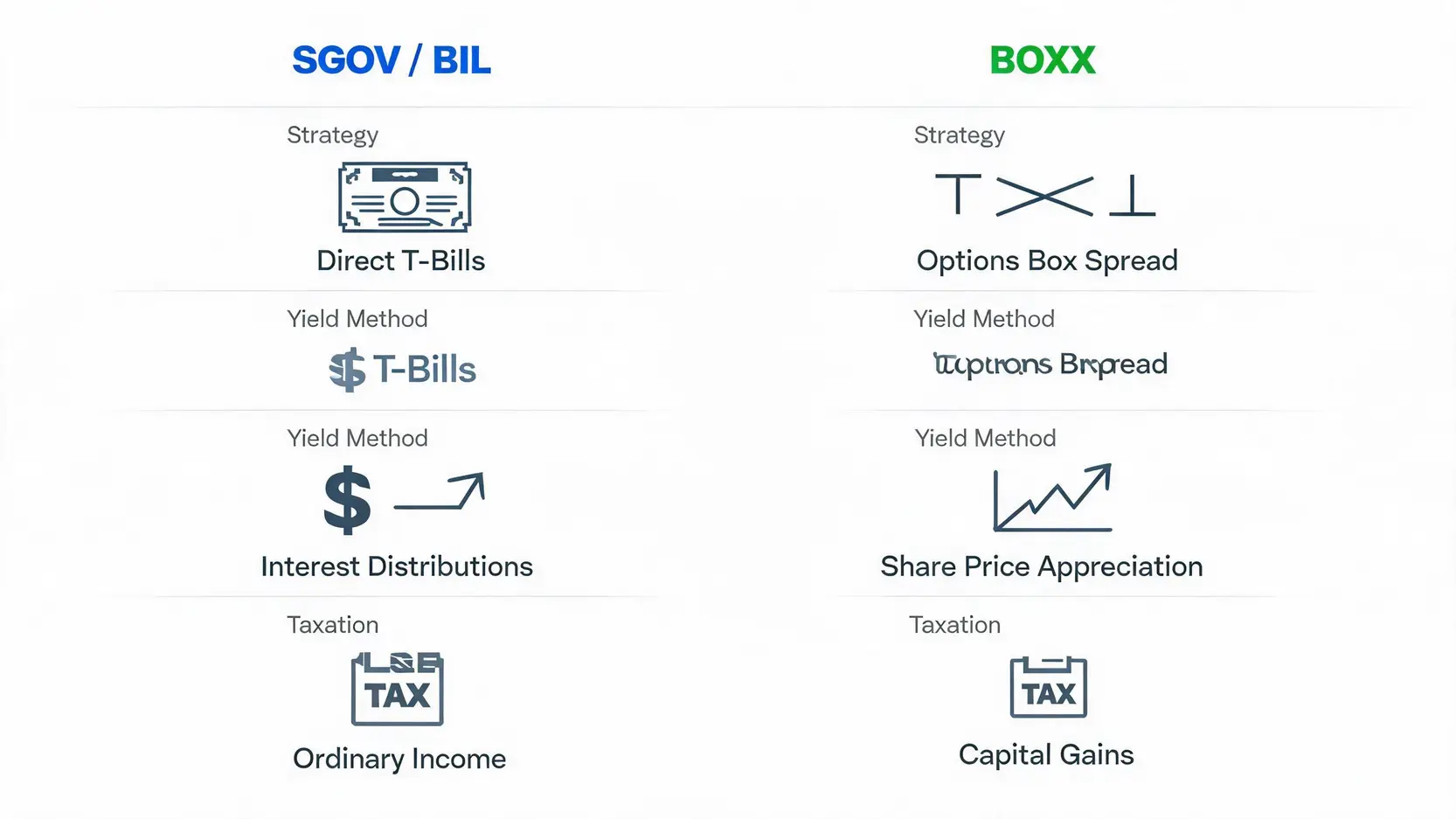
BOXX stands apart from its peers. Instead of directly holding Treasury bills, it employs a sophisticated options strategy known as a box spread. This strategy is designed to replicate the risk-free return of T-Bills but in a more tax-efficient manner. By using options on broad-based indexes like the S&P 500, BOXX aims to generate returns that can be treated as long-term capital gains, offering a significant advantage for investors in higher tax brackets. This innovative structure introduces a different kind of complexity compared to the direct T-Bill ownership of SGOV and BIL.
Head-to-Head 2026 Comparison: Analyzing Key ETF Metrics
When comparing these ultra-short-term ETFs, investors must look beyond the surface-level yields. A holistic analysis of performance, costs, and liquidity provides a much clearer picture of their true value in a portfolio.
Performance, Distribution Yield, and SEC Yield
As of mid-2026, with the interest rate environment stabilizing, all three ETFs offer competitive yields. However, how these yields are presented and generated differs.
- SGOV & BIL: Their yields are directly tied to the interest paid by the underlying T-Bills. The SEC Yield is a standardized measure that reflects the interest an investor would receive over the next 12 months, while the Distribution Yield reflects recent payouts. These are generally very close to the federal funds rate.
- BOXX: BOXX does not distribute dividends. Its value is designed to appreciate over time at a rate that approximates the risk-free rate. Therefore, its return is realized as a capital gain upon selling shares, not through income distributions. Its performance has closely tracked its T-Bill counterparts, proving the effectiveness of its box spread strategy.
| Metric (as of Q2 2026) | SGOV | BIL | BOXX |
|---|---|---|---|
| SEC Yield (30-Day) | ~5.15% | ~5.14% | N/A (Appreciation) |
| Expense Ratio | 0.07% (tiered) | 0.1354% | 0.39% |
| Assets Under Management (AUM) | ~$25 Billion | ~$33 Billion | ~$3.5 Billion |
| Tax Treatment | Ordinary Income | Ordinary Income | Primarily Capital Gains |
Expense Ratios and Total Cost of Ownership
Costs are a critical factor in low-yield environments. SGOV has a competitive tiered expense ratio that can be as low as 0.07%, making it exceptionally cheap. BIL’s expense ratio is slightly higher at 0.1354%. BOXX comes in with the highest fee at 0.39%. However, for high-income earners, the potential tax savings from BOXX can far outweigh its higher expense ratio, making the after-tax total cost of ownership potentially lower than that of SGOV or BIL.
Assets Under Management (AUM) and Trading Liquidity
Both SGOV and BIL are titans in this space, with tens of billions in AUM. This massive size ensures deep liquidity and tight bid-ask spreads, making them easy to trade in large volumes without significant price impact. BOXX, while newer and smaller, has grown rapidly and maintains sufficient liquidity for most retail and institutional investors, facilitated by market makers.
Under the Hood: How Their Unique Investment Strategies Differ
The core of the SGOV vs. BIL vs. BOXX decision lies in their foundational strategies. While SGOV and BIL are passive vehicles holding government debt, BOXX is an active fund executing a specific financial engineering strategy.
SGOV & BIL: The Direct Treasury Bill Approach
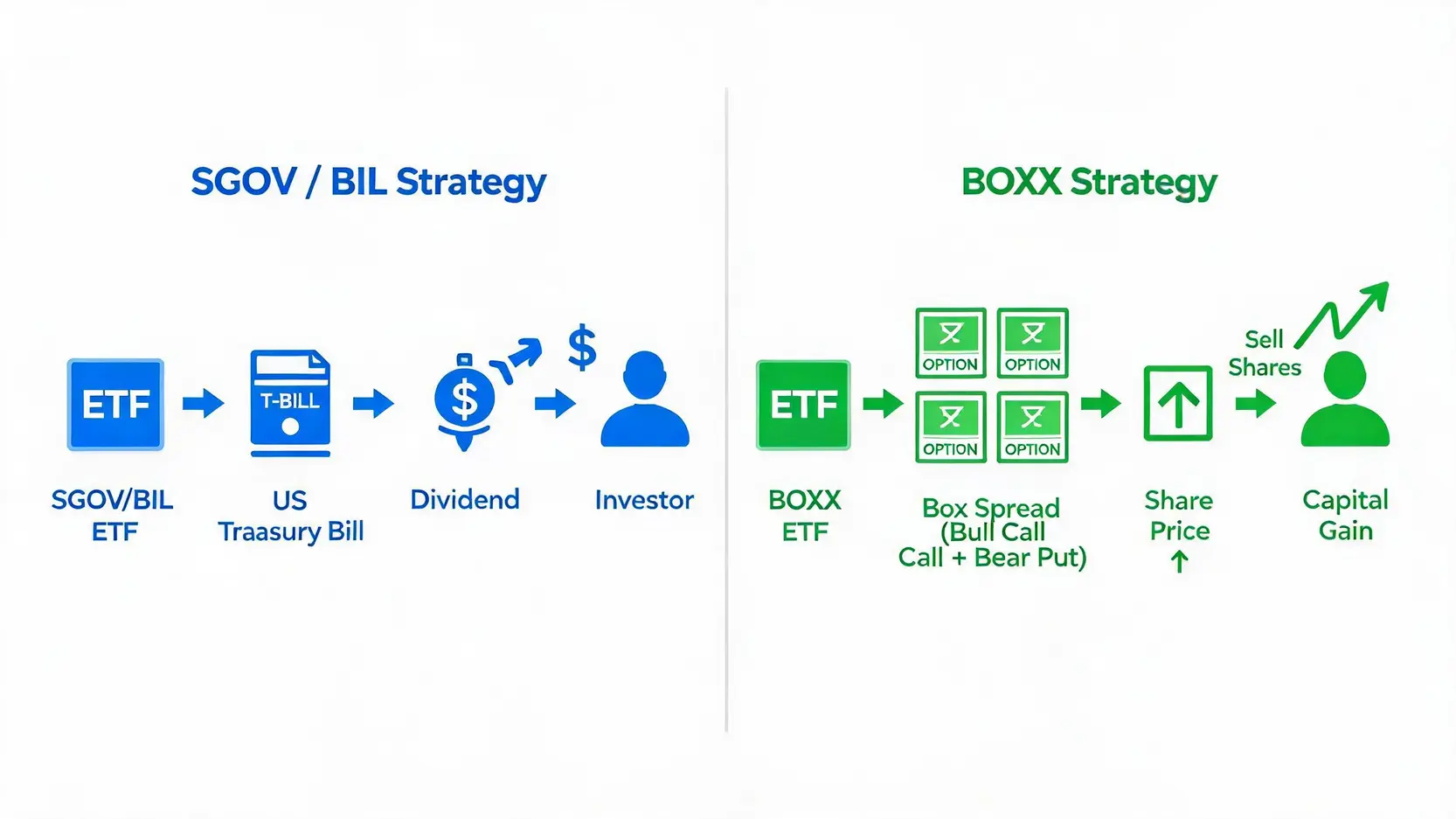
The strategy for SGOV and BIL is as simple as it gets: buy and hold a basket of U.S. Treasury bills. These are short-term debt obligations backed by the full faith and credit of the U.S. government, widely considered the safest financial asset in the world. The ETFs act as a pass-through vehicle, collecting interest from these T-Bills and distributing it to shareholders after deducting a small management fee. Their portfolios are transparent and easy to understand.
BOXX: Understanding the Options-Based Box Spread Strategy
BOXX’s strategy is more complex but designed for a specific purpose: tax efficiency. It uses an options trading technique called a Box Spread. In essence, a box spread combines a bull call spread and a bear put spread on a major index. When structured correctly, this combination of options creates a synthetic loan that generates a risk-free return, similar to a T-Bill. Because the returns are generated through the price appreciation of the ETF shares via options contracts rather than interest distributions, they are generally subject to capital gains tax rules upon sale, which can be much more favorable than ordinary income tax rates.
The Critical Tax Difference: A Key Consideration for High Earners
Perhaps the most significant differentiator in the SGOV vs BIL vs BOXX 2026 comparison is taxation. The tax implications can dramatically alter an investor’s net returns, especially for those in higher tax brackets. For a deeper dive into the nuances of fund taxation, exploring an ETF vs Index Fund Tax Efficiency 2026 guide can provide valuable context.
Tax Treatment of SGOV and BIL (Ordinary Income)
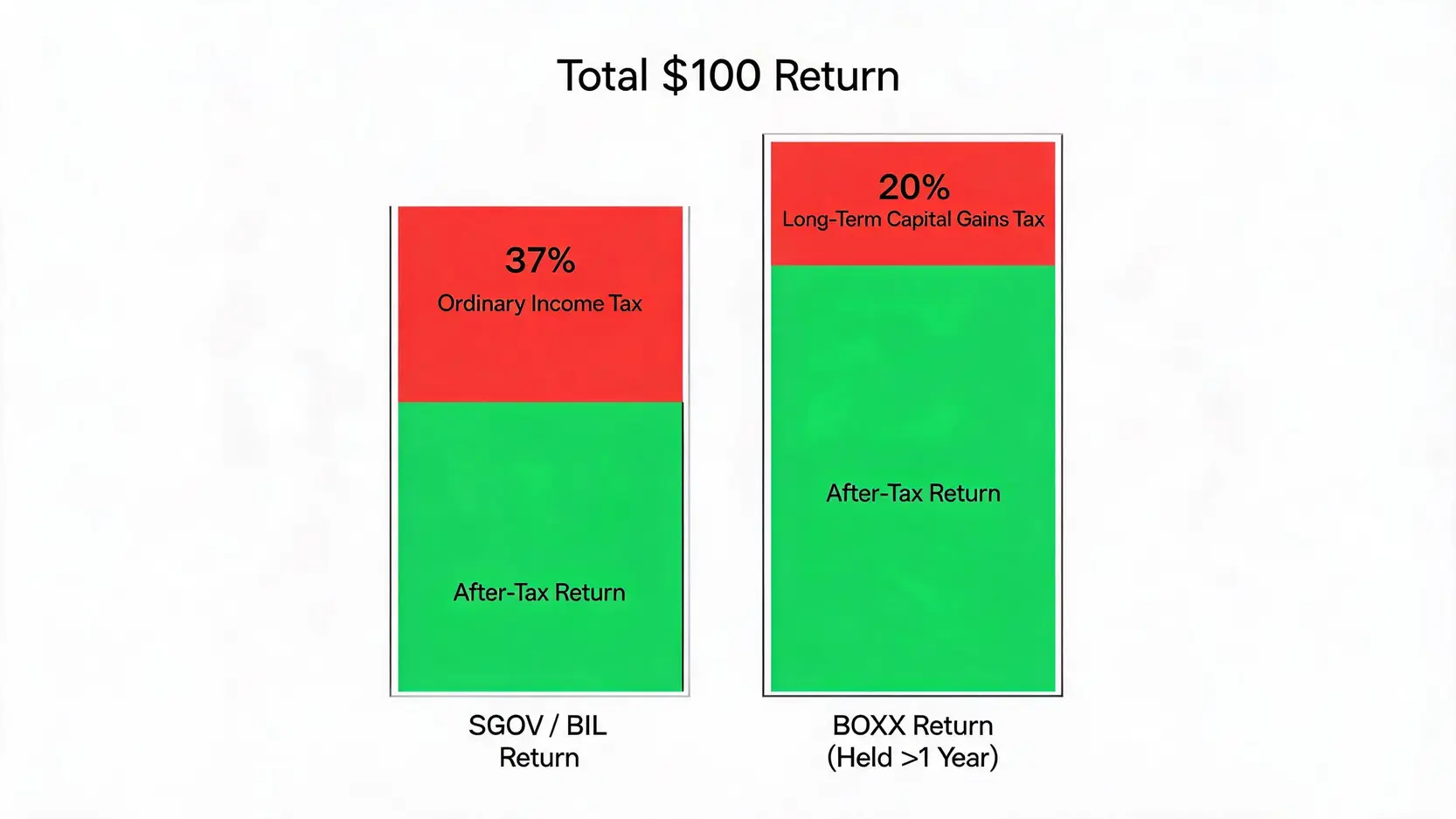
The distributions from SGOV and BIL, derived from T-Bill interest, are taxed at federal ordinary income tax rates, which can be as high as 37% (or higher, depending on legislation). This means a significant portion of the yield can be lost to taxes for high earners.
The Potential Tax Advantages of BOXX (Capital Gains)
BOXX is structured to avoid distributions. Instead, its net asset value (NAV) grows daily. An investor’s profit is only realized when they sell their shares. If the shares are held for more than one year, the profit is taxed at the more favorable long-term capital gains rate, which is currently capped at 20%. This difference between 37% and 20% can result in substantial tax savings, making BOXX a powerful tool for tax-managed cash allocation.
State and Local Tax Exemptions for Treasury ETFs
One notable advantage for SGOV and BIL is that the income generated from U.S. Treasury obligations is exempt from state and local taxes. This can be a significant benefit for investors living in high-tax states like California or New York, potentially closing the after-tax return gap with BOXX for some individuals.
Which ETF is Best For Your Portfolio in 2026?
The best choice among SGOV, BIL, and BOXX is not universal; it depends entirely on your individual circumstances, particularly your tax situation and investment sophistication. A sound investment strategy always begins with personal financial assessment.
Choose SGOV or BIL if… You Prioritize Simplicity and Lowest Fees
You should opt for SGOV or BIL if your primary goals are capital preservation, simplicity, and minimizing management fees. These ETFs are ideal for:
- Investors in lower or moderate tax brackets where the tax advantage of BOXX is less impactful.
- Those who prefer the transparency and security of holding direct U.S. government debt.
- Investors residing in high-tax states who can benefit from the state and local tax exemption.
- Anyone who is uncomfortable with the complexity of an options-based strategy.
Choose BOXX if… You Are in a High Tax Bracket and Seek Tax Efficiency
BOXX is the superior choice if you are focused on maximizing your after-tax returns and are in a high federal income tax bracket. This ETF is best suited for:
- High-income earners who can fully leverage the difference between ordinary income and long-term capital gains tax rates.
- Investors with a holding period of more than one year to qualify for long-term capital gains treatment.
- Those comfortable with the fund’s options-based strategy and its structural complexity.
- Investors in states with low or no income tax, where the state tax exemption of SGOV/BIL is irrelevant.
Conclusion
In the SGOV vs BIL vs BOXX 2026 analysis, the optimal choice is uniquely personal. SGOV and BIL represent the pinnacle of simplicity and low-cost exposure to U.S. Treasury bills, making them the default, prudent choice for the vast majority of investors seeking a safe haven for their cash. BOXX, with its innovative options-based strategy, offers a compelling and powerful alternative for sophisticated, high-income investors who prioritize tax efficiency above all else. The decision requires a clear assessment of your personal tax bracket, your comfort with financial complexity, and your overall portfolio goals. By understanding the critical distinctions in their strategies and tax treatments, you can confidently select the ETF that best serves your financial future.
Frequently Asked Questions (FAQ)
Q: What is the main difference between SGOV and BIL?
A: The primary difference is negligible for most investors. They are managed by different firms (iShares vs. SPDR) and have slightly different expense ratios. Both hold U.S. T-Bills with maturities under three months and offer nearly identical risk-return profiles. The choice between them often comes down to personal preference or platform availability.
Q: Is BOXX safer than SGOV or BIL?
A: In terms of credit risk, SGOV and BIL are considered safer as they hold direct obligations of the U.S. government. BOXX’s box spread strategy, while designed to be risk-free, carries a different set of risks, such as counterparty risk with the options clearinghouse and potential liquidity issues during extreme market stress. However, these risks are generally considered very low.
Q: How would falling interest rates in 2026 affect these ETFs?
A: All three ETFs would be affected similarly. As the Federal Reserve cuts interest rates, the yields on new short-term T-Bills would fall, directly reducing the future distributions from SGOV and BIL. For BOXX, the implied rate of return on new box spreads would also decrease, slowing its rate of appreciation. Their primary function is to track short-term rates, so their returns will always move in tandem with Fed policy.
Q: Can you lose money in these ETFs?
A: While they are considered cash equivalents, it is technically possible to lose money. The share price (NAV) of SGOV and BIL can fluctuate slightly, and if you sell on a day when the NAV is lower than your purchase price, you could realize a small capital loss. BOXX also has NAV fluctuation. However, these are designed to be extremely low-volatility instruments, and significant losses are highly improbable under normal market conditions.