Table of Contents
At a Glance: Core Differences Between BAI and VGT
As the technology sector navigates the complex crosscurrents of 2026, investors face a critical choice between two distinct exchange-traded funds (ETFs): the iShares A.I. Innovation and Tech Active ETF (BAI) and the Vanguard Information Technology ETF (VGT). This decision transcends a simple preference; it’s a strategic choice between a nimble, actively managed fund targeting the explosive AI revolution and a venerable, passive giant representing the broad tech market.
The core of the BAI vs VGT 2026 debate hinges on one’s conviction in active management’s ability to outperform in a rapidly evolving niche versus the time-tested stability of passive indexing. A pivotal factor influencing both is the unprecedented surge in hyperscaler capex impact on tech ETFs, a trend reshaping the industry’s infrastructure and value chain.
Investment Strategy: Active AI Selection vs. Passive Market Indexing
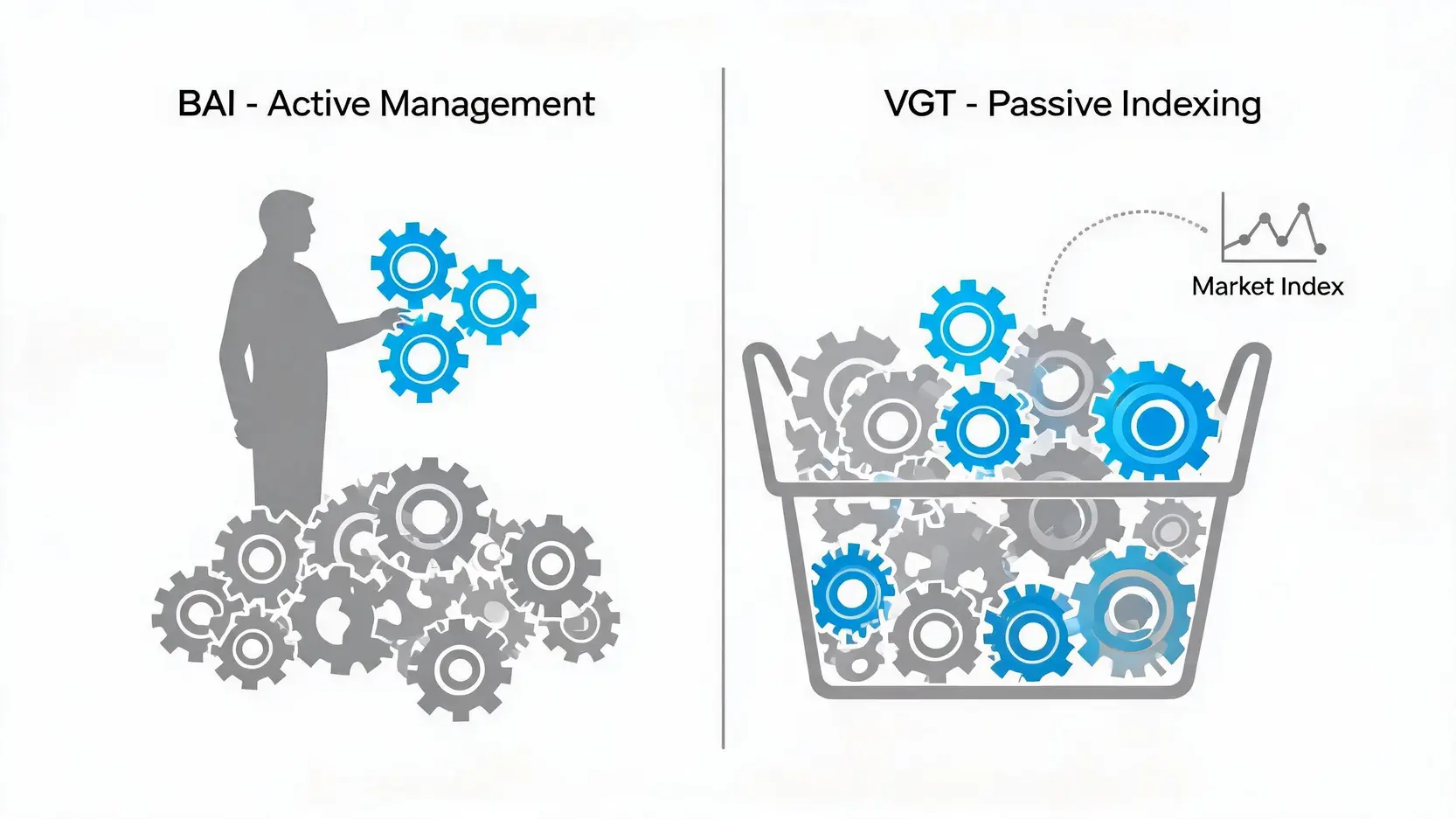
The philosophical divide between BAI and VGT is their core investment strategy. BAI is an actively managed ETF, meaning a portfolio manager makes discretionary decisions to buy and sell securities, aiming to outperform a benchmark. Its mandate is to identify and invest in companies at the forefront of the artificial intelligence boom, from semiconductor designers to software developers and infrastructure providers. This approach allows for tactical shifts to capitalize on emerging trends and potentially mitigate risks from overvalued sub-sectors.
In stark contrast, VGT employs a passive indexing strategy. It seeks to replicate the performance of the MSCI US Investable Market Index (IMI)/Information Technology 25/50. This means VGT automatically holds a broad portfolio of U.S. technology stocks, weighted by market capitalization. There is no active stock picking; the fund simply mirrors the index. This provides comprehensive exposure to the entire tech sector, from mega-cap leaders to smaller growth companies. The debate over active management vs passive indexing in ETFs is central to an investor’s choice here.
Expense Ratios and Top 10 Holdings Compared
Costs and composition are critical differentiators that directly impact net returns. Active management inherently incurs higher research and trading costs, which is reflected in BAI’s expense ratio.
| Metric | iShares A.I. Innovation and Tech Active ETF (BAI) | Vanguard Information Technology ETF (VGT) |
|---|---|---|
| Expense Ratio | ~0.55% | 0.10% |
| Strategy Focus | Concentrated, high-conviction AI bets | Broad, market-cap-weighted U.S. Tech |
| Example Top Holdings | NVIDIA, Arista Networks, Broadcom, Super Micro Computer, Monolithic Power Systems | Microsoft, Apple, NVIDIA, Broadcom, Salesforce |
BAI’s holdings are a curated list of companies poised to benefit directly from AI infrastructure build-out. VGT’s holdings, dictated by the index, are dominated by the largest, most established names in technology. While there is some overlap (e.g., NVIDIA, Broadcom), the weighting and surrounding portfolio are vastly different.
Key Metrics: AUM, Dividend Yield, and Trading Volume
These metrics offer insight into each ETF’s market presence, income potential, and liquidity.
- Assets Under Management (AUM): VGT, as one of the oldest and largest tech ETFs, boasts an AUM exceeding $70 billion. BAI, being a more specialized and newer active fund, has a significantly smaller AUM, reflecting its niche focus.
- Dividend Yield: VGT typically offers a modest dividend yield (around 0.70-0.90%), stemming from its holdings in mature, profitable companies like Microsoft and Apple. BAI’s focus on high-growth, reinvestment-oriented AI companies results in a lower, often negligible, dividend yield.
- Trading Volume: VGT experiences massive daily trading volume, ensuring high liquidity and tight bid-ask spreads. BAI’s trading volume is lower, which is typical for active ETFs but still sufficient for most retail and institutional investors.
Performance Review: Analyzing Historical Returns and Future Projections in the BAI vs VGT 2026 Outlook
Past performance is not indicative of future results, but it provides context. In the AI-driven rally of recent years, a concentrated fund like BAI has shown periods of significant outperformance. However, this concentration also exposes it to higher volatility.
Year-by-Year Performance Breakdown (2024-2026 YTD)
Hypothetically, in a market cycle dominated by AI enthusiasm (like 2024 and early 2025), BAI’s targeted approach likely delivered superior returns as its core holdings saw explosive growth. VGT would have also performed well, lifted by its significant allocation to mega-cap tech, but its broader diversification would have muted the upside compared to a pure-play AI fund. As of mid-2026, with the market potentially assessing valuations more critically, the performance gap may narrow or even invert during periods of sector rotation.
Risk Analysis: Volatility and Drawdown Comparison
Risk metrics reveal the other side of the performance coin. BAI’s standard deviation (a measure of volatility) is inherently higher than VGT’s. During market downturns, its concentration in a high-beta sector like AI could lead to deeper drawdowns. VGT, while still a tech-focused fund, benefits from the relative stability of its mega-cap components and broader diversification across over 300 stocks, which generally results in lower volatility and shallower drawdowns compared to a thematic, concentrated portfolio like BAI.
The 2026 Deciding Factor: Unpacking the Hyperscaler Capex Impact
The single most important trend for tech investors in 2026 is the colossal wave of capital expenditure (Capex) from hyperscalers—the giants of cloud computing like Amazon (AWS), Microsoft (Azure), Google (GCP), and Meta.
What is Hyperscaler Capex and Why It Matters for Tech Investors
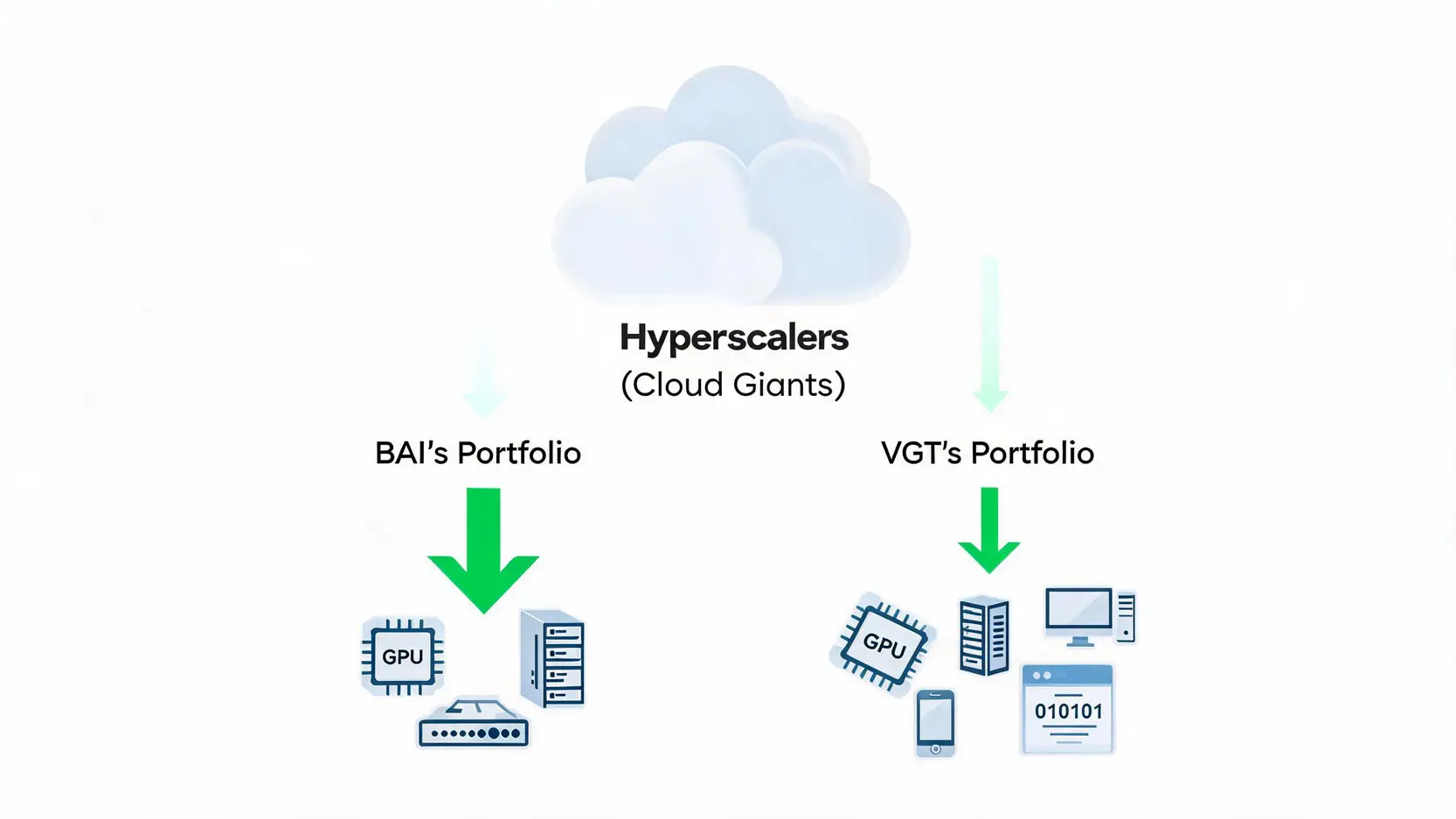
Hyperscaler Capex refers to the massive investments these companies make in physical infrastructure, primarily data centers, servers, networking equipment, and specialized AI accelerators (like GPUs). As detailed in analyses of the AI infrastructure sprint, this spending is projected to exceed $700 billion in 2026. This isn’t just a budget line item; it is the foundational fuel for the entire AI and cloud computing economy. For investors, tracking this capital flow is like following a river of revenue to the companies that stand to benefit most.
How Capex Trends Directly Influence BAI’s Concentrated AI Bets
BAI’s strategy is a direct play on this capex boom. Its portfolio is heavily weighted towards the primary beneficiaries of this spending. When Microsoft or Google announces a multi-billion dollar data center expansion, they are buying GPUs from NVIDIA, networking switches from Arista Networks, and processors from Broadcom—all core holdings in BAI. The fund’s performance is thus tightly correlated to the growth and acceleration of hyperscaler investment. If capex forecasts remain strong or are revised upwards, BAI is structurally positioned to capture that upside directly.
How Capex Cycles Affect VGT’s Broad Tech Holdings
VGT’s relationship with hyperscaler capex is more nuanced. Its top holdings—Microsoft, Apple, and Alphabet—are the very companies driving the capex spend. For them, capex is an investment to fuel future growth in their cloud and AI services divisions. Therefore, high capex signals confidence in future revenue and market dominance, which is positive for VGT’s largest constituents.
However, VGT also holds the beneficiaries of this spending (like NVIDIA), but their weight is balanced by the entire spectrum of the tech industry, including software and consumer devices, which are less directly impacted. VGT thus offers a more balanced, albeit less direct, exposure to the capex theme.
Investor Profile: Who Should Buy BAI vs. Who Should Buy VGT based on 2026 investment goals?
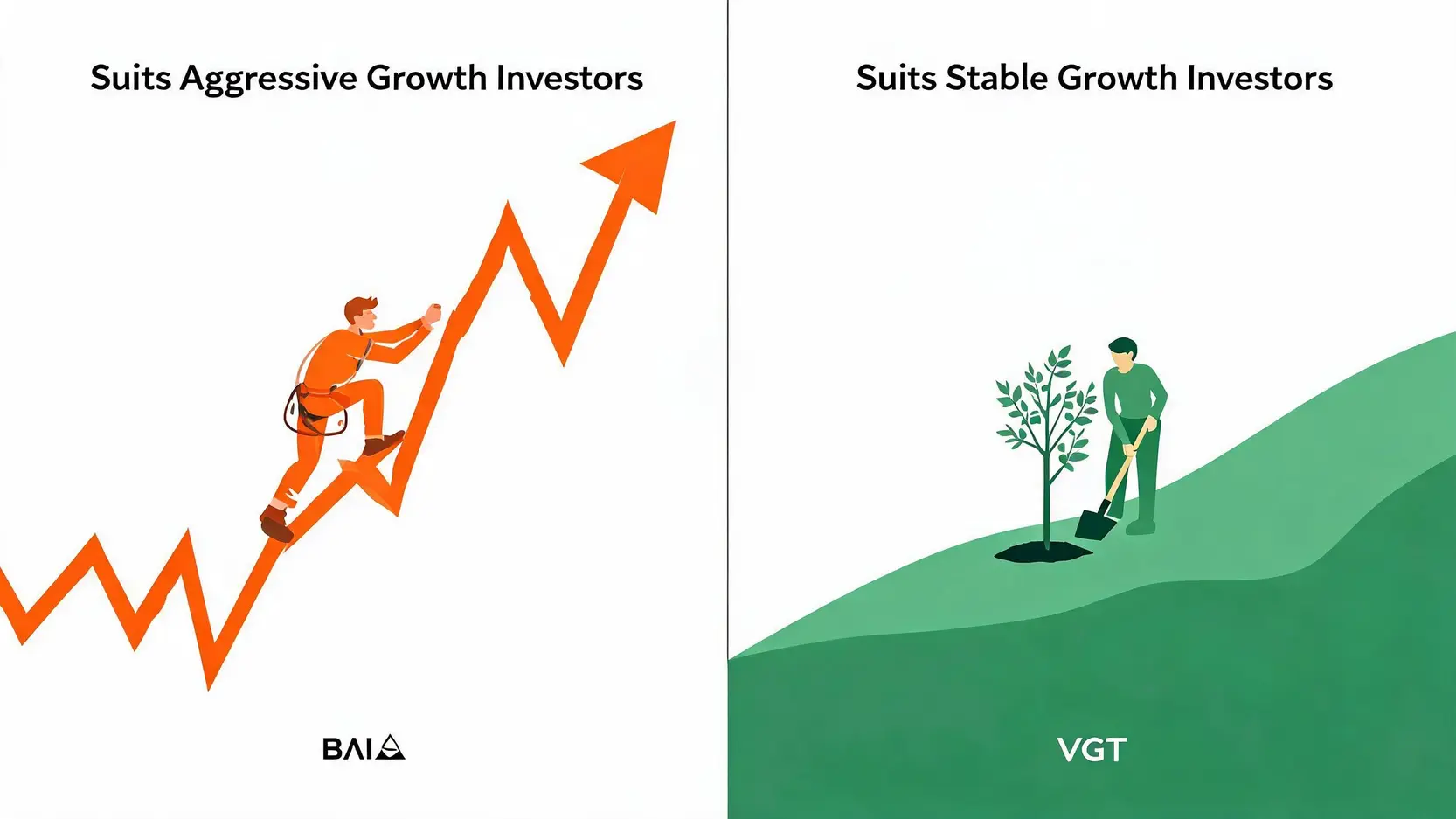
The choice between an active AI ETF and a passive tech ETF ultimately depends on an investor’s risk appetite, investment horizon, and market outlook. Knowing how to choose the right investment vehicle is paramount.
Why Aggressive Growth Investors Might Prefer BAI’s Active Approach
Investors who fit this profile typically have a higher risk tolerance and a strong conviction in the long-term disruptive power of artificial intelligence. They should consider BAI if they:
- Believe in Active Management: Trust that a skilled manager can navigate the volatile AI sector better than an index.
- Seek Concentrated Exposure: Want a portfolio that is a pure-play on the AI infrastructure theme, directly benefiting from the hyperscaler capex cycle.
- Have a Longer Time Horizon: Can withstand short-term volatility for the potential of higher long-term growth.
- Are Willing to Pay Higher Fees: Accept the higher expense ratio as the cost of potential alpha generation.
Why Long-Term, Stable Growth Investors May Favor VGT
This investor profile is often characterized by a preference for steady, diversified growth and a focus on minimizing costs. VGT is the more suitable choice for those who:
- Trust in Passive Indexing: Believe that, over the long term, it is difficult and costly to consistently beat the market.
- Want Broad Tech Exposure: Prefer to own the entire U.S. technology sector, from established giants to emerging players.
- Are Cost-Conscious: Prioritize a low expense ratio to maximize compounded returns over time.
- Seek Lower Volatility: Prefer a smoother ride with less portfolio concentration risk.
Conclusion
The BAI vs VGT 2026 analysis reveals a clear strategic divergence for investors. BAI offers a high-octane, concentrated bet on the AI revolution, directly supercharged by the historic hyperscaler capex boom. It represents a vote of confidence in active management’s ability to pick winners in a dynamic field. This path offers the potential for explosive growth but comes with higher fees and heightened volatility.
Conversely, VGT provides a steady, diversified, and low-cost gateway to the entire U.S. technology landscape. It benefits from the capex trend more broadly, anchored by the very giants funding this technological arms race. The optimal choice for an investor’s portfolio in 2026 is less about predicting a definitive winner and more about a candid assessment of one’s own risk tolerance, belief in active versus passive strategies, and conviction in the focused AI infrastructure narrative versus the enduring strength of the broader technology sector.
Frequently Asked Questions (FAQ)
Q: What are the main risks associated with the iShares A.I. Innovation and Tech Active ETF (BAI)?
A: The primary risks for BAI are concentration risk and manager risk. Its portfolio is concentrated in the AI sub-sector, making it more volatile than a broad tech fund. If the AI sector faces a downturn or regulatory hurdles, BAI could underperform significantly. Manager risk is the risk that the active portfolio manager’s decisions may lead to underperformance relative to its benchmark or peers.
Q: How does VGT’s performance compare to the Nasdaq 100?
A: VGT’s performance is highly correlated with the Nasdaq 100 (tracked by QQQ) as both are heavily weighted towards large-cap technology stocks. However, there are key differences. VGT is a pure technology sector fund, whereas the Nasdaq 100 also includes non-tech companies like Amazon, Tesla, and PepsiCo. This can lead to periods of performance divergence depending on the market environment.
Q: Is an actively managed ETF like BAI better than a passive one like VGT during market volatility?
A: The answer is theoretical. Proponents of active management argue that a skilled manager can react to volatility by shifting to more defensive assets or avoiding overvalued stocks, potentially reducing drawdowns. However, there is no guarantee of this. A passive ETF like VGT simply rides out the volatility, and its diversification can provide a degree of stability. Historically, most active managers have failed to consistently outperform passive indexes, especially after fees.
Q: What are the top 5 holdings of BAI and VGT as of mid-2026?
A: As of mid-2026, BAI’s top holdings would likely include NVIDIA Corp (NVDA), Arista Networks (ANET), Broadcom Inc (AVGO), Super Micro Computer (SMCI), and Monolithic Power Systems (MPWR), reflecting its focus on AI infrastructure. VGT’s top holdings remain the tech mega-caps: Microsoft Corp (MSFT), Apple Inc (AAPL), NVIDIA Corp (NVDA), Broadcom Inc (AVGO), and Salesforce (CRM).
Q: How do expense ratios affect my returns with BAI vs VGT?
A: Expense ratios directly reduce your investment returns. VGT’s 0.10% fee means that for every $10,000 invested, you pay $10 annually. BAI’s ~0.55% fee amounts to $55 on the same investment. While this difference seems small, it compounds significantly over many years. BAI must outperform VGT by at least 0.45% annually just to break even on costs. Understanding the impact of the ETF expense ratio is crucial for long-term planning.