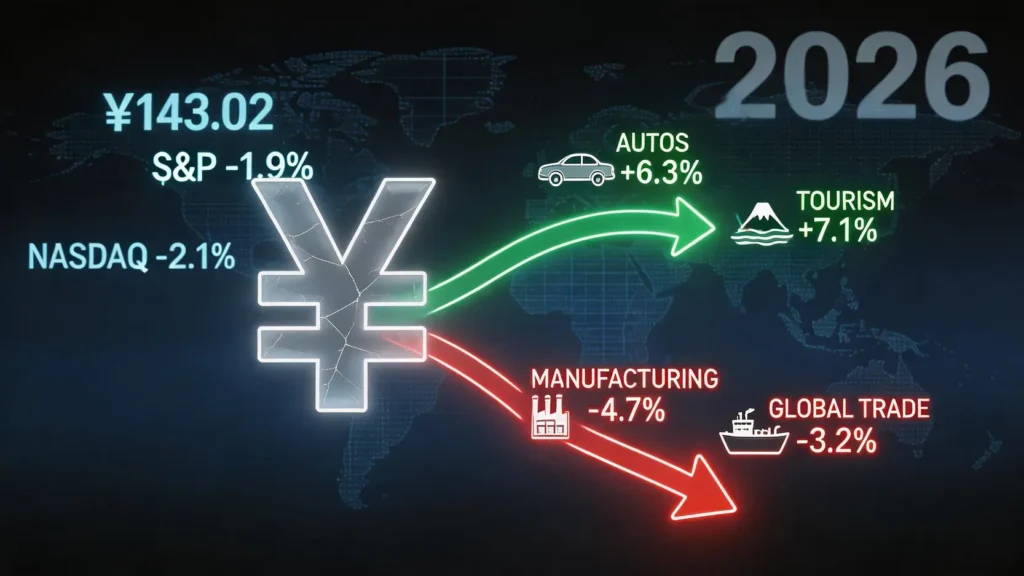
The Weak Yen Global Market Impact has become one of the most important macro stories for traders in 2026 as USD/JPY continues to trade near the sensitive 160 level. Yen weakness is no longer just a Japan-focused currency issue. It is now influencing global carry trades, U.S. Treasury demand, Asian currency pressure, equity sentiment, and broader cross-asset volatility.
The reason the Weak Yen Global Market Impact matters is that the yen remains a major funding currency for global investors. When the yen stays weak and borrowing costs in Japan remain low, capital can flow into higher-yielding assets worldwide.
But if the yen suddenly rebounds because of intervention risk or a Bank of Japan policy shift, those trades can unwind quickly. This article explains how yen depreciation affects global markets, why the weak Japanese yen matters for traders, and which signals investors should watch in 2026.
Table of Contents
Why the Weak Yen Is a Global Warning Signal
The weak yen functions as a global warning signal primarily because it is the world’s cheapest major funding currency and a sensitive barometer for global risk appetite.
Its status as a financial bellwether is not accidental but a direct consequence of the Bank of Japan’s (BOJ) long-standing ultra-loose monetary policy. This policy stance has created a significant interest rate differential between Japan and other major economies, making the yen a unique tool in global finance. Analysing the weak yen global market impact requires a deep understanding of these two core functions.
The Yen’s Role as a Major Funding Currency
The Japanese yen’s role as a major funding currency is one of the clearest reasons the Weak Yen Global Market Impact matters in 2026. Because Japan’s borrowing costs remain far lower than those in the U.S. and Europe, global investors can still use the yen as cheap funding to buy higher-yielding currencies, bonds, equities, and risk assets.
This strategy, known as the yen carry trade, creates steady yen selling and supports capital flows into global markets. When USD/JPY stays elevated, it often signals that investors are comfortable taking risk and using low-cost Japanese funding. That is why yen weakness is not just a local exchange-rate issue. It is a global liquidity signal that can affect asset prices far beyond Japan.
An Indicator for Global Risk Appetite and Volatility
A weak yen is also an important signal of global risk appetite. When markets are calm, investors are more willing to borrow yen and move into higher-return assets. This can support equities, emerging market currencies, credit markets, and other carry-trade-sensitive assets.
However, the same mechanism can quickly turn into a volatility risk. If the yen suddenly strengthens because of Bank of Japan policy changes, intervention risk, or a broader risk-off shock, investors may be forced to unwind yen-funded positions. That means buying back yen and selling other assets, which can spread volatility across global markets. This is why the Weak Yen Global Market Impact is closely linked to carry trade risk, cross-asset liquidity, and sudden market reversals.
How a Weak Yen Reshapes Carry Trade Dynamics
A weak yen amplifies carry trade profitability by providing cheap funding and a depreciating liability, encouraging investors to leverage into higher-yielding global assets.
This dynamic creates a self-reinforcing cycle: the weaker the yen becomes, the more attractive carry trades are, which in turn puts more downward pressure on the yen. Understanding this feedback loop is essential to grasping the full scope of the weak yen global market impact.
Funding a Global Search for Yield
The core of the carry trade is the ‘search for yield.’ In an environment where the BOJ’s policy rate is anchored near zero, investors can borrow JPY for a negligible cost. They then convert this borrowed capital into currencies of countries with much higher interest rates, such as the Mexican Peso (MXN), the Brazilian Real (BRL), or even the U.S. Dollar (USD).
By simply holding these currencies or investing in their short-term government bonds, investors can profit from the interest rate differential. A weak and stable yen makes this strategy incredibly potent.
For instance, if an investor can borrow at 0.1% in Japan and invest at 5.5% in the U.S., they capture a significant spread. The weak yen global market impact is that it essentially provides the fuel for a global hunt for returns, pushing capital into various asset classes.
The Link Between Yen Weakness and Risk Asset Rallies
A weakening yen offers a double benefit to carry traders. Not only do they profit from the interest rate differential, but they also gain from the currency’s depreciation. If an investor borrows ¥1,000,000 when USD/JPY is at 140 and invests it in a dollar-denominated asset, their loan is worth approximately $7,142.
If the yen weakens and USD/JPY moves to 160, that same ¥1,000,000 loan is now only worth $6,250. The value of their liability has decreased in dollar terms, generating a capital gain on top of the yield earned.
This powerful combination provides a strong tailwind for risk assets. The liquidity generated by yen-funded carry trades often finds its way into equity markets, corporate credit, and emerging market assets, helping to fuel rallies. This positive correlation between a rising USD/JPY and rising global stock indices is a clear manifestation of the weak yen global market impact.
| Currency Pair | Target Currency Policy Rate | Funding Currency (JPY) Policy Rate | Indicative Yield Spread |
| USD/JPY | 5.25% | 0.10% | 5.15% |
| MXN/JPY | 11.00% | 0.10% | 10.90% |
| AUD/JPY | 4.35% | 0.10% | 4.25% |
Understanding the Risks of a Crowded Trade Unwind
The greatest risk associated with this dynamic is its potential for a sudden and disorderly reversal. Because the trade is so popular and profitable, it becomes ‘crowded,’ meaning a large volume of capital is positioned in the same way.
This creates systemic vulnerability. A trigger event—such as direct currency intervention by the Japanese authorities, a hawkish surprise from the BOJ, or a global recession that sends investors fleeing to safe havens—could cause a rapid appreciation of the yen.
In this scenario, carry traders would face losses from both the narrowing interest rate differential and, more damagingly, the rising value of their yen-denominated debt. This would trigger margin calls and force them to sell the very assets they bought, leading to a cascade of selling pressure across global markets.
The widespread and correlated nature of these liquidations is the most dangerous aspect of the weak yen global market impact, as it can transform a currency-specific move into a global liquidity event.
The Ripple Effect: Weak Yen’s Impact on Asian FX Markets
The weak yen’s primary impact on Asian foreign exchange markets is the creation of intense competitive pressure, forcing regional central banks to choose between defending their currencies or maintaining export competitiveness.
Japan remains an economic powerhouse in Asia, and the value of its currency has significant spillover effects on its neighbours. The extreme weakness of the yen creates a difficult policy dilemma for other export-oriented economies in the region, such as South Korea, Taiwan, and China. This regional dimension is a critical component of the weak yen global market impact.
Competitive Devaluation Pressures on Regional Currencies
When the yen depreciates significantly, Japanese goods become cheaper and more attractive on the international market. This puts direct competitive pressure on countries that compete with Japan in similar export sectors, like automobiles, electronics, and industrial machinery. For example, a weak yen makes Japanese cars more affordable relative to their South Korean counterparts, potentially harming the profitability of manufacturers like Hyundai.
This can tempt regional central banks to allow their own currencies to weaken in a ‘competitive devaluation’ or ‘currency war’ scenario to protect their export sectors. This response, however, comes with its own set of problems, including higher import costs, domestic inflation, and the risk of capital flight. The pressure to devalue is a major channel through which the weak yen global market impact destabilises regional economies.
Shaping Investor Sentiment Across Asian Economies
A plunging yen can also negatively affect investor sentiment towards the entire Asian region. Extreme volatility in a major regional currency like the yen can be perceived as a sign of instability, prompting international investors to reduce their exposure to Asian assets altogether.
This risk-off sentiment can lead to capital outflows from markets like South Korea, Thailand, and Indonesia, putting further downward pressure on their currencies and equity markets.
Furthermore, the Chinese yuan is closely watched in this context. While the People’s Bank of China manages the yuan’s exchange rate tightly, a significantly weaker yen increases the pressure on Beijing to allow for a weaker yuan to maintain its own export competitiveness.
A sharp depreciation in the yuan would have a far greater global shockwave than the yen, and the yen’s weakness is seen as a potential catalyst for such a move. This interconnected risk highlights the far-reaching nature of the weak yen global market impact on geopolitical and economic stability.
The Critical Link Between a Weak Yen and U.S. Treasuries
The link is critical because Japan is the largest foreign holder of U.S. debt, and the yen’s weakness, combined with rising hedging costs, can significantly alter Japanese demand for U.S. Treasuries.
This connection is one of the most significant yet often overlooked aspects of the weak yen global market impact. Any change in Japanese investment behaviour can have profound consequences for U.S. interest rates and, by extension, global financial conditions.
Japan’s Position as the Largest Foreign Holder of U.S. Debt
Japanese investors, including massive public pension funds like the GPIF, life insurance companies, and commercial banks, collectively hold over $1.1 trillion in U.S. Treasury securities. This makes Japan the single largest foreign creditor to the United States. For decades, these investors have been reliable buyers of U.S. debt, helping to fund the U.S. government’s deficit and keep its borrowing costs low. This stable demand has been a cornerstone of global financial stability. However, the dynamics driving this investment are now under threat, directly linked to the weakness of the yen.
How Hedging Costs Influence Japanese Investment Flows
While a weak yen may seem beneficial for unhedged investments, large institutional investors in Japan, such as life insurers, cannot afford to take on significant currency risk. They must hedge their foreign bond investments back into yen. The cost of this hedge is determined primarily by the short-term interest rate differential between the U.S. and Japan.
A weak yen is a symptom of this wide differential. As the gap between U.S. and Japanese rates has widened, the cost for a Japanese investor to hedge U.S. dollar exposure has skyrocketed. In many cases, these costs have become so high that they completely wipe out the yield advantage of holding U.S. Treasuries.
The ‘currency-hedged yield’ on a 10-year U.S. Treasury can even turn negative for a Japanese investor, meaning they would be paying for the privilege of lending to the U.S. government. This powerful disincentive is a direct result of the policies creating the weak yen global market impact.
The Potential Impact on U.S. Treasury Yields
When U.S. Treasuries become unattractive on a hedged basis, Japanese investors are forced to look elsewhere. They may choose to repatriate their funds and invest in Japanese Government Bonds (JGBs) or seek out other markets where hedging costs are lower, such as Europe. A reduction in demand from such a large and consistent buyer would be a significant blow to the U.S. Treasury market.
A decline in Japanese purchases, or worse, active selling, would mean the U.S. Treasury would need to offer higher interest rates to attract other buyers. This would lead to a rise in U.S. Treasury yields, which serve as the benchmark for borrowing costs globally.
The knock-on effects would include higher mortgage rates in the U.S., increased costs for corporate borrowing worldwide, and a potential repricing of all financial assets. This is perhaps the most potent long-term risk posed by the weak yen global market impact.
A Trader’s Dashboard: How to Monitor Weak Yen Risk
Traders can effectively monitor the weak yen global market impact by tracking a dashboard of key indicators, including the USD/JPY exchange rate, correlated assets like the Nikkei 225, and broader market sentiment gauges.
A systematic approach to monitoring these interconnected assets is crucial for anticipating shifts in market sentiment and managing risk exposure effectively.
Key Currency Pair: USD/JPY Levels to Watch
The USD/JPY exchange rate is the primary indicator. Traders should pay close attention to key psychological and technical levels that may trigger a policy response from Japanese authorities.
For 2026, the 160 level is widely seen as a line in the sand. A sustained move above this level significantly increases the probability of direct currency intervention by the Ministry of Finance.
Other key levels, such as 162 and 165, should also be monitored as potential action zones. Volatility and the speed of the ascent are just as important as the level itself; rapid, one-sided moves are more likely to provoke a response.
Correlated Assets: Nikkei, Brent Crude, and the DXY
Beyond the currency pair itself, several assets offer clues about the broader weak yen global market impact:
- Nikkei 225: Japan’s benchmark stock index has a strong positive correlation with USD/JPY. A rising USD/JPY (weaker yen) boosts the overseas earnings of Japanese exporters, often lifting the Nikkei. A divergence in this relationship—for instance, if the Nikkei starts falling despite a weak yen—could be a warning sign that the negative impacts of the weak currency (e.g., high import costs) are starting to outweigh the benefits.
- Brent Crude: As a major energy importer, Japan’s economy is highly sensitive to oil prices. A weak yen exacerbates this, making oil significantly more expensive in local currency terms. Soaring Brent prices combined with a weak yen could damage the Japanese economy, potentially forcing the BOJ to alter its policy stance.
- U.S. Dollar Index (DXY): The yen’s weakness is often a story of broad U.S. dollar strength. Monitoring the DXY provides context. If USD/JPY is rising but the DXY is stable or falling, it points to specific, idiosyncratic yen weakness. If both are rising in tandem, it indicates a broader risk-off move into the dollar, which has different implications for global markets.
Broader Market Indicators: 10Y UST and Asian FX Pairs
Finally, to gauge the systemic weak yen global market impact, traders should watch:
- 10-Year U.S. Treasury (UST) Yield: Watch for unusual upward spikes in the 10-year yield that are not easily explained by U.S. inflation data or Fed commentary. Such moves could be an early indicator that Japanese demand for U.S. debt is waning, a significant long-term risk.
- Asian FX Pairs (USD/KRW, USD/CNH): Monitor the South Korean won (KRW) and offshore Chinese yuan (CNH) against the dollar. If these currencies begin to weaken in lockstep with the yen, it suggests that competitive devaluation pressures are building, increasing the risk of regional financial instability.
Conclusion
The weak yen global market impact in 2026 is a complex and multifaceted issue that extends far beyond a simple foreign exchange rate. The Japanese yen sits at the nexus of global finance, acting as a key funding currency for leveraged trades, a barometer for risk appetite, a source of competitive pressure in Asia, and a critical component of demand in the U.S.
Treasury market. Its sustained weakness has created a fragile equilibrium, one that fuels risk-asset rallies but also builds systemic risk beneath the surface.
For traders and investors, ignoring the signals from the yen is to ignore one of the most important macro stories of our time. A deep understanding of these dynamics is indispensable for navigating the potential for widespread market volatility should the yen’s trajectory suddenly reverse.
Frequently Asked Questions (FAQ)
Why does a weak yen affect global markets so broadly?
A weak yen affects global markets because the yen is one of the world’s key funding currencies.
When Japanese interest rates stay low, investors can borrow yen cheaply and use that money to buy higher-yielding assets elsewhere. This links yen weakness to global liquidity, carry trades, equity flows, bond demand, and broader risk appetite.
What assets are most affected by yen volatility?
The assets most affected by yen volatility are USD/JPY, global equities, U.S. Treasuries, Asian currencies, and carry-trade-sensitive assets.
A weaker yen can support risk assets when carry trades expand, but a sudden yen rebound can pressure stocks, bonds, and higher-yielding currencies at the same time. Asian currencies may also face pressure because yen weakness affects regional export competition.
Is a weak yen good for global stocks?
A weak yen can support global stocks in the short term, but it is not always positive.
When the yen weakens gradually, it can signal strong risk appetite and support carry trades. But if yen weakness becomes extreme, intervention risk rises. A sudden yen reversal could force investors to unwind leveraged positions and trigger broader equity volatility.
Why does the carry trade matter for the average investor?
The carry trade matters because it can influence the prices of stocks, bonds, and currencies even for investors who never trade forex.
Yen-funded carry trades add liquidity to global markets when conditions are calm. But if those trades unwind quickly, investors may sell risk assets to repay yen funding, creating wider market stress across diversified portfolios.