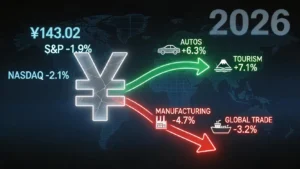
The weak yen carry trade risk has emerged as a dominant, yet often underappreciated, threat to global financial stability in 2026. As the USD/JPY exchange rate continues to test multi-decade highs near the 160 level, the profitability of borrowing low-cost Japanese yen to invest in higher-yielding international assets has attracted enormous capital flows.
However, this strategy, while lucrative, creates highly crowded positions that are acutely vulnerable to sudden and violent reversals. A shift in central bank policy, direct currency intervention, or a change in global risk sentiment could trigger a rapid unwind, posing a significant systemic risk to markets far beyond foreign exchange.
This article provides a comprehensive analysis of the weak yen carry trade risk. We will dissect the mechanics of the trade, explore why a depreciating yen amplifies both returns and dangers, identify the key triggers for a potential unwind, and outline the cascading impact such an event could have on global asset classes.
For sophisticated investors and traders in the English market, understanding this dynamic is no longer optional; it is essential for prudent risk management in the current macroeconomic environment.
Table of Contents
What Is the Yen Carry Trade?
The yen carry trade is a financial strategy that involves borrowing Japanese yen at a low interest rate and subsequently using those funds to purchase assets in a different currency that offer a higher rate of return. The core objective is to profit from the interest rate differential, or ‘carry’, between the two currencies. This strategy’s success hinges on the stability or depreciation of the yen against the currency of the high-yielding asset.
The Core Mechanics: Borrowing Low, Investing High
The mechanics of the trade are straightforward but carry inherent risks. An investor executes the following steps:
- Borrowing: An investor borrows a significant sum of Japanese yen. Given the Bank of Japan’s (BOJ) historically ultra-low interest rate policy, the cost of this borrowing is minimal.
- Conversion: The borrowed yen are sold, and a currency like the U.S. dollar is purchased.
- Investment: The acquired dollars are then invested in a high-yield asset, such as U.S. Treasury bonds, corporate debt, or even equities.
- Profit: The investor’s profit is derived from the difference between the high yield earned on the investment and the low interest paid on the yen loan. This profit is amplified if the yen weakens against the dollar, as it requires fewer dollars to repay the original yen-denominated loan. This currency movement component is what magnifies the weak yen carry trade risk when it reverses.
Historical Context of the Yen as a Funding Currency
Japan’s decades-long battle with deflation and stagnant economic growth has entrenched its status as the world’s primary funding currency. Since the 1990s, the Bank of Japan has maintained interest rates near zero, creating a vast and cheap pool of capital. This has made the yen the natural choice for carry traders globally.
While other currencies have occasionally served this role, none have offered the same combination of deep liquidity, political stability, and persistently low borrowing costs as the yen.
This long history has created a deep-seated belief in the yen’s role, which contributes to the formation of crowded trades and elevates the ultimate weak yen carry trade risk when market dynamics shift.
Why a Weak Yen Fuels the Carry Trade and Inflates Risk
A continuously weakening yen acts as a powerful accelerant for the carry trade, creating a self-reinforcing cycle that boosts returns while simultaneously accumulating systemic risk. The depreciation of the funding currency adds a capital appreciation component on top of the interest rate differential, making the strategy exceptionally profitable and attractive to a wider range of market participants, often involving significant leverage.
How a Depreciating Yen Boosts Returns
The profitability of the yen carry trade comes from two sources:
- Interest Rate Differential:The predictable profit stream from the ‘carry’ (e.g., earning 5% on a U.S. bond while paying 0.1% on a yen loan).
- Currency Depreciation:The additional, often larger, profit from the foreign exchange movement. If an investor borrows ¥160 million (when USD/JPY is at 160) to buy $1 million, and the yen weakens to 170, the original loan is now worth only approximately $941,176. The investor pockets the difference, significantly boosting the total return.
This dual-engine of returns creates a powerful incentive to join the trade. As more investors sell yen to buy dollars, it puts further downward pressure on the yen, making the trade even more profitable and attracting yet more participants. This feedback loop is what inflates the weak yen carry trade risk to dangerous levels.
The Danger of Crowded Positions and Over-Leverage
The primary danger of this self-reinforcing cycle is the creation of a ‘crowded trade’. When a vast number of market participants hold the same position (short yen, long high-yield assets), the market becomes dangerously one-sided. This situation presents several critical risks:
- Lack of Counterparties: When a reversal is triggered, everyone rushes to exit the trade simultaneously. They all need to buy back yen, but there are few natural sellers, causing the yen’s value to skyrocket.
- Leverage Amplifies Losses: Because the interest rate differential is often small in nominal terms, many carry traders use significant leverage to magnify their returns. While this boosts profits during favourable conditions, it leads to catastrophic losses when the trade reverses. A relatively small appreciation in the yen can wipe out an entire year’s worth of gains for a highly leveraged position.
- Complacency: The longer the trade works, the more complacent investors become. This leads them to underestimate the inherent weak yen carry trade risk, viewing it as a low-volatility, high-return strategy, which is a dangerous misconception.
The Unwind: Key Triggers That Could Ignite a Crisis
The unwind of the yen carry trade is the point at which the strategy’s profitability rapidly reverses, forcing a mass exodus from the position. This is not a gradual process; it is often a violent and disorderly repricing event. The weak yen carry trade risk materialises when one or more specific triggers cause a fundamental shift in the trade’s underlying assumptions. Investors must be vigilant in monitoring these potential catalysts.
Bank of Japan (BOJ) Policy Shift: A Hawkish Surprise
The most direct threat to the carry trade is a change in the BOJ’s monetary policy stance. Any action or communication that signals a move away from its ultra-dovish position can act as a powerful trigger. This could include:
- An unexpected interest rate hike.
- A reduction in asset purchases or an end to yield curve control.
- Forward guidance from the BOJ Governor suggesting a faster pace of policy normalisation than the market anticipates.
Such a shift would narrow the interest rate differential, directly eroding the trade’s profitability and prompting a rush to buy back yen.
Government Intervention in the FX Market
When the yen weakens to levels deemed detrimental to the national economy (e.g., by excessively increasing import costs), Japan’s Ministry of Finance (MOF) may instruct the BOJ to intervene directly in the currency markets. This involves selling foreign currency reserves (like U.S. dollars) to buy Japanese yen.
The goal is to cause a sharp, sudden appreciation in the yen. The mere threat of intervention can make traders nervous, but actual intervention is designed to break the one-way momentum of yen depreciation and inflict maximum pain on speculators, making it a key component of the weak yen carrying trade risk.
Sudden Changes in U.S. Interest Rates or Economic Data
The carry trade is a two-sided equation. A shift in the outlook for the high-yielding currency can also trigger an unwind. Weaker-than-expected U.S. economic data (e.g., inflation, employment) could lead the market to price in earlier or more aggressive interest rate cuts by the Federal Reserve. This would narrow the U.S.-Japan interest rate differential, reducing the ‘carry’ and making the trade less attractive. A sudden fall in U.S. bond yields would be a significant red flag for carry traders.
A Global “Risk-Off” Shift in Investor Sentiment
The yen traditionally acts as a ‘safe-haven’ currency. During periods of global financial stress, geopolitical turmoil, or economic uncertainty, investors often sell risky assets and repatriate capital. This ‘risk-off’ dynamic leads to a flight to safety, which includes buying yen. As the carry trade is fundamentally a ‘risk-on’ strategy, a sudden shift in sentiment forces its rapid unwinding.
Investors sell their high-yield assets (stocks, corporate bonds) and buy back the yen they borrowed, causing the yen to appreciate and risk assets to fall simultaneously. This is perhaps the most dangerous trigger, as it is often unpredictable and widespread.
| Trigger Event | Primary Impact Mechanism | Potential Impact Level |
| BOJ Hawkish Shift | Narrows interest rate differential | High |
| MOF FX Intervention | Causes sudden, forced JPY appreciation | Very High |
| Falling U.S. Yields | Reduces the ‘carry’ profit | Medium |
| Global Risk-Off Event | Triggers flight to safety and deleveraging | High |
What Happens When the Carry Trade Unwinds?
The unwinding of the yen carry trade is a domino effect that ripples across global financial markets. Due to the sheer size of the capital involved and the leverage employed, the consequences extend far beyond the foreign exchange market. The materialisation of the weak yen carry trade risk is a systemic event characterised by rapid deleveraging and a violent repricing of risk assets.
Rapid Yen Appreciation and Its Ripple Effects
The immediate and most visible consequence is a sharp appreciation of the Japanese yen. As traders scramble to close their short yen positions, they must buy back yen in the open market.
This sudden surge in demand, coupled with a lack of sellers, can cause currency pairs like USD/JPY and EUR/JPY to plummet by several percentage points in a very short period.
This rapid move inflicts immediate, severe losses on anyone still in the carry trade, triggering margin calls and forcing further liquidations, which exacerbates the yen’s rally.
Potential Sell-Off in Global Stocks and Risk Assets
To raise the capital needed to buy back the yen they borrowed, investors must sell the assets they purchased. This means liquidating positions in U.S. stocks, European equities, emerging market bonds, and other high-yield instruments.
This forced selling can lead to a broad-based decline in global stock markets and other risk assets. The correlation is direct: a rising yen driven by a carry trade unwind is often accompanied by falling stock indices worldwide. The weak yen carry trade risk thus transforming from a currency issue into a global equity market risk.
Impact on Bond Markets and Credit Spreads
The bond market is also significantly affected. The unwinding process leads to a ‘flight to quality’, where investors sell riskier corporate and high-yield bonds and purchase safer government bonds, such as U.S. Treasuries or German Bunds. This causes credit spreads—the yield difference between corporate and government bonds—to widen dramatically.
A widening spread indicates rising perceived risk in the corporate sector and tightening financial conditions, which can have negative consequences for economic growth. The following table illustrates the potential domino effect:
| Asset Class | Direct Impact of a Carry Trade Unwind |
| Japanese Yen (JPY) | Rapid and significant appreciation against major currencies (USD, EUR). |
| Global Equities (e.g., S&P 500) | Sharp sell-off as leveraged investors liquidate positions to cover JPY loans. |
| High-Yield Corporate Bonds | Prices fall and yields rise as credit spreads widen due to risk aversion. |
| Market Volatility (VIX Index) | Spikes upwards, reflecting increased market uncertainty and fear. |
How to Monitor and Manage Carry Trade Risks
For traders and investors, proactively monitoring and managing the weak yen carry trade risk is crucial. Recognising the warning signs of market stress can provide a valuable opportunity to adjust portfolios before a disorderly unwind occurs. This requires a multi-faceted approach that combines monitoring key market indicators with implementing prudent risk management strategies.
Key Indicators to Watch: USD/JPY, VIX, and Bond Yields
Several key indicators can signal rising stress in the yen carry trade:
- USD/JPY Price Action: This is the most direct indicator. Sharp, sudden drops in the USD/JPY pair, especially from psychologically important or intervention-sensitive levels like 160, are a major red flag. A failure to make new highs despite favourable interest rate differentials can also signal exhaustion.
- The VIX Index: Known as the ‘fear gauge’, the CBOE Volatility Index (VIX) measures expected volatility in the S&P 500. A sharp spike in the VIX indicates rising investor anxiety and can often precede or coincide with a risk-off event that triggers a carry trade unwind.
- Government Bond Yield Spreads: Pay close attention to the yield spread between U.S. Treasuries and Japanese Government Bonds (JGBs). A narrowing of this spread makes the carry trade less appealing and can signal the beginning of a reversal.
- Nikkei 225 Performance: A strong inverse correlation often exists between the yen and the Japanese stock market (Nikkei). A sudden downturn in the Nikkei can sometimes signal domestic concerns that lead to yen strength and an unwinding of carry trades.
Strategies for Hedging and Diversification
Managing the weak yen carry trade risk is not about perfectly timing the market, but about implementing strategies to mitigate potential losses.
- Hedging with Options: Investors who hold assets that would suffer during an unwind can purchase protective instruments. For example, buying put options on the USD/JPY gives the holder the right to sell the pair at a predetermined price, providing a hedge against a falling dollar and rising yen. Similarly, buying VIX call options can offer a hedge against a broad market sell-off.
- Position Sizing and Avoiding Over-Leverage: The most fundamental risk management tool is controlling position size. Avoiding the use of excessive leverage ensures that a sudden adverse move does not result in a catastrophic loss.
- Diversification: Investors should assess their portfolio’s sensitivity to a carry trade unwind. Diversifying into assets that are less correlated or may even benefit from a risk-off environment (such as high-quality government bonds or gold) can help cushion the portfolio during periods of market stress.
By combining vigilant monitoring with disciplined risk management, investors can better navigate the complexities and dangers associated with the current market environment, where the weak yen carry trade risk remains a significant concern.
Conclusion
The weak yen carry trade risk stands as one of the most significant hidden vulnerabilities within the global financial system in 2026. While the strategy has delivered substantial returns, its success has fostered complacency and led to dangerously crowded positioning.
The longer the USD/JPY exchange rate remains near levels that invite official intervention, and the more leveraged these positions become, the greater the potential for a violent and disorderly unwind. Such an event would not be contained to the FX market; it would trigger a cascade across global equities, credit, and volatility markets.
For investors, it is imperative to move beyond simply enjoying the benefits of the low-volatility environment this trade has helped create and to actively assess and manage the underlying risks.
Acknowledging the catalysts—a hawkish BOJ, direct intervention, or a global risk-off shock—and understanding the mechanics of the unwind are the first steps toward building resilient portfolios. In the current landscape, ignoring the weak yen carry trade risk is not a viable strategy; it is an invitation to significant future losses.
Frequently Asked Questions (FAQ)
What constitutes the primary risk in a modern yen carry trade?
The primary risk is a sudden and sharp appreciation of the Japanese yen. Because many participants are highly leveraged, even a small upward move in the yen’s value can erase profits and trigger margin calls, forcing a mass liquidation of both the currency position and the financed assets, leading to a cascading market event.
What event is most likely to trigger a rapid unwind of the yen carry trade?
Direct intervention in the foreign exchange market by the Japanese Ministry of Finance is the most potent trigger. Unlike policy shifts, which can be telegraphed, intervention is designed to be a sudden shock that causes an immediate and painful reversal, catching speculators off guard and forcing a disorderly unwind.
How does the Bank of Japan’s policy directly influence carry trade risk?
The Bank of Japan’s ultra-low interest rate policy is the foundation of the carry trade. Any hawkish shift, such as a rate hike or more aggressive forward guidance, directly erodes the trade’s profitability by narrowing the interest rate differential. This undermines the core reason for the trade’s existence and can trigger an unwind.
Which global asset classes are most vulnerable during a carry trade unwind?
Global equities, high-yield corporate bonds, and emerging market assets are most vulnerable. These are the typical ‘risk-on’ assets purchased with borrowed yen. During an unwind, they are sold indiscriminately to fund the repayment of yen loans, leading to widespread price declines and increased market volatility.