
The ongoing Bitcoin vs Gold debate has reached a pivotal juncture in 2026. Institutional investors and retail traders alike are constantly evaluating these two dominant alternative assets. Understanding the Bitcoin vs Gold market cap comparison is no longer just an academic exercise; it is an essential component of modern asset allocation. Furthermore, tracking the evolving Bitcoin vs Gold correlation provides critical insights into how these assets respond to macroeconomic shocks, currency fluctuations, and shifting monetary policies.
Table of Contents
The Fundamentals Behind the Bitcoin vs Gold Market Cap Comparison
To accurately assess the financial weight of both assets, investors must look directly at the numbers. As of mid-2026, physical gold commands a staggering market capitalization approaching $28.9 trillion, bolstered by persistent central bank purchases and sustained demand for a traditional safe haven. In contrast, Bitcoin’s market capitalization oscillates in the multi-trillion dollar range, representing roughly 4% to 8% of gold’s aggregate value depending on the current trading quarter.

For a detailed visual representation of these metrics, professional analysts frequently reference the Gold vs. Bitcoin – Market Capitalization data. This gap in market capitalization highlights a fundamental difference in liquidity and historical entrenchment. Gold’s supply grows at a predictable 1.5% to 2% annually, while Bitcoin operates on a strictly capped protocol of 21 million coins, with its issuance rate permanently reduced following the 2024 halving event.
Both assets serve as an inflation hedge, but they achieve this through vastly different mechanisms. Gold relies on thousands of years of established trust, whereas the digital currency leverages decentralized cryptographic scarcity.
Analyzing the Evolving Bitcoin vs Gold Correlation
Historically, the Bitcoin vs Gold correlation hovered near zero, indicating that the two assets moved independently of one another. However, recent data suggests periodic negative correlations, occasionally dipping to -0.82 during distinct market cycles. When global real yields rise, gold often faces immediate pricing pressure. Conversely, Bitcoin tends to react aggressively to global liquidity metrics and broader technology sector momentum.
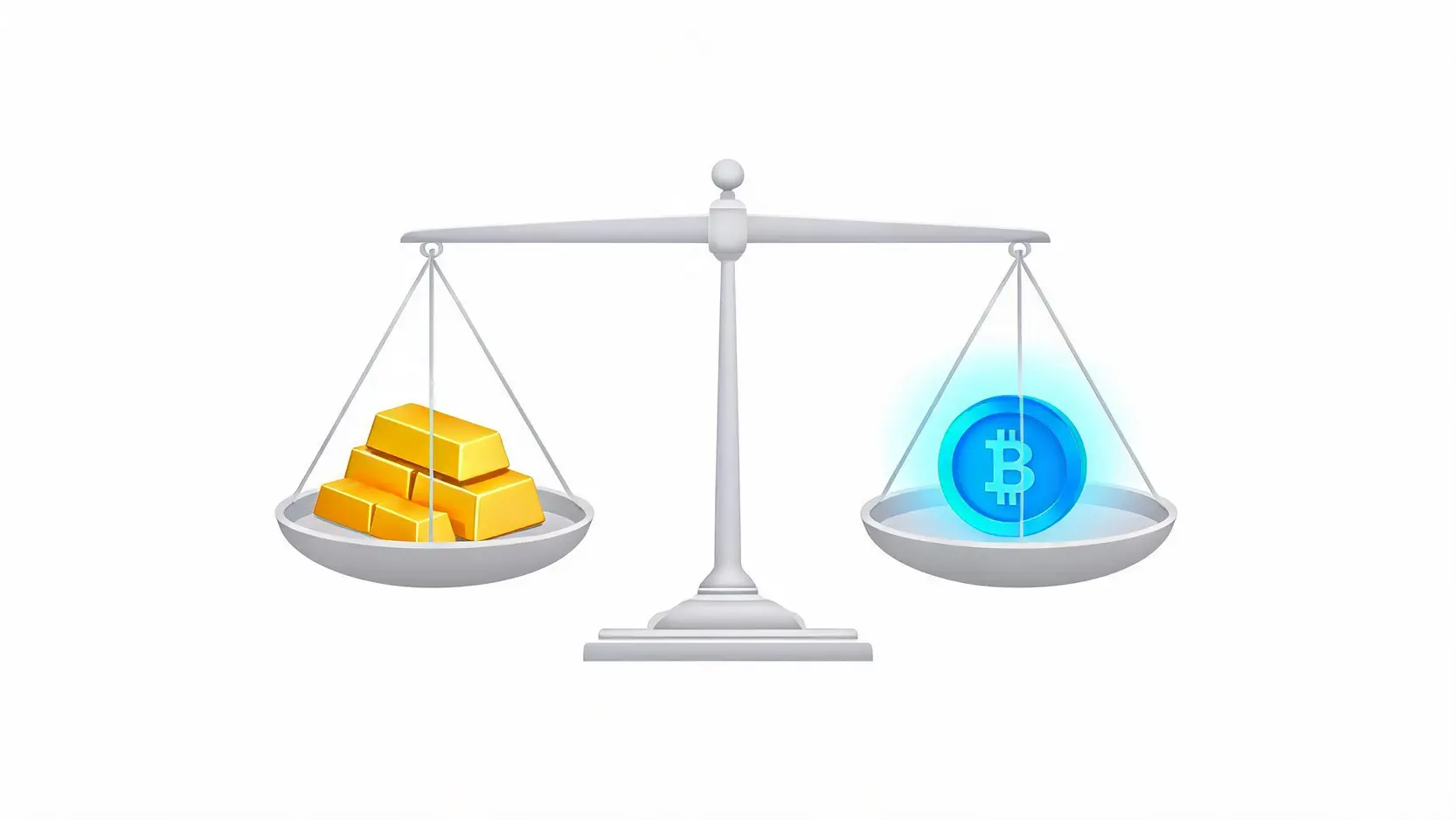
Investors seeking robust portfolio diversification can exploit this fluctuating relationship. Holding both assets can theoretically dampen maximum drawdowns during extreme volatility. For those interested in how geopolitical tensions specifically alter the demand for decentralized digital assets, understanding the underlying mechanics is crucial.
Investment Strategies Incorporating Gold Market Capitalization Data
Recognizing the sheer scale of the gold market capitalization allows traders to implement pragmatic position sizing. Because gold is highly liquid and less volatile, it often constitutes a larger percentage of a defensive portfolio. 📈

- Defensive Allocation: Utilizing physical gold or broad gold exchange-traded funds to anchor a portfolio against fiat currency debasement.
- Aggressive Growth: Allocating a smaller, risk-adjusted percentage to Bitcoin to capture the asymmetric upside potential tied to digital adoption.
- Dynamic Rebalancing: Shifting capital between the two assets based on the current divergence in the Bitcoin vs Gold correlation.
Furthermore, evaluating institutional flows into specific investment vehicles can dictate short-term price action. To gain a deeper perspective on how these capital movements influence underlying asset valuations, traders should consistently monitor How ETF Flows Affect Gold Prices to refine their entry and exit parameters.
Conclusion
The strategic choice between Bitcoin and gold does not require absolute binary thinking. In 2026, sophisticated portfolios leverage the strengths of both. Gold offers unparalleled historical stability and massive market capitalization, providing a reliable anchor during traditional financial crises. Bitcoin, operating outside the legacy financial system 24/7, offers an immutable digital scarcity that appeals heavily in an increasingly digitized global economy. By carefully monitoring their correlation and market caps, investors can engineer a resilient defense against future economic uncertainties.
FAQ
What is the current Bitcoin vs Gold market cap comparison?
As of mid-2026, gold maintains a massive lead with a market capitalization of approximately $28.9 trillion, while Bitcoin’s market cap sits lower, typically representing around 4% to 8% of gold’s total value, depending on recent market fluctuations.
Is the Bitcoin vs Gold correlation positive or negative?
The correlation fluctuates based on macroeconomic conditions. While they are both viewed as alternative assets, they often display a negative correlation, meaning they do not consistently move in the same direction, providing excellent diversification benefits.
Which asset acts as a better inflation hedge?
Gold has a proven track record spanning millennia as a preserver of purchasing power. Bitcoin offers a mathematically hard-capped supply, which theoretically protects against fiat debasement, but it carries significantly higher price volatility.
How do institutional ETF flows impact these assets?
The introduction and maturation of ETFs for both gold and Bitcoin allow massive institutional capital to enter the space. Heavy ETF inflows typically drive up the spot price of the underlying asset by constraining the available circulating supply.
Can I hold both Bitcoin and gold in the same portfolio?
Absolutely. Holding both assets is a favored strategy among modern analysts. It balances the high-volatility, high-reward nature of digital assets with the low-volatility, defensive characteristics of precious metals.